Recorded November 24, 2026
Space & AstronomyReported finding
37 Million CPU Hours to Hunt Dark Matter's Fingerprints
MIT and Harvard physicists have built a flexible simulation code and secured 37 million CPU hours to test whether self-colliding dark matter leaves detectable fingerprints on galaxies.
By James Calloway4 min read715 words
In brief
- Dark matter accounts for about 85% of all matter in the universe but cannot be seen directly
- The team received 37 million CPU hours, equal to 4,000+ years on a single CPU core, via the ACCESS program
- Paper published in Monthly Notices of the Royal Astronomical Society (2026), DOI: 10.1093/mnras/stag1674
- The simulation code tests dark matter across dwarf galaxies, satellite galaxies and galaxy cluster collisions
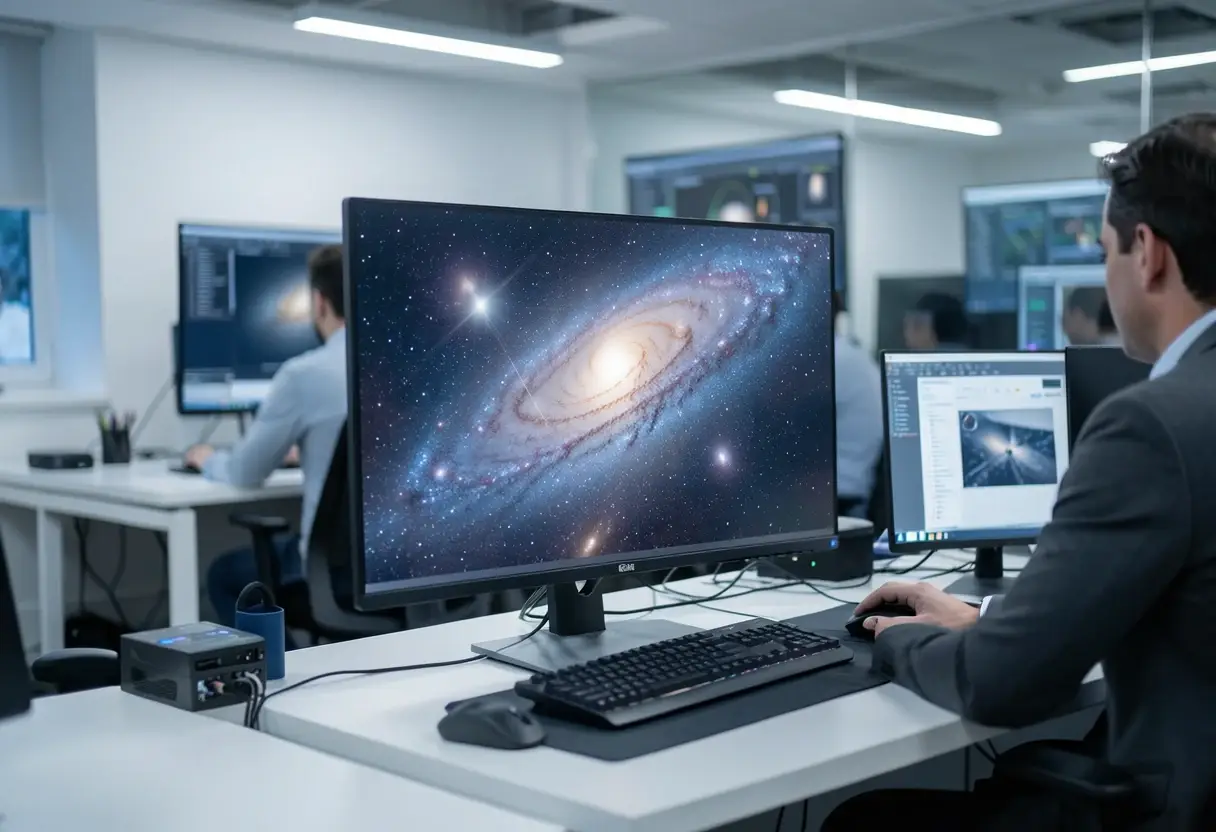
A team at MIT and Harvard has secured 37 million CPU hours of supercomputing time — more than 4,000 years of continuous single-core computing — to simulate what happens if dark matter collides with itself. The real news, though, is smaller and more durable: a flexible simulation code, published in Monthly Notices of the Royal Astronomical Society, that can test many dark-matter models without rebuilding the machinery each time.
Dark matter makes up roughly 85% of all matter in the universe, if the standard picture holds. Nobody has seen it. It neither emits, absorbs nor reflects light, which is why scientists hunt for it through indirect traces instead. That is the day job of Martin Rosenlyst Jørgensen, an astroparticle physicist with a Ph.D. from the University of Southern Denmark, now at the MIT Kavli Institute for Astrophysics and Space Research.
"If we can identify the fingerprints that different forms of dark matter leave on galaxies and galaxy clusters, we may be able to uncover which fundamental particles and forces are hiding in the dark sector of the universe," Jørgensen said.
Why the code matters more than any single result
Here's the honest caveat before the promise. The researchers haven't found dark matter. They haven't found its fingerprints either. What they've built is a tool — a method for predicting what those fingerprints would look like, if they exist at all.
The standard assumption is that dark matter interacts with almost everything through gravity alone. Jørgensen finds that assumption suspiciously tidy. Visible matter — us, the planets, the stars — contains a whole world of particles and forces. Why should the dark side of the universe be simpler?
"We normally assume that dark matter interacts with other matter almost entirely through gravity. But why should dark matter necessarily be so simple?" he said. "Perhaps dark matter also has unknown forces of its own that leave a kind of fingerprint on the universe."
If dark matter particles do collide with each other, those collisions could slowly reshape how dark matter piles up inside galaxies, over billions of years. Astronomers would then have something concrete to look for. First, though, physicists need to know what the fingerprint looks like. That's what the simulations are for.
What does this change for the hunt?
Practically, three things. The code is flexible enough to swap in new particle-physics models cheaply, rather than writing a simulation from scratch for each candidate. It runs across astrophysical systems of wildly different sizes — small dwarf galaxies, satellite galaxies orbiting bigger ones, and colossal collisions between entire galaxy clusters. And the team has the computing muscle, via the American ACCESS supercomputing program, to actually run the thing at scale.
That range matters, and Jørgensen is blunt about why. A model that explains dark matter in a dwarf galaxy hasn't succeeded. It must also explain galaxy clusters. Dark matter can't follow one set of rules in one place and another somewhere else. Because these systems differ sharply in density and velocity, the same model can produce very different effects in each.
"We are not simply trying to find dark matter's fingerprints in one place in the universe," he said. "By combining these tests, we can distinguish much more effectively between different dark-matter theories and potentially rule some of them out."
Ruling theories out, it's worth noting, is the modest and realistic goal here. Not discovery.
The next bottleneck: matching fake universes to the real one
Simulations produce enormous volumes of data. Observations produce enormous volumes of data. Connecting the two is the next problem, and Jørgensen expects artificial intelligence to carry part of the load — algorithms trained on simulated universes until they can recognize the structural patterns each model produces, then matched against what astronomers actually see.
"By bringing particle physicists and astronomers together in this way, we can move from theories about invisible particles to concrete signatures that astronomers can actually look for in the universe," he said.
The paper, led by Oliver Zier and colleagues, appears in Monthly Notices of the Royal Astronomical Society (2026), DOI: 10.1093/mnras/stag1674. It presents the simulation method itself as the key result. Any actual fingerprint in the sky remains, for now, exactly where dark matter is: unseen.
via phys.org/rss-feed/ (Source)
More from James Calloway
Show full bio
Staff writer covering regulation, policy and their impact on general science news at SciBeat.
596 articles
Nearby plates
- Planets and Stars as Dark Matter Traps: New Study Rules Out Scenarios
- Dark Matter May Behave Like Waves — and a Distant Quasar Could Prove It
- H.E.S.S. telescopes set strongest limits yet on Milky Way dark matter
- Wave Simulations Bring Fuzzy Dark Matter Into Sharper Focus
- Dark Matter Detector Records One Event It Can't Explain