Plate Nº 75 · recorded October 10, 2026
Biology & EvolutionReported finding
518-Million-Year-Old Fossil Rewrites the Starfish Family Tree
A 518-million-year-old fossil from China suggests starfish ancestors had tentacles, revising the picture of early echinoderm evolution.
By Nathan Brooks3 min read519 words
In brief
- The fossil of Yujingia glutenotunica is 518 million years old.
- It was discovered in southwestern China.
- It lived near the evolutionary roots of ambulacrarians — starfish, sea urchins, and acorn worms.
- Its anatomy hints the lineage began with tentacles, challenging the previous picture of the earliest ancestor.
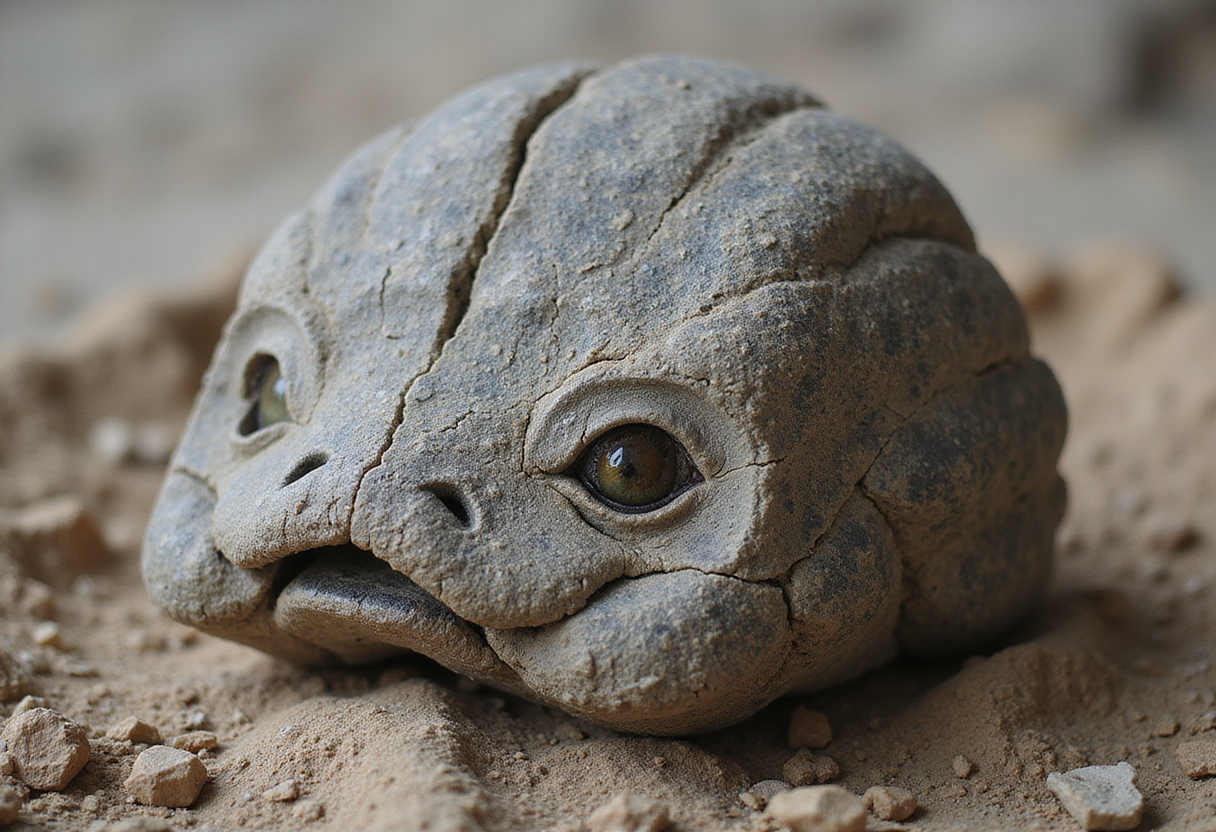
A fossil preserved for 518 million years suggests that the starfish family may have begun with tentacles, challenging a long-standing picture of what the group's earliest ancestor looked like.
The fossil belongs to an animal named Yujingia glutenotunica, discovered in southwestern China. Researchers report that it lived close to the evolutionary roots of ambulacrarians — the broad animal group that today includes starfish, sea urchins, and acorn worms.
Why does one fossil matter so much?
Starfish and their relatives, known collectively as echinoderms, have puzzled biologists for over a century. Their adult bodies are built on an unusual five-fold symmetry, so unlike most other animals that reconstructing their ancestry from living species alone has proven extremely difficult.
That is where exceptionally preserved fossils from the Cambrian period — the geological era roughly 540 to 485 million years ago, when most major animal groups first appear in the record — come in. Yujingia glutenotunica dates to about 518 million years ago, placing it near the dawn of this evolutionary branching.
Its anatomy, the researchers report, hints at a tentacle-bearing start for the lineage. In other words, instead of resembling a simplified starfish or sea urchin, the earliest members of this family may have carried structures more akin to the feeding tentacles seen in acorn worms and other related creatures today.
What are ambulacrarians, exactly?
Ambulacrarians form one of the two great branches of the deuterostomes, a larger grouping that also includes vertebrates — animals with backbones, humans among them. The ambulradian branch splits into:
- Echinoderms — starfish, sea urchins, brittle stars, sea cucumbers, and crinoids
- Hemichordates — acorn worms and their filter-feeding relatives
Understanding what the earliest ambulacrarians looked like therefore matters beyond starfish trivia. It helps scientists reconstruct one of the deepest forks in the animal family tree, the one that eventually led to vertebrates on one side and to spiny-skinned marine creatures on the other.
How solid is the conclusion?
The finding rests on the interpretation of fossils, and fossils this old never tell a complete story. Soft tissues decay quickly, so even in exceptional preservation sites like those in southwestern China, researchers must infer anatomy from partial impressions. The precise position of Yujingia glutenotunica on the family tree — and whether its tentacle-like features truly represent the ancestral condition for the whole group — will need testing against further discoveries.
Still, the specimen adds a concrete data point from a critical moment in evolutionary history. If the tentacle interpretation holds up, textbooks describing the ancestor of starfish and sea urchins may need revision.
What comes next?
Paleontologists will likely continue working through Cambrian fossil deposits in China, which have already produced a series of finds reshaping views of early animal evolution. Each new well-preserved specimen from this window of time sharpens the picture of how the odd five-armed bodies of modern echinoderms came to be.
For now, the 518-million-year-old Yujingia glutenotunica stands as a reminder that the origins of familiar animals can look surprisingly unfamiliar — and that the earliest chapter of the starfish story may have opened not with arms, but with tentacles.
via google.com (Original)
More from Nathan Brooks
Nearby plates
- Animals May Have Evolved 200 Million Years Earlier Than Fossils Show
- Animals May Have Evolved 200 Million Years Earlier Than Thought
- Gobi Desert Fossil Rewrites 40-Year Mammal Evolution Theory
- A 245-Million-Year-Old Reptile Fossil Keeps Its Stomach, Liver and Gut
- 3D genome reshuffling may explain cephalopod brain complexity