Plate Nº 56 · recorded September 30, 2026
Biology & EvolutionReported finding
AI Scientist Makes Biological Discoveries With Minimal Human Help
A closed-loop AI lab at Chalmers University generates hypotheses, runs experiments on yeast, and learns from results with minimal human intervention.
By Marcus Bennett3 min read691 words
In brief
- Researchers at Chalmers University of Technology built a closed-loop AI laboratory that generates hypotheses, designs experiments, and interprets results on brewer's yeast with minimal human intervention.
- The system combines large language models, automated reasoning, and laboratory automation, and was fed the yeast's genome, metabolism, and prior studies.
- The study appears in the Journal of the Royal Society Interface (2026), DOI: 10.1098/rsif.2026.0043.
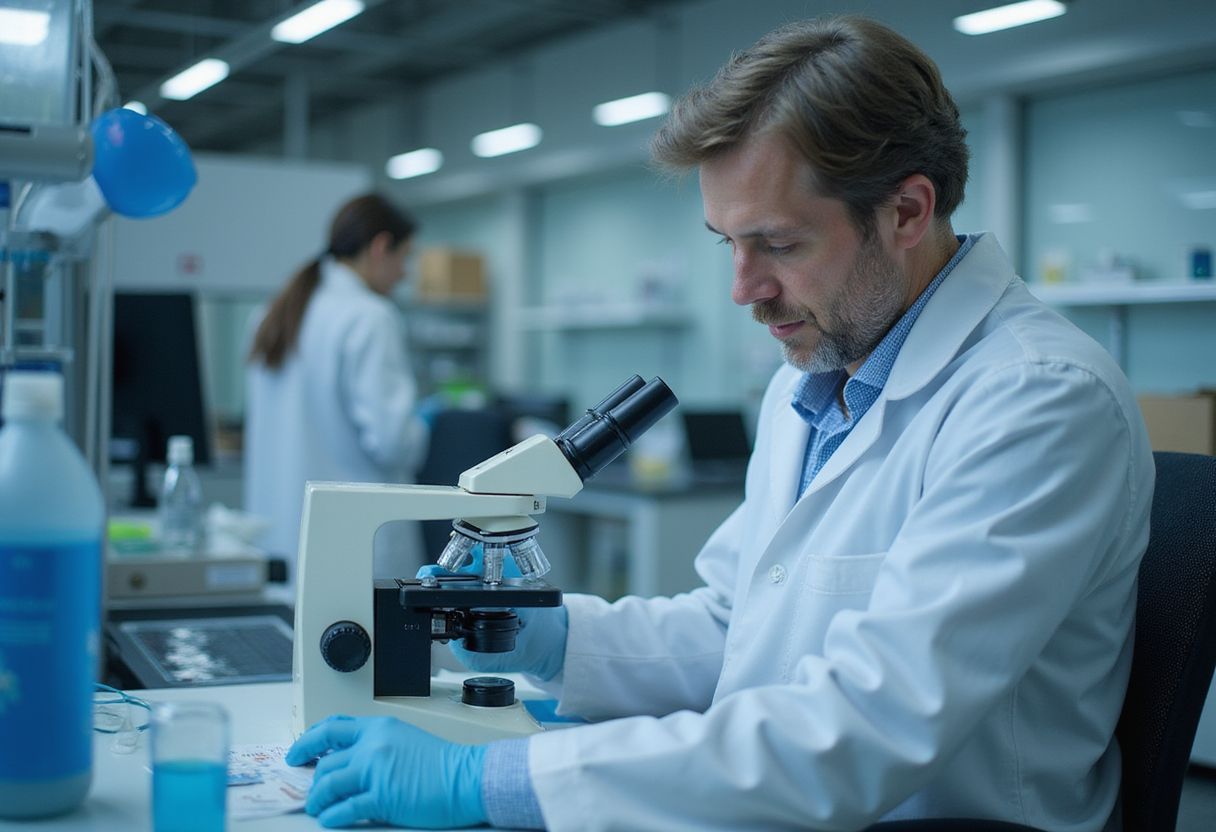
Researchers at Chalmers University of Technology in Sweden have developed an AI system that can generate scientific hypotheses, design experiments, and interpret the results — making new biological discoveries with little human intervention. The team describes the work as a significant advance for so-called self-driving laboratories.
The study, published in the Journal of the Royal Society Interface, shows how the researchers combined three technologies: large language models (the type of AI behind modern chatbots), automated reasoning, and laboratory automation. The result is a closed-loop AI laboratory — a system that runs research cycles without a human steering every step — capable of conducting experiments on brewer's yeast, Saccharomyces cerevisiae, a common model organism in biology.
Before starting, the team fed the AI a large body of scientific knowledge about the yeast, including its genome (its complete set of genetic instructions), its metabolism (the chemical processes that keep the cell alive), and previous research studies.
That amount of information is far beyond what a person can meaningfully analyze. "It is too much information for a human to analyze, but our AI scientist could identify promising biological questions, recommend experiments to test them, evaluate experimental outcomes and iteratively refine its understanding based on new evidence," says Ievgeniia Tiukova, a postdoctoral researcher in the Department of Life Sciences at Chalmers and one of the study's authors. "Rather than serving solely as a decision-support tool, the AI scientist actively generates new scientific knowledge."
Linking AI reasoning to laboratory action
What sets this work apart is the integration of AI's thinking power with physical experimental capability. This combination is still rare, even in a fast-growing field where researchers are building AI scientists that autonomously perform extensive research. Tiukova compares the development to self-driving cars, which also use AI and machine learning to process information, draw conclusions, and then act on them.
Ross King, a professor in the Department of Computer Science and Engineering at Chalmers and the University of Gothenburg and the study's senior author, believes autonomous laboratories will change how research is done. In his view, they will systematically investigate biological systems much faster than is possible today.
"AI scientists will collaborate with human scientists to accelerate discoveries across biology, medicine and biotechnology," King says. "Such AI systems have the potential to reduce the time required to explore complex scientific questions and optimize the use of laboratory resources."
That last point matters for practical reasons. Laboratory time and equipment are expensive and limited. If an AI can plan experiments more efficiently and take over repetitive cycles of testing, researchers could get more out of the resources they already have.
Humans stay in charge — for now
Both authors are careful to stress a boundary. For the foreseeable future, autonomous AI will augment scientists rather than replace them, increasingly taking on the routine cycles of hypothesis generation and experimental testing.
"Human scientists remain essential for defining research priorities, interpreting broader scientific significance and ensuring ethical oversight," King says. "Future generations of autonomous discovery systems will become increasingly capable of collaborating with human scientists, becoming valuable partners in addressing some of the most challenging questions in biology and medicine."
In other words, the division of labor looks set to shift rather than disappear. The AI handles the high-volume, repetitive work of generating ideas, running experiments, and refining its understanding. People decide what matters, what the findings mean in a broader context, and what is ethically acceptable.
The findings are early-stage in an emerging field, and the current system works within a single, well-studied organism — brewer's yeast. How well the approach transfers to more complex biological systems remains an open question that future research will need to address.
Still, the study offers a concrete demonstration that an AI can do more than suggest experiments from behind a screen. It can close the loop: ask a biological question, test it at the bench, learn from the outcome, and try again.
Publication: Daniel Brunnsåker et al., "Agentic AI integrated with scientific knowledge: laboratory validation in systems biology," Journal of the Royal Society Interface (2026). DOI: 10.1098/rsif.2026.0043
via Phys.org Biology (Source)
More from Marcus Bennett
Nearby plates
- AI System Aims to Speed Up Clinical Trial Patient Matching
- AI Companions May Cause Lasting Psychological Harm, Study Finds
- AI Searches Millions of Enzymes to Find Pollution Fighters
- Autonomous AI Freed Up 8,500 Dermatology Appointments in UK Study
- New AWARE Framework Helps Psychiatrists Ask About Patient AI Use