Plate Nº 56 · recorded November 10, 2026
Space & AstronomyReported finding
Cape Cod bolide traced to a Jupiter-perturbed asteroid orbit
Radar, infrasound and camera evidence linked the May 30, 2026 Cape Cod bolide to an elongated, Jupiter-perturbed asteroid orbit, with no known meteor-shower match.
By Priya Raman5 min read1,024 words
In brief
- The May 30, 2026 bolide was about 1 meter (3 feet) wide and crossed Cape Cod Bay at 1:06 p.m. local time.
- Its total impact energy was about 1.1 kilotons of TNT, with fragmentation releasing the equivalent of 500 tons.
- The trail echo reached 20 miles (32 km), below the head-echo range from 56 miles (90 km) to 44 miles (71 km).
- Its reconstructed orbit reached almost to Jupiter and showed no association with any known meteor shower.
- Only three recorded bolides had greater impact energy during 2025.
By Priya Raman
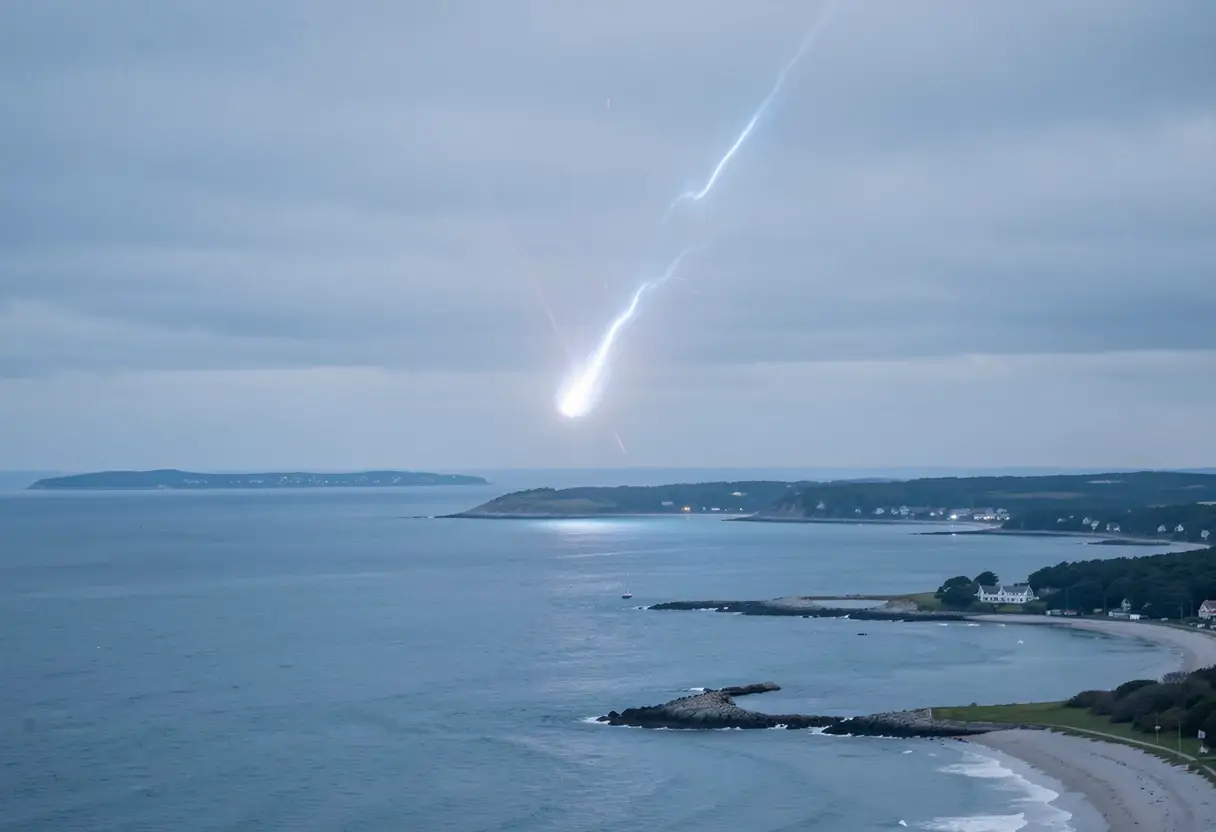
The roughly one-meter-wide bolide that crossed Cape Cod Bay on May 30, 2026, released 1.1 kilotons of TNT equivalent and had previously followed an elongated orbit reaching almost to Jupiter, according to a preliminary arXiv analysis.
What fell over Cape Cod?
At 1:06 p.m. local time (18:06 UTC), the object appeared as a bolide, a meteor bright enough to be seen in daylight. It descended over coastal Massachusetts and was widely witnessed, with a sonic boom rumbling along the northeastern United States. Dashcam and security-camera records, alongside eyewitness reports, helped establish the fall’s path.
A Europe-and-United States team led by space physicist Juha Vierinen of the Arctic University of Norway in Tromsø combined observations from a meteor-radar network, routine weather radar, infrasound stations and camera footage. The instruments let the team characterize the fall and reconstruct the orbit of the meteoroid (the solid body before atmospheric entry) around the Sun.
Central to the reconstruction was the Spread Spectrum Interferometric Meteor Observing Network, or SIMONe, based at MIT’s Haystack Observatory. MIT, the Arctic University of Norway and the Leibniz Institute of Atmospheric Physics in Kühlungsborn, Germany, jointly developed the system.
Ryan Volz, a radio scientist at Haystack Observatory and a member of the team, said: “We got pretty lucky to observe this one.” For the bolide’s head echoes to register, it had to enter the atmosphere within about 62 miles (100 kilometers) of a SIMONe-like meteor radar. Only a handful of places worldwide currently met that condition.
How did the instruments reconstruct the fall?
Head echoes arise when a meteoroid enters the atmosphere, superheats its outer surface and creates a surrounding cloud of plasma, an ionized gas. Such echoes supplied the strongest constraints on the trajectory. For this fall, the brief head echo appeared between altitudes of 56 miles (90 kilometers) and 44 miles (71 kilometers).
It then changed into a trail echo, produced by turbulent plasma left in the wake. On May 30, radar detected that trail to an unusually low altitude of 20 miles (32 kilometers). At that point, the body fragmented with an explosive force equivalent to 500 tons of TNT, while the bolide’s total impact energy was about 1.1 kilotons.
Only three recorded bolides worldwide had greater impact energy during 2025, making this a rare high-energy event. Four Next Generation Weather Radar, or NEXRAD, stations then tracked chunks of rock falling into the bay as meteorites. The National Weather Service, Federal Aviation Administration and U.S. Air Force jointly operate those radars.
Infrasound, pressure waves below the range of human hearing, registered the hypervelocity fall and breakup. Such waves can travel hundreds or thousands of kilometers. Detections came from the Elginfield Infrasound Array, or ELFO, in Ontario, Canada, and citizen-operated Raspberry Shake/Boom sensors, build-your-own micro-barometers (small pressure-measuring devices) produced by the Raspberry Pi Foundation.
Six citizen-operated sensors jointly constrained the arrival direction. Five other single-station detections and ELFO supplied the signal periods used to estimate energy release. Vierinen credited the volunteers, saying their measurements expanded the coverage and helped locate the event.
The combined data indicated that the meteoroid was about one meter, or three feet, across. The depth it reached before fragmenting suggested a relatively solid body. The researchers said it was possibly rich in iron.
Where did the meteoroid come from?
Vierinen summarized the orbital result with a direct caveat: “We cannot determine its exact history, but we found no association with any known meteor shower.” The backward extrapolation instead produced a comet-like, elongated orbit around the Sun, with its aphelion (its farthest point from the Sun) close to Jupiter’s orbit.
Objects on such paths are called Jupiter-family comets because Jupiter’s gravitational influence governs their orbits, but this meteoroid was not a comet. Previous research has shown that Jupiter can pull small asteroids from the main asteroid belt, the region between Mars and Jupiter, onto such orbits.
Team member Marc Fries said a close pass by the gas giant may have flung the rock onto its recent Earth-crossing path. He also argued that this transfer mechanism has slowly depleted the asteroid belt over the solar system’s long history.
Why does the meteoroid matter?
Meter-scale meteoroids occupy an observational gap. Larger asteroids are easier to detect from Earth, while pebble-sized objects fall often enough to appear routinely as shooting stars. Meter-scale bodies do not fall that frequently and remain difficult to detect while in space, leaving their population and arrival frequency poorly constrained.
Each recorded bolide therefore adds to estimates of impact frequency, energy, location and source orbit. Fries said measurements of total power, location and original orbit are especially valuable because these larger meteoroids and asteroids are the ones encountered least often. The Cape Cod case supplies one of the few such multi-instrument records.
The fall over a populated coast was fortunate. Global ground stations and satellites can usually narrow a meteor’s path even over uninhabited terrain, but radar yields more accurate geometry. Meteor-radar coverage remains sparse. SIMONe and similar systems are expanding it, although only a handful of sites currently have the sensitivity needed to detect comparable head echoes.
The Cape Cod bolide was much smaller than the roughly 18-meter-wide asteroid that exploded over Chelyabinsk in 2013 with an estimated 400 to 500 kilotons of TNT equivalent. The comparison matters because tracing meter-scale objects back to their orbits could help identify previously unknown groups of potentially hazardous impactors.
The team’s paper remains a preprint, a manuscript posted for review before journal publication, on arXiv and has not yet appeared in a peer-reviewed journal. Even so, the observations provide a coherent reconstruction of a solid, roughly meter-sized asteroid whose Jupiter-perturbed path brought it over a populated coast and whose breakup left radar, acoustic, visual and citizen-sensor records.
Until global meteor-radar coverage closes the gap, each well-instrumented fall remains a rare and valuable test of where such bodies come from.
via space.com (Source)
More from Priya Raman
Show full bio
Senior reporter covering people, launches and day-to-day practice in general science news at SciBeat.
343 articles
Nearby plates
- Asteroid 1995 BJ4 Grew a Tail — and It May Be the Largest Main-Belt Comet
- Soviet-Era Satellite Breaks Apart, Adding Tens of Debris Fragments to Orbit
- Euclid Telescope Finds Its First-Ever New Comet 1.3 Billion Km Away
- Meteors Don't Just Burn: Seven Violent Stages Decide Their Fate
- Euclid Telescope Finds Comet C/2026 S1 While Mapping Dark Energy