Recorded November 23, 2026
PhysicsReported finding
Cloverleaf atomic oscillations found in altermagnets
MLU physicists predict d-wave phonons in altermagnets: atoms rotate in a cloverleaf pattern, sortable by temperature and steerable with magnetic fields, pointing to energy-saving signal transport.
By Marcus Bennett3 min read604 words
In brief
- MLU and Münster researchers describe d-wave chiral phonons in altermagnets, published in Physical Review Letters in 2026.
- Atoms in these oscillations change rotation direction four times, forming a cloverleaf d-wave pattern.
- Altermagnets were first identified as a material class in 2019.
- Right-handed spin waves couple only with right-handed chiral phonons, and vice versa.
- A simple temperature change can sort the phonons; external magnetic fields can control them.
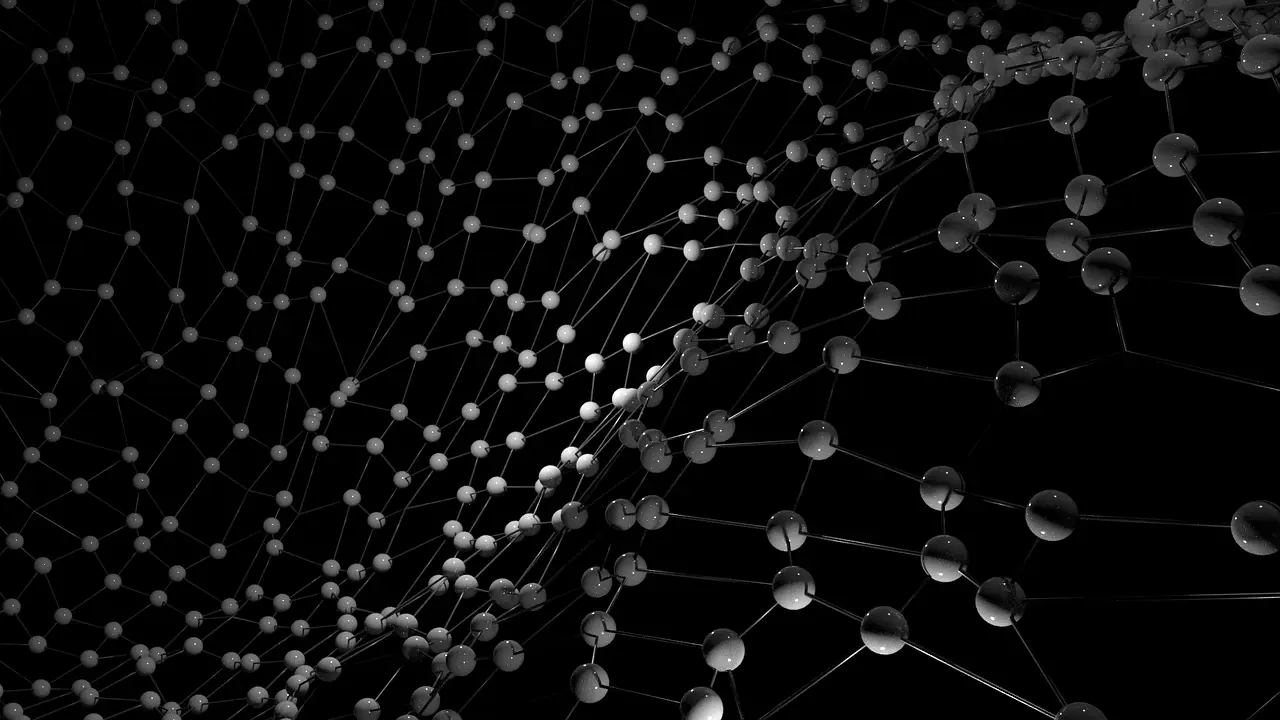
Physicists at Martin Luther University Halle-Wittenberg (MLU) and the University of Münster have predicted a new type of atomic oscillation in altermagnets: chiral phonons that form a four-lobed, cloverleaf symmetry across the crystal. The theoretical work appeared in Physical Review Letters in 2026.
The atoms in a solid never sit still. They vibrate around their equilibrium positions, and these vibrations travel through the material as lattice waves known as phonons. In most materials the atoms move in simple linear waves. Altermagnets — a class of magnetic materials first identified in 2019 — behave differently. There, atoms can rotate around their rest positions, producing what physicists call chiral phonons.
The practical stakes are energy. Professor Ingrid Mertig, a physicist at MLU, frames the long-term goal plainly: "The overarching aim of our research is to develop new concepts for electronic components that transmit information not via electric currents but, for example, via spin waves—thereby saving energy."
What did the model actually find?
Spin waves are ripples of coupled oscillation in the spins — the magnetic moments of electrons — and they propagate like waves through a magnetic material. Chiral phonons carry mechanical angular momentum, so they can interact with, influence, or even excite those spin waves. The MLU team built a theoretical model that couples the magnetic properties of altermagnets with their lattice oscillations in one framework.
Within that model, the researchers isolated a specific subtype: d-wave phonons. "With this type of phonon, the direction of rotation changes. The atoms can rotate either clockwise or counterclockwise depending on the direction of propagation. We were the first to describe this phenomenon," said Dr. Robin Neumann of MLU, who designed and analyzed the model together with co-author Hannah Bendin.
The underlying mechanism is selective coupling. Right-handed spin waves interact only with right-handed chiral phonons, and left-handed with left-handed. Before this study, nobody knew what caused that selectivity or under what conditions engineers could exploit it.
Takeaway: the model explains, for the first time, why rotating lattice vibrations and spin waves pair up only when they rotate the same way.
Why does the cloverleaf pattern matter?
The oscillations arrange themselves in a d-wave pattern: the atoms change their rotation direction four times over the crystal, producing the cloverleaf symmetry. That structure is what makes the effect predictable and controllable.
Two consequences follow:
- A phonon angular momentum splitter. Because the pattern is known, researchers can predict that these phonons will sort according to rotation direction. A simple change in temperature is enough to trigger the sorting — no elaborate apparatus required.
- Magnetic control. Spin waves drive the rotation, so applying external magnetic fields gives a precise handle on the oscillations.
Takeaway: a temperature knob sorts the phonons, and a magnetic field steers them.
What comes next?
This is a theoretical result, and the researchers state its limits themselves. The MLU group now plans to investigate how these rotating phonons influence electrons, and which applications might realistically emerge. Any device that carries information via phonons instead of electric currents remains a long-term prospect, not a near-term product.
Even so, the prediction gives experimental groups a concrete target: a d-wave phonon angular momentum texture in altermagnets, produced by magnon-phonon hybridization, that should respond to heat and magnetic fields in specific ways.
The paper is Hannah Bendin et al., "D-Wave Phonon Angular Momentum Texture in Altermagnets by Magnon-Phonon Hybridization," Physical Review Letters (2026), DOI: 10.1103/r43h-ch8r.
If the prediction holds up in experiments, altermagnets gain a second tuning knob — magnetic fields plus temperature — for routing signals without moving charge.
via phys.org/rss-feed/ (Source)
More from Marcus Bennett
Show full bio
News editor covering regulation, policy and their impact on general science news at SciBeat.
597 articles
Nearby plates
- Layered cobalt material yields first signs of altermagnetism
- After 90 Years, Physicists Confirm a Third Type of Magnetism Is Real
- Simulation Brings Elusive 'Fracton' Particles Closer to Lab Detection
- Crystal Flaws Lose Energy in Predictable Ways, Study Finds
- Strain yields over 100-fold resistance response in magic-angle graphene