Plate Nº 42 · recorded November 13, 2026
PhysicsReported finding
Cornell chip-based laser cooling speeds trapped-ion quantum computers
Cornell engineers cooled a trapped ion to near its quantum ground state in 150 microseconds using laser light delivered through a chip, three times faster than conventional setups, PRX Quantum reports.
By Elena Vasquez3 min read684 words
In brief
- Cornell researchers cooled a trapped ion near its quantum ground state in ~150 microseconds, versus ~500 microseconds conventionally.
- The findings were published Nov. 9 in PRX Quantum by a team led by Karan Mehta.
- The chip-based technique cooled all three modes of the ion's motion simultaneously across a range of about 5 megahertz.
- The team demonstrated cooling below the Doppler limit, confirming a longstanding theoretical prediction.
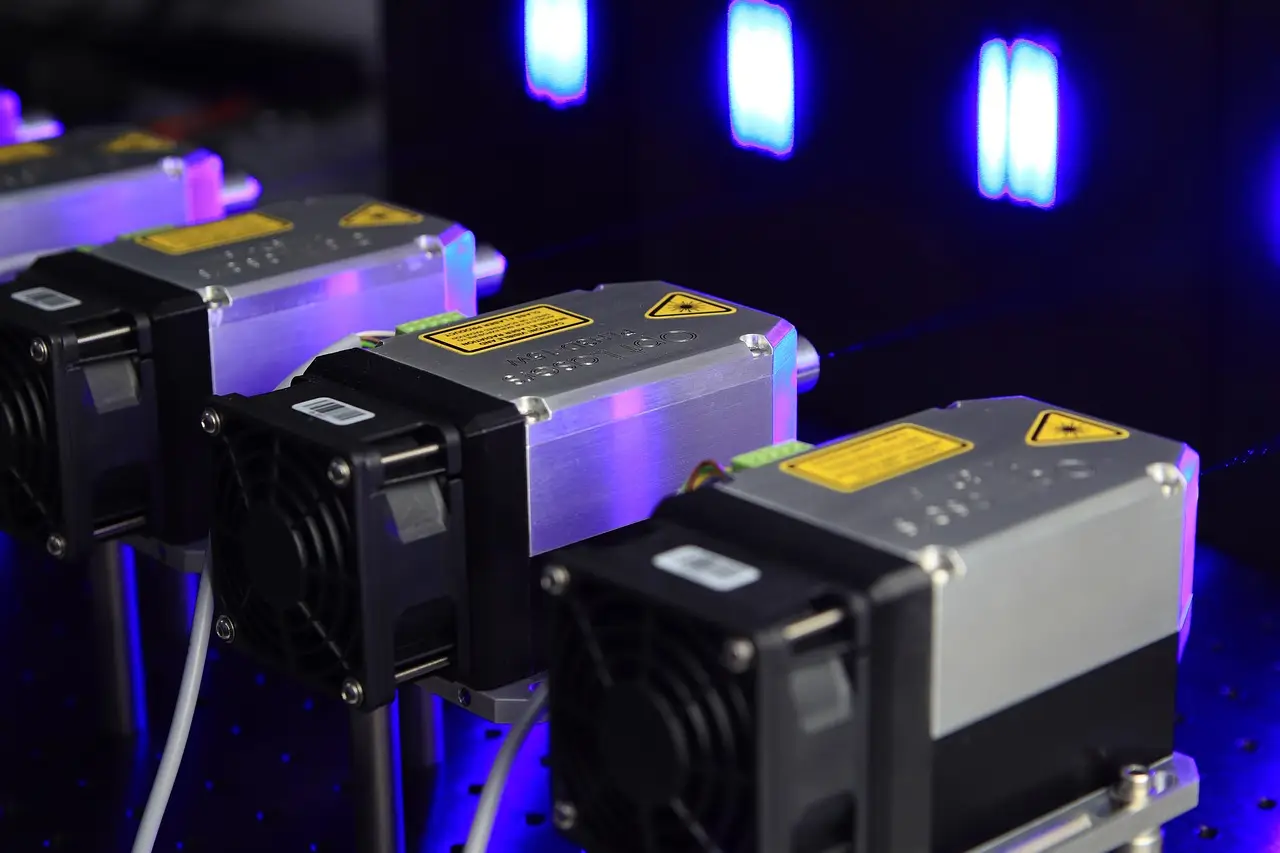
A chip-delivered laser technique cooled a trapped ion close to its quantum ground state in roughly 150 microseconds — about three times faster than the approximately 500 microseconds a conventional laser arrangement needs. Engineers at Cornell developed the method, publishing their results Nov. 9 in the journal PRX Quantum, and they say it targets one of the biggest practical bottlenecks in building larger quantum computers.
The project was led by Karan Mehta, assistant professor of electrical and computer engineering in the Cornell Duffield College of Engineering. Doctoral students Zhenzhong Xing and Hamim Mahmud Rivy share first authorship on the paper.
Why does cooling slow quantum computers down?
Trapped-ion quantum computers store information in individual electrically charged atoms suspended in electromagnetic fields. Ions give researchers exceptionally precise quantum control, which is why several leading quantum machines rely on them. But even tiny amounts of unwanted motion interfere with calculations, so lasers must repeatedly cool the ions to near their lowest possible energy states — the quantum ground state.
That maintenance eats up more computing time than most people expect. "You might think that the logic operations associated with running a computer would be the dominant timescale," Mehta said. "But cooling operations, particularly to near the quantum ground state, end up being a major bottleneck in leading systems."
How does the chip cool the ion?
Mehta's group works on integrated photonics — guiding light through microscopic pathways built into the same chip that hosts the atoms. The team used two laser beams traveling in opposite directions to create a standing wave, a fixed pattern of alternating high- and low-intensity light.
The researchers positioned a trapped calcium ion at a point of minimum intensity in that pattern. At that spot, the light removes energy from the ion's motion while suppressing unwanted interactions that would otherwise heat it back up.
The experiment had two stages. Xing first developed the theoretical predictions, then he and Rivy translated the modeling into a working demonstration. That included packaging that let the chips handle wavelengths from ultraviolet to near-infrared light while operating at cryogenic temperatures — extremely cold conditions near which many ion-trap experiments run.
What did the cooling achieve?
The team used a method called electromagnetically induced transparency cooling, which uses carefully tuned light to siphon energy out of an atom's motion. The measured results:
- Cooling to near the quantum ground state in about 150 microseconds, versus roughly 500 microseconds with a conventional laser setup.
- Simultaneous cooling of all three measured modes of the ion's motion, spanning a frequency range of approximately 5 megahertz.
- Cooling below the conventional Doppler limit, a standard theoretical floor for laser cooling, experimentally confirming a longstanding prediction.
The three-mode result matters because an ion oscillates in three dimensions, and each direction can carry a different frequency. Conventional setups often need separate cooling passes for different types of motion.
"Usually it's challenging to cool all of them with just one single cooling mechanism," Xing said. "But what we demonstrate here is that if those motional frequencies are not too far apart, we can effectively cool them to the ground state."
Could this scale to bigger machines?
The key practical feature is that the optical components sit on the chip itself rather than in elaborate arrangements of external lasers. The chip delivers the multiple wavelengths of light needed to control the ion, an approach several groups in the field are pursuing to push systems to many more qubits — the quantum equivalent of bits.
The chips were fabricated commercially in the Netherlands through a collaboration with ETH Zurich. Cornell facilities, including the Cornell NanoScale Science and Technology Facility, handled packaging and device preparation for the experiments.
The experiments involved only a single ion, so the results remain an early-stage demonstration rather than a proven recipe for large-scale machines. Still, Mehta said the broader significance is that technologies being investigated to make quantum computers larger can simultaneously improve the fundamental operations those computers depend on. In plain terms: the hardware that helps quantum computers grow may also make them run faster.
via phys.org/rss-feed/ (Source)
More from Elena Vasquez
Show full bio
Correspondent covering money, funding and market shifts around general science news at SciBeat.
396 articles