Plate Nº 58 · recorded October 29, 2026
Space & AstronomyReported finding
Dead Star With Two Debris Rings May Preview Our Solar System's End
Astronomers found the first white dwarf with a two-ring debris disk, possibly shaped by surviving planet-like bodies — a preview of the sun's fate in 5 billion years.
By Nathan Brooks3 min read644 words
In brief
- ESO announced the discovery of white dwarf J1328-1450's double debris disk on October 27, 2026.
- The peer-reviewed study appeared in Nature Astronomy on October 26, 2026.
- The suspected outer planetary body may be Pluto- or moon-sized; the inner one about a mile across.
- The sun will become a red giant in about 5 billion years and a white dwarf roughly 1 billion years later.
- The inner ring is rich in magnesium gas while the outer ring has little — evidence the rings may have different origins.
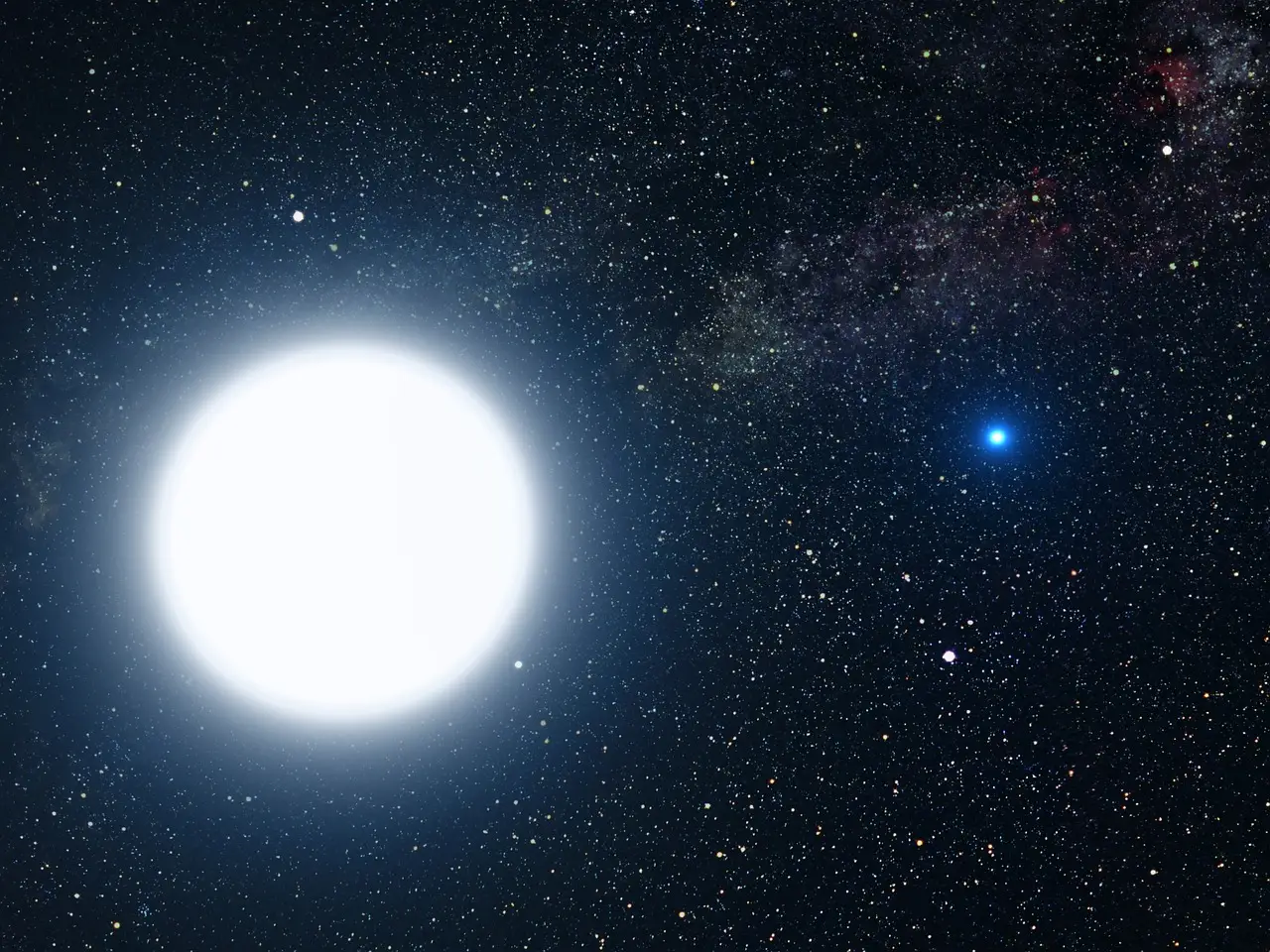
Astronomers have found a dead star ringed by two separate debris belts — the first such double disk ever recorded, and a possible preview of what our own solar system will look like in roughly 5 billion years. The European Southern Observatory (ESO) announced the discovery on October 27, 2026, one day after the peer-reviewed study appeared in Nature Astronomy on October 26.
The star at the center of the find is a white dwarf called J1328-1450. A white dwarf is the dense, burnt-out core a star leaves behind after exhausting its hydrogen fuel and shedding its outer layers. Our sun is headed for exactly that fate — but not soon. It still has about 5 billion years of hydrogen left, and it will spend roughly 1 billion of its final years as a swollen red giant before collapsing into a white dwarf.
What makes this disk different?
Researchers observed J1328-1450 with ESO's Very Large Telescope in Chile. Astronomers had detected disks around white dwarfs before. What they'd never seen is a disk with a distinct gap splitting it into two rings, each circling the dead star at a different speed.
Lead author Nicola Gentille Fusillo of the University of Trieste in Italy put it plainly: "We have known for some time that planets may survive beyond the transformation of their central star, but this is the first example of a complex system with a double debris disk and potentially two surviving planetesimals."
Planetesimals are small planet-like bodies — the leftover building blocks of planetary systems. The researchers believe two of them, still orbiting in their own lanes, are shepherding the rings and carving the gap between them.
How big are the suspected survivors?
The team hasn't seen the bodies directly, but their size estimates split the pair:
- The inner object is likely asteroid-sized, roughly a mile (1.6 kilometers) or more across.
- The outer object could be far larger — comparable to Pluto, or even Earth's moon.
The rings themselves carry chemical fingerprints. Spectral analysis detected calcium, oxygen, magnesium and iron in the disk. The two rings don't match: the inner one is rich in magnesium gas, while the outer one contains little of it. That difference supports the idea that each ring was fed by a different parent body with its own composition.
Co-author Felipe Lagos-Vilches of the University of Warwick in the U.K. and the Universidad Técnica Federico Santa María in Chile highlighted the system's stability: "The structure we see in this system is particularly intriguing because the two gaseous rings are remarkably stable and remain separated by a gap."
Could one planet explain it instead?
Maybe — and the researchers are careful not to oversell the two-body scenario. The rings could also come from a single destroyed planet, with one ring fed by its crust and the other by its exposed core. The data can't yet rule that out.
Either way, Gentille Fusillo sees the system as more than a curiosity. "The system is a rare glimpse of the violent, chaotic process by which a planetary system meets its end," he said, "and it hints that dead stars can have disk structures far more complex than previously realized."
Why it matters for our own backyard
When the sun dies, its planets face the same violent reckoning. A system like J1328-1450 gives astronomers a working model of what might survive: possibly scorched remnants of worlds, still herding debris in stable rings around the sun's cooling core.
The finding is preliminary in one key respect — the suspected planetesimals remain unseen, their existence inferred from the rings' structure and chemistry. Confirming them will take further observation. Still, as a single concrete glimpse of a planetary system's afterlife, this double-ringed dead star is the clearest picture astronomers have.
via nature.com (Original)
More from Nathan Brooks
Show full bio
Market editor covering companies, deals and strategy in general science news at SciBeat.
268 articles
Nearby plates
- The phoenix planet: Astronomers spot a world rebuilt from stellar ashes
- A Star Is Slowly Eating Its Companion — and Could for Billions of Years
- Hubble Data Reveals Possible Planet Born Around a Dead Star
- Niobium Around a White Dwarf Hints at a Second-Generation Planet
- Star Caught Slowly Snacking on a Brown Dwarf 300 Light-Years Away