Plate Nº 16 · recorded October 14, 2026
Health & Medicine ResearchReported finding
Dissolving Particles Cut Knee Pain in 80% of Patients Over 12 Months
A 194-patient study found 80% of participants with knee osteoarthritis experienced clinically meaningful pain relief lasting 12 months after genicular artery embolization with dissolving particles.
By Elena Vasquez4 min read794 words
In brief
- 80% of 194 patients reported clinically meaningful pain relief at the 12-month follow-up
- The findings were published October 14, 2026, in the journal Radiology
- Researchers performed 239 procedures on 194 patients at Charité Berlin between July and November 2024
- Median pain scores on a 0–10 scale fell from 7 before treatment to 3 at 12 months
- No moderate or severe adverse events occurred; mild, transient complications were seen in 6.7% of procedures
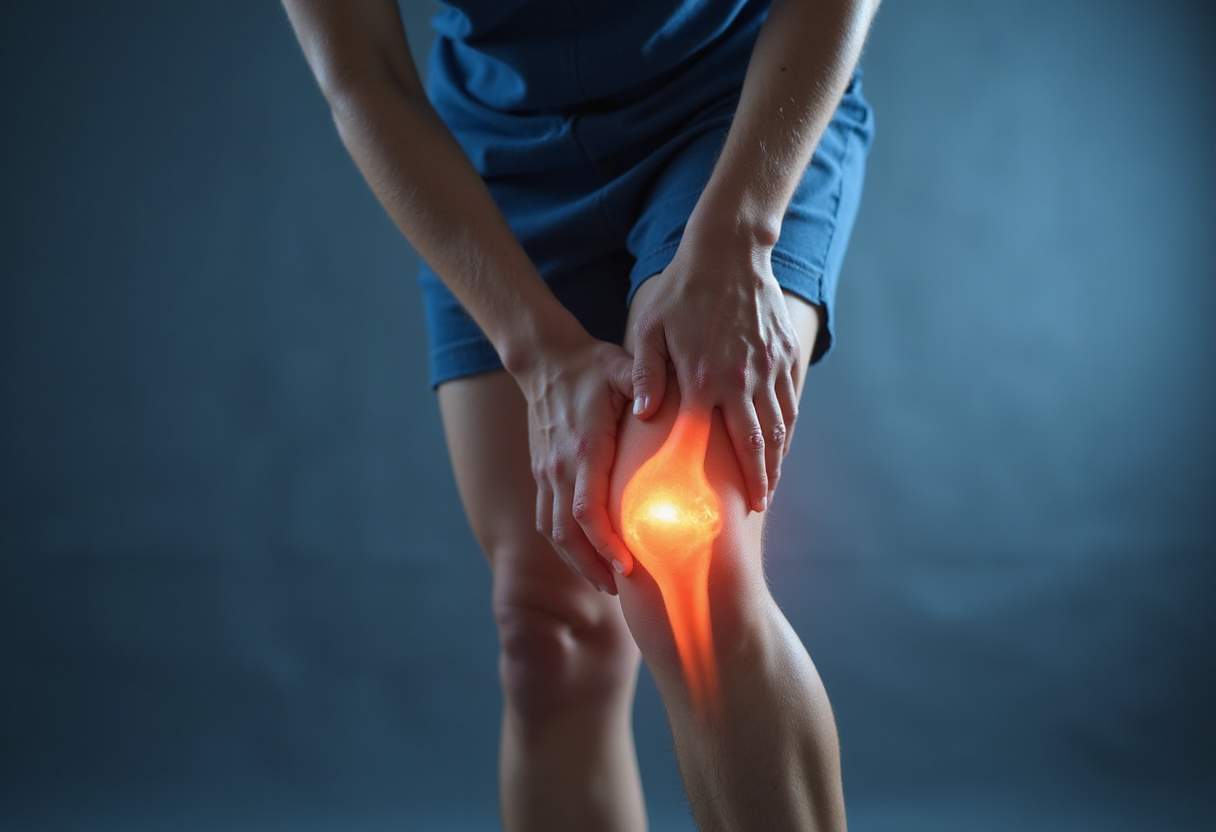
A new procedure that blocks abnormal blood vessels around the knee delivered clinically meaningful pain relief to 80% of patients for at least 12 months, according to a study of 194 adults published October 14, 2026, in the journal Radiology.
The treatment, called genicular artery embolization (GAE), uses tiny gelatin-based microspheres that dissolve within hours. Interventional radiologists thread a thin catheter into arteries feeding the inflamed joint and inject the particles to cut off blood flow to problem vessels while sparing normal circulation.
Researchers at Charité — Universitätsmedizin Berlin performed 239 procedures between July and November 2024 on 194 patients with osteoarthritis-related knee pain that had not improved after at least three months of standard care. The group included 114 women and 80 men, with a median age of 69 and a median body mass index of 28.4. All 239 procedures were technically successful.
What did the patients actually experience?
Median pain scores on a 0-to-10 scale fell from 7 before treatment to 4 at six weeks, dropped further to 3 at six months, and held at 3 at the 12-month check. That is more than a 50% reduction from baseline. Mobility, sports, daily activities, and quality-of-life measures all improved meaningfully across the year.
Follow-up rates ran high: 94% at six weeks, 89% at three and six months, and 79% at 12 months. No moderate or severe adverse events occurred. Mild, temporary complications appeared in 6.7% of procedures — mostly brief skin discoloration and one superficial blood pooling near the catheter site.
"Most importantly, their quality of life significantly increased," said Dr. Florian Nima Fleckenstein, the study's lead author and deputy head of Interventional Radiology at Charité. "We believe these results carry real weight because they come from real-world data."
The plain takeaway: pain dropped by more than half on average, and four out of five patients cleared the bar for a meaningful improvement at one year.
Why target blood vessels in the first place?
Osteoarthritis goes deeper than bone-on-bone contact. Inflammation, abnormal blood vessel growth inside the synovium — the membrane lining the joint — and oversensitive pain nerves all feed chronic discomfort. The World Health Organization estimates knee osteoarthritis affects more than 365 million adults worldwide.
GAE aims at that vascular component. By choking off the abnormal vessels, doctors can dial down inflammation and disrupt the nerve growth that drives pain. The particles vanish within hours, leaving normal circulation intact.
"GAE is a whole new treatment regimen that targets abnormal hypervascularity around the joint and, in turn, modulates the pathological neurovascular environment," Fleckenstein said. "By reducing both inflammation and pain, GAE with resorbable microspheres may be the first procedure that alters the course of the disease, slowing its progression."
Whether the technique actually slows cartilage deterioration is unclear. The study did not measure cartilage loss or track how many patients eventually needed joint replacement.
How does this fit with prior work?
The new paper is the largest on dissolving gelatin particles. It joins a growing but uneven evidence base:
- A 2026 study in Clinical Radiology randomized 50 patients to GAE plus standard care or standard care alone. After one year, pain scores dropped 72.7% in the embolization group versus 24.2% in controls.
- A randomized, sham-controlled trial in European Radiology in April 2026 followed 58 patients. Both treatment and sham arms improved similarly, with no statistically significant difference.
- A September 2026 systematic review in the European Journal of Radiology pooled 22 studies covering 633 patients. Pain improved in most, yet no significant edge over sham emerged when three randomized trials were combined.
- A June 2026 review of 45 studies and 2,205 patients described real-world gains yet judged the evidence low or very low certainty.
The pattern: observational data look strong; controlled data look weaker. Fleckenstein's study has no sham or untreated comparison arm.
The plain takeaway: the new results are real and large, but without a sham arm they cannot separate the procedure's effect from placebo.
Could this approach replace knee surgery?
Not yet. The Society of Interventional Radiology endorsed GAE in a 2026 position statement for appropriately selected patients who cannot undergo or want to delay joint replacement, while calling for careful patient selection and continued trials.
For the many patients stuck between failed injections and unwanted surgery, the approach is real progress. "This lets us speak about safety and efficacy with real confidence," Fleckenstein said. "For the right patient, it can mean lasting relief from a single, minimally invasive procedure — a meaningful new option between injections and joint replacement."
The plain takeaway: GAE is becoming a credible bridge between conservative care and the operating room, though longer controlled trials will decide its final place.
via dx.doi.org (Original)
More from Elena Vasquez
Show full bio
Correspondent covering money, funding and market shifts around general science news at SciBeat.
232 articles
Nearby plates
- Eli Lilly's Next-Generation Obesity Drug Cuts Weight and Eases Knee Pain in Phase 3 Trial
- Epilepsy Drug Lacosamide May Reverse Osteoarthritis Cartilage Damage
- Robotic Joint Replacement Does Not Lower Early Repeat Surgery Risk
- Retatrutide Delivers Up to 71.2 Lbs Weight Loss in Phase 3
- Blocking One Aging Protein Regrew Knee Cartilage in Mice