Plate Nº 52 · recorded November 14, 2026
Neuroscience & MindReported finding
Doctor Octopus in the Lab: Mind-Controlled Extra Arms That Don't Hijack Your Hands
Ten volunteers steered four robotic-arm commands through skin vibrations while their hands stayed busy — and three days of practice closed the accuracy gap between multitasking and sitting still.
By James Calloway5 min read940 words
In brief
- 10 volunteers reached 69.7% dual-task command accuracy by day three, closing the gap with 79.1% single-task accuracy
- The interface used the P300 brainwave, a voltage spike appearing 200-500 milliseconds after a noticed stimulus
- Four vibrators near the wrists and elbows encoded four commands, cycled every 1.6 seconds
- The system averaged responses across pulses and locked on in roughly two recognition attempts
- Sustained-attention testing covered only four volunteers and was descriptive
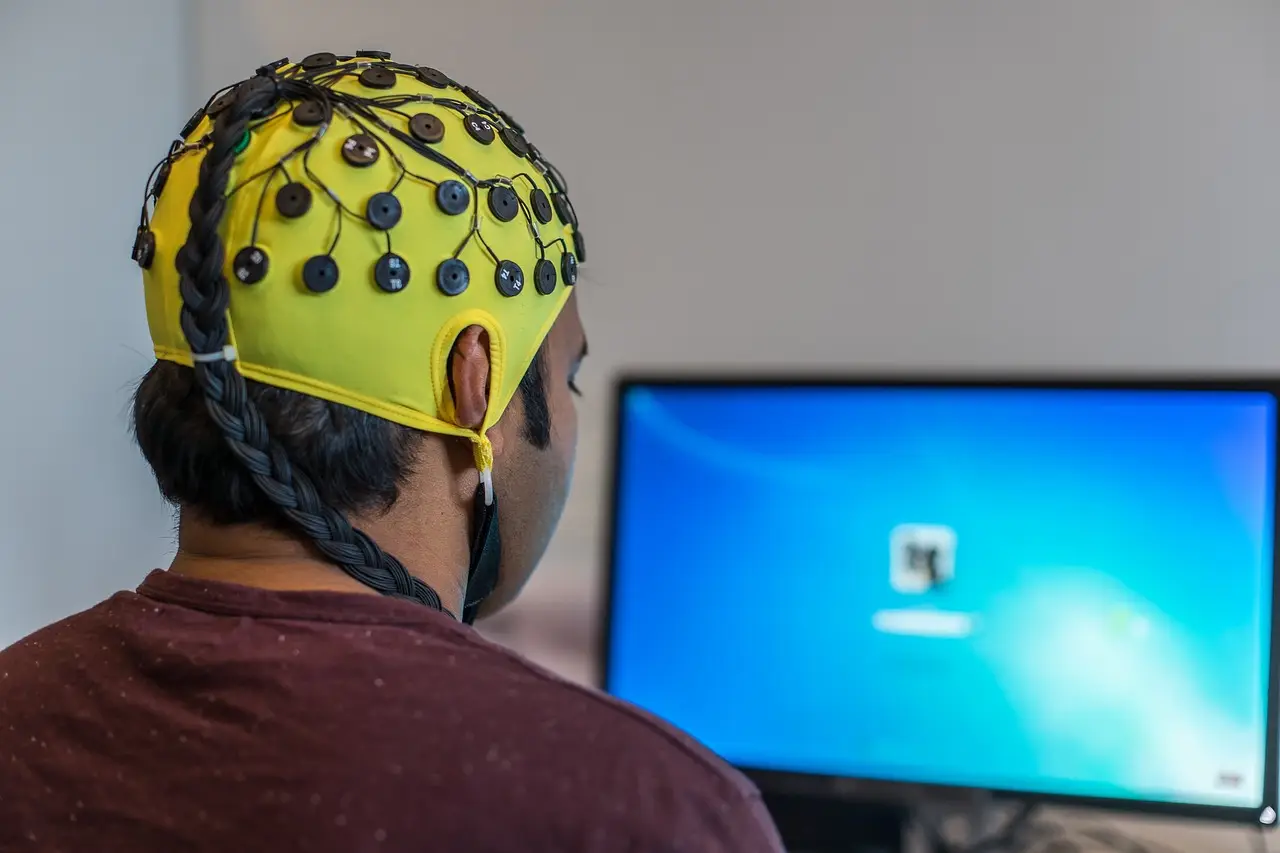
Ten volunteers learned to fire off four distinct commands to robotic arms using nothing but their attention to gentle skin vibrations — while their real hands juggled a balancing task, according to a new study in Nature Communications. After three days of practice, the accuracy gap between moving both hands and sitting still vanished.
A brain-computer interface reads electrical activity from the brain, often via scalp sensors, and translates specific patterns into commands for machines. Most of this field aims at restoring movement after paralysis. This study, led by Tianyu Jia and Dario Farina of Imperial College London, aims elsewhere: at augmenting able-bodied people with extra limbs.
Jia, a postdoctoral bioengineering researcher, cited an unlikely muse. "The initial inspiration came partly from Doctor Octopus, the fictional character from Spider-Man," he told PsyPost. "We wanted to probe the limits of human movement control abilities and turn a science-fiction vision into reality."
Why extra limbs are a hard problem
The body has no spare motor channels. Earlier workarounds each carried a cost. A 2021 study taught adults to steer a robotic thumb with toe pressure sensors over five days, but that occupied their feet and shifted how the brain represents the natural hand. A 2018 experiment decoded a robotic third arm from imagined hand grasps while volunteers balanced a ball, but it offered a single on-off command.
Imagined movements hit a wall. Picturing one motion while performing another produces overlapping electrical activity in the brain's motor regions, and non-invasive scalp sensors struggle to separate the signals. So the team bypassed motor brainwaves entirely.
How does vibration beat imagination?
They built the interface on the P300 response — a small positive voltage spike the brain produces roughly 200 to 500 milliseconds after a person notices an infrequent target stimulus amid ignored ones. Standard P300 systems flash letters on screens, monopolizing eyesight. Vibrations on the skin evoke the same wave while leaving vision and the motor system free.
Each of ten right-handed volunteers, aged 23 to 37 (six men, four women; eight with no prior brain-interface experience), wore a 64-sensor electroencephalography cap plus four small vibrators taped near the wrist and elbow of both arms. Each vibrator mapped to one command, pulsing for 200 milliseconds with 200-millisecond pauses, cycling through all four sites every 1.6 seconds. To pick a command, a participant silently focused on one vibrator's buzzes and ignored the rest. A machine-learning classifier watched for a yes-or-no P300 spike and matched its timing to whichever pad had just pulsed. The dataset and analysis code are public.
Each session opened with a 60-second baseline: hold a plastic tray, roll a ball through all four corners. After 15 minutes of decoder calibration, participants completed 32 command runs sitting still and 32 while rolling the ball.
What did three days of training change?
Day one was rough. Dual-task accuracy hit 53.1 percent versus 68.1 percent sitting still. Day two: 56.3 versus 77.2 percent. By day three, dual-task success climbed to 69.7 percent — a gain of roughly 17 percentage points — against 79.1 percent single-task, and the difference was no longer statistically significant.
"Operating such an interface is not necessarily a fixed ability and may improve through practice," Jia noted.
Speed stayed flat across all days and conditions: the system needed an average of roughly two recognition attempts (1.5 to 2.3) to lock on, differences not statistically significant. And natural coordination held. Tray-rotation times showed no significant difference between solo baseline and dual-task runs.
The mechanism is telling. The P300 spike — typically 5 to 10 microvolts — actually shrank during movement (4.7 versus 7.2 microvolts on day three) and didn't grow with training. What improved was timing. Peak-timing jitter between pulses was worse in the dual task on days one and two; by day three that difference disappeared. Steadier timing yielded taller averaged peaks, and the authors suggest practice helped participants allocate attention consistently, offsetting "sensory gating" — the brain's tendency to dial down touch signals during movement.
A four-person exploratory test of sustained attention showed detection in 91.1 percent of windows sitting still and 87.0 percent while balancing, with false alarms at 1.6 and 5.3 percent. Those figures aren't comparable to the main experiment's accuracy. One demonstrator also directed two tabletop robotic arms along preset trajectories — picking up balls, lifting a cup while another arm dropped a straw in, running a ball relay.
"People can use a brain-computer interface to issue commands to additional robotic limbs while performing a task with both natural hands," Jia said. "The human nervous system may be able to accommodate an additional control channel for multitasking, at least in this specific sense."
What does this change for users?
Right now, not much outside a lab. The decoder needed several seconds of averaging to separate signal from noise — nothing like a biological limb's reflexes. The robotic arms ran preprogrammed routines, not smooth proportional control. The sustained-attention mode was tested descriptively in only four people, and the tray task was deliberately smooth, avoiding complex grips or sudden planning. Prolonged vibration may also dull skin sensitivity over hours, weakening P300 responses. Larger groups, longer training, faster decoders, and wearable sensors come next.
The study, "Concurrent control of natural and robotic limbs through a tactile-encoded brain-computer interface," was authored by Tianyu Jia, Xingchen Yang, Ciaran McGeady, Yifeng Li, Jinzhi Lin, Kit San Ho, Feiyu Pan, Linhong Ji, Chong Li, and Dario Farina.
via psypost.org (Source)
More from James Calloway
Show full bio
Staff writer covering regulation, policy and their impact on general science news at SciBeat.
388 articles
Nearby plates
- A Wrist Sensor Spotted Parkinson's Signs Nearly 7 Years Early
- Wrist Sensor Beats Clinicians at Tracking Stroke Recovery
- Agentic robotics adds 15,000+ packages per robot each year
- Concept2Brain: AI Predicts Human Brain Waves From Pictures and Text
- Study: Under Uncertainty, Brain Holds Onto Irrelevant Visual Cues