Plate Nº 59 · recorded November 18, 2026
Biology & EvolutionReported finding
Eagles Kill 26-kg Baboons, Rethinking Human Ancestors' Predator Fears
Eagle talon marks on baboon bones over 26 kg from Chad's Ennedi plateau break the 13-kg ceiling for raptor-killed primates — and reopen questions about eagle predation on human ancestors.
By Marcus Bennett4 min read721 words
In brief
- A study published Nov. 18 in the American Journal of Biological Anthropology documents eagle predation on a baboon over 26 kg (57 pounds).
- No primate above 13 kg (29 pounds) had previously been confirmed killed by raptors.
- Hominins were thought to have escaped eagle predation roughly 2.5 million years ago.
- The bones came from baboons on Chad's isolated Ennedi plateau in the Sahara.
- Verreaux's eagles triggered alarm calls and escape responses in the baboons.
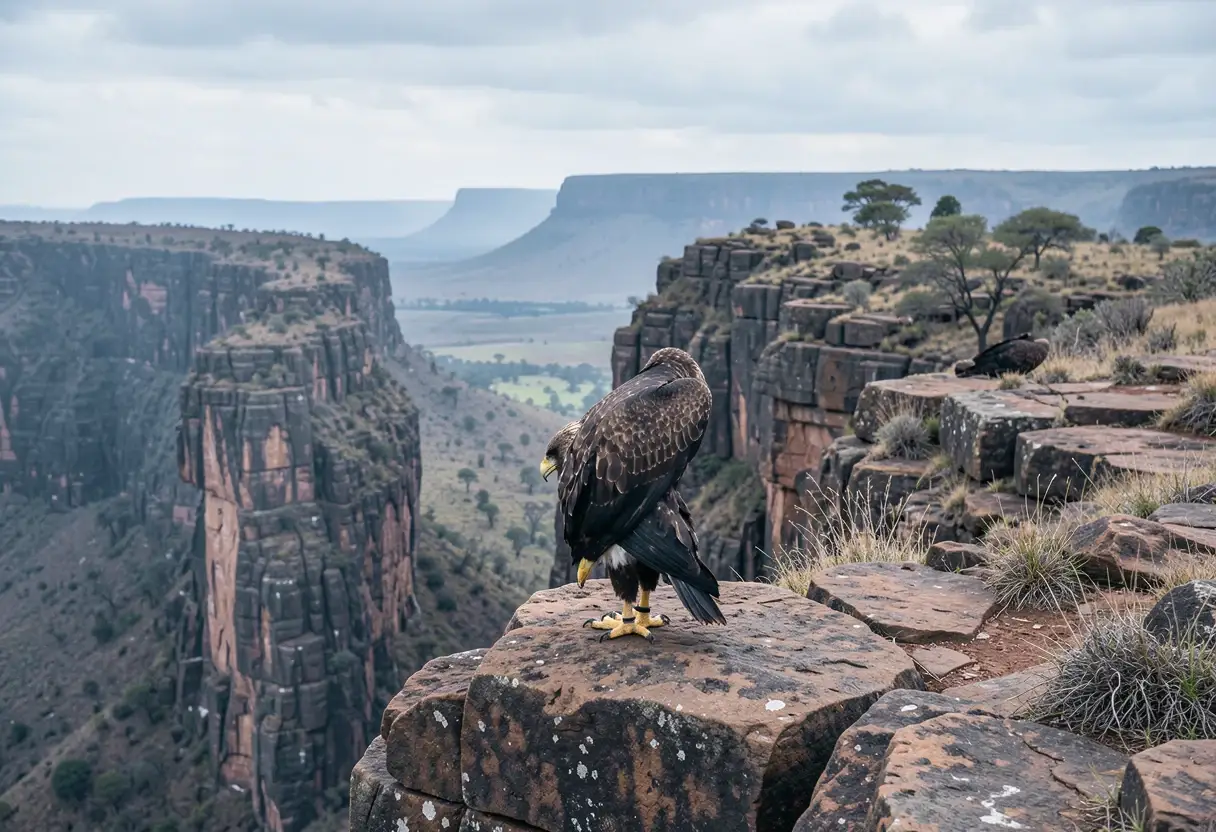
A baboon weighing more than 26 kg (57 pounds) — squarely within the size range of our early human ancestors — was killed by an eagle. That single finding, published Nov. 18 in the American Journal of Biological Anthropology, dismantles a long-standing assumption about who could hunt large primates.
Until now, no primate heavier than 13 kg (29 pounds) had ever been confirmed killed by a raptor. Scientists reasoned that humans and their hominin ancestors escaped eagle predation roughly 2.5 million years ago because their bodies grew too heavy for even the giant eagles of the past to lift. The new evidence forces a rewrite of that timeline.
What did the researchers actually find?
A team from the University of St Andrews, working with Dartmouth College, the University of Konstanz, the Max Planck Institute of Animal Behavior and African Parks, studied an isolated baboon population on the Ennedi plateau of northern Chad, in the middle of the Sahara.
They recovered skulls and bones of adult male baboons bearing the signature marks of eagle predation:
- Talon punctures to the skull
- Characteristic scrapes and "rakes" on the shoulder bones
From these remains, the researchers calculated body weight. One individual came in at over 26 kg — double the previous confirmed ceiling for raptor-killed primates, and well within the range of hominin species.
Senior author Nathaniel Dominy, a professor at Dartmouth College, described how the team's skepticism dissolved: "At first, the idea of eagles hunting adult male baboons seemed to exist on the thin edge of possibility, until it didn't. Our skepticism slowly gave way to acceptance. The evidence was convincing."
Why does one punctured skull matter for human evolution?
Primates defend themselves very differently against aerial predators than against land predators such as big cats and crocodiles. Against eagles, primates "mob" — larger adult males charge the attacker to drive it off. If hominins faced the same airborne threat, scientists must reconsider how key behaviors evolved, from communication to group cooperation.
Modern primates living alongside eagle predators often move in large mixed groups with other primate species. For most of our evolutionary history, early ancestors lived alongside other hominin species and other primates. Researchers usually frame those relationships as competition; the new findings suggest there may have been cooperative advantages to sticking together.
How did the fieldwork unfold?
Lead author Catherine Hobaiter, a professor at the School of Psychology and Neuroscience at St Andrews, called the expedition "any primatologist's dream." Some baboons there live so remotely that they rarely, if ever, see people.
"After a couple of days they ended up following us around — we were probably the most interesting thing they'd seen for a while," she said.
The eagle connection surprised the researchers themselves. "We saw the eagles while we were searching for the baboons, but we never imagined that they might be a threat to them," Hobaiter said. "Then we found the first skull with a puncture mark, and then another, and another."
One observation stood out: when a pair of Verreaux's eagles swept overhead, the baboons alarm-called and dropped to safety. The same animals stayed relaxed around other big birds of prey. Primates, Hobaiter noted, respond only to eagles that pose a genuine threat.
What comes next?
The findings carry caveats. This is one population at one remote site, and the paper reports signs of predation on a 22-kg adult primate rather than direct observation of a kill. Whether similar predation occurred on hominins remains inference, not demonstrated fact.
Still, the discovery points researchers toward understudied places. Dr. Gisela Kopp of the University of Konstanz and the Max Planck Institute of Animal Behavior said: "Primatology often focuses on regions with a high diversity of primates, but shifting our attention to a place where no primatological data has ever been collected before proved to be extremely rewarding."
Dr. Jean Didier Akpona of African Parks, who has worked in the region for about three years, said the evidence prompted him to "explore further the mystery that surrounds the gueltas of the Sahara Desert" — pockets of water that form within rock formations.
The team plans further study of the Ennedi baboons, whose diet and social lives have already defied expectations. In Hobaiter's words: "I can't wait to see what new 'rules' they'll break next."
via phys.org/rss-feed/ (Source)
More from Marcus Bennett
Show full bio
News editor covering regulation, policy and their impact on general science news at SciBeat.
494 articles
Nearby plates
- Bone marks suggest eagles prey on human-sized baboons in the Sahara
- Four-Winged Dinosaur From China Hints Flight Evolved Twice
- Jurassic Bird from China Was a Flightless Killer With Sickle Claws
- 1.4-Million-Year-Old Footprints Reveal Larger Paranthropus Than Expected
- 210-Million-Year-Old Dinosaur From Zimbabwe Rewrites Africa's Map