Plate Nº 71 · recorded October 13, 2026
Space & AstronomyReported finding
First Phobos sample mission launches 19 October, JAXA confirms
JAXA-led MMX launches from Japan on 19 October 2026 to collect and return the first-ever sample from Mars's moon Phobos, with NASA, ESA, CNES and DLR aboard.
By James Calloway3 min read635 words
In brief
- MMX launches at 04:41 JST on 20 October 2026 (20:41 BST on 19 October) from Tanegashima Space Center.
- MMX will be the first mission to return a sample from the Martian moon Phobos.
- The mission is led by JAXA with NASA, CNES, DLR and ESA as partners.
- The spacecraft launches on Japan's H3 rocket.
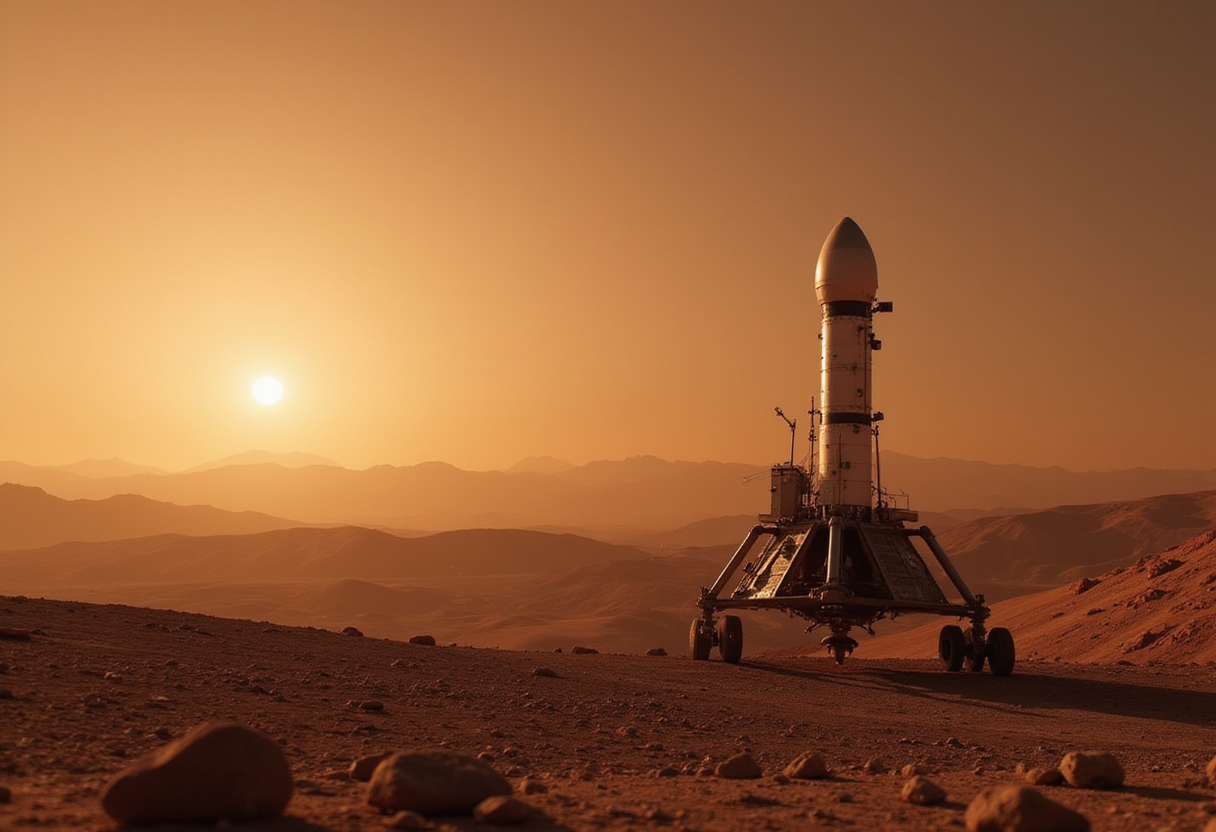
Japan will launch the first mission ever to grab a sample from the Martian moon Phobos on 19 October 2026 — 20:41 BST, or 04:41 on 20 October local time at the Tanegashima Space Center. The spacecraft rides an H3 rocket, and nobody has done anything like this before. That is the claim. Let's look at what's actually promised.
The Martian Moons eXploration mission, known as MMX, is led by the Japan Aerospace Exploration Agency (JAXA). It has heavyweight company: NASA, the French space agency CNES, the German Aerospace Center DLR, and the European Space Agency are all partners. If it works, MMX becomes the first mission to collect material from Phobos and fly it back to Earth.
What is MMX actually doing?
In plain terms: land on Phobos, scoop up surface material, seal it, and return it to our planet for laboratory analysis. Phobos is the larger of Mars's two small moons — a lumpy body roughly 22 kilometres across that orbits closer to its planet than any other known moon.
Why does a pile of gravel from a moon nobody has landed on matter? Because scientists still argue about where Phobos came from. One camp says it's a captured asteroid. Another says it formed from debris thrown up by a giant impact on Mars itself. A sample could settle the argument, and if the Martian-debris theory holds, that sample might contain ancient Martian material — handed to us without ever landing a rover on the Red Planet's surface.
That's the promise. The caveat follows, as it always should.
What could go wrong?
Plenty, and JAXA knows it. The launch itself is a question mark: the H3 rocket that will carry MMX is Japan's newer flagship launcher, and its debut flight in March 2023 ended in failure, forcing operators to destroy it. The rocket has flown successfully since. Still, first-attempt history matters in this business.
Then there's the landing. Phobos has weak, uneven gravity — about one two-thousandth of Earth's — which makes touching down less like landing and more like docking with a drifting rock. Mission planners also have to thread a path through the Mars system and back home, a round trip measured in years, not weeks.
JAXA does have form here. Its Hayabusa2 mission brought asteroid material back to Earth in 2020, and the original Hayabusa managed a sample from asteroid Itokawa in 2010 despite near-fatal breakdowns. MMX borrows that heritage. But heritage is not a guarantee.
What does this change for the rest of us?
Fair question. Sample-return missions sound remote, but they're how planetary science actually advances. Rocks analyzed in Earth laboratories yield far more detail than any instrument a lander can carry. The Apollo samples are still producing papers fifty years on.
A confirmed Phobos sample would give researchers material that could:
- settle whether Phobos is a captured asteroid or shattered Mars debris;
- possibly expose preserved fragments of the early Martian surface;
- sharpen plans for any future human missions to the Mars system.
And for the partner agencies — ESA, NASA, CNES, DLR — it's a stake in Japanese engineering with shared scientific returns. Europe in particular gets instruments and expertise aboard a mission it could not run alone.
The bottom line
The date is set, the rocket is assigned, and the partners are named. What we don't have yet is a launch. Until that H3 lifts off from Tanegashima, and until a capsule carrying Phobos dust survives the trip home, every headline about "firsts" stays provisional. Space has a long record of punishing confidence.
Mark your calendar for 19 October 2026 anyway. If it works, we finally get our hands on a piece of a Martian moon — and possibly a free sample of Mars itself.
via twitter.com (Original)
More from James Calloway
Show full bio
Staff writer covering regulation, policy and their impact on general science news at SciBeat.
224 articles
Nearby plates
- A Giant Crater May Reveal Whether Phobos Is a Captured Asteroid
- NASA Details Its Role in Japan's Mission to Mars's Moons
- NASA Picks PSI-Led Team to Probe Possible Cave Beneath Lunar Pit
- NASA Picks Three Missions to Find Caves, Ice and Hazards for First Moon Base
- NASA Picks Three New Payload Suites to Scout Its Future Moon Base