Plate Nº 87 · recorded October 10, 2026
Space & AstronomyReported finding
Interstellar comet 3I/ATLAS holds unusually high methanol levels
ALMA observations of interstellar comet 3I/ATLAS show methanol-to-HCN production ratios of roughly 70 and 120 — among the highest ever measured, hinting the comet formed under conditions unlike our solar system's.
By Marcus Bennett4 min read704 words
In brief
- ALMA measured methanol-to-HCN production ratios of roughly 70 and 120 in comet 3I/ATLAS on two dates in late 2025
- 3I/ATLAS is the third confirmed interstellar visitor, following 1I/'Oumuamua (October 2017) and 2I/Borisov (August 2019)
- Earlier James Webb Space Telescope observations found the comet's coma dominated by carbon dioxide while still far from the Sun
- The study was published on September 9, 2026 in The Astrophysical Journal Letters, volume 999 (2): L32
- Lead author Nathan Roth of American University described the comet as 'bursting with methanol in a way we just don't usually see' in solar system comets
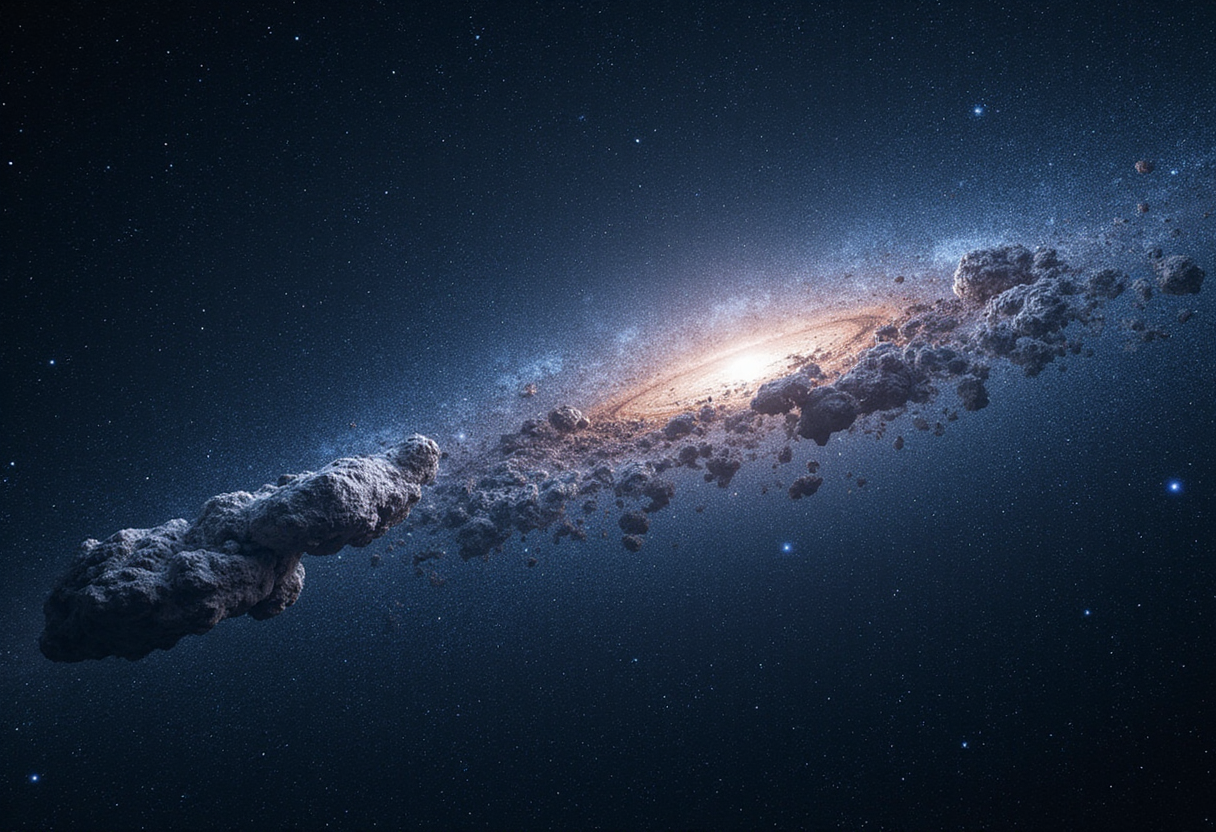
On two nights in late 2025, the Atacama Large Millimeter/submillimeter Array (ALMA) measured methanol-to-hydrogen cyanide production ratios of roughly 70 and 120 in comet 3I/ATLAS — values that place it among the most methanol-rich comets ever studied.
The interstellar visitor, only the third confirmed object ever observed entering our solar system, continues to defy chemical expectations.
Earlier James Webb Space Telescope (JWST) observations had already found carbon dioxide dominating its coma — the hazy gas cloud enveloping the solid nucleus — while still far from the Sun.
ALMA's new measurements, captured as the comet approached, add abundant methanol (CH3OH) — a simple alcohol — to the growing list of unusual features.
"Observing 3I/ATLAS is like taking a fingerprint from another solar system," Nathan Roth, lead author and a professor at American University, said. "The details reveal what it's made of, and it's bursting with methanol in a way we just don't usually see in comets in our own solar system."
What did ALMA actually see?
The team used ALMA's Atacama Compact Array in Chile on several dates as 3I/ATLAS moved closer to the Sun.
Sunlight warmed the comet's icy surface, releasing gas and dust that formed a bright cloud around its core.
The scientists focused on faint submillimeter wavelengths — light sitting between microwaves and infrared — to detect two molecules: methanol and hydrogen cyanide (HCN), a nitrogen-bearing organic compound common in solar system comets.
On two observation dates, the team measured ratios of roughly 70 and 120. Most solar system comets show methanol-to-HCN production ratios of just a few percent.
The interstellar visitor is therefore releasing tens to over a hundred methanol molecules for every HCN molecule.
Why does the methanol level matter?
The ratio functions as a chemical fingerprint of where and how a comet's ices formed.
Most comets in our solar system acquired their volatile ices — substances that readily vaporize when warmed — in the cold outer regions of the planet-forming disk around the young Sun, where temperatures and radiation produced a fairly predictable mix.
3I/ATLAS's exceptionally high methanol suggests its ices either formed under different conditions or were later exposed to a different environment.
Possible explanations include more energetic radiation, colder temperatures, or a distinct chemistry in the protoplanetary disk — the rotating ring of gas and dust around a young star — where this comet originated.
Earlier JWST data already pointed to a carbon-dioxide-rich coma. The new ALMA measurements reinforce that picture.
Where is the methanol coming from?
ALMA's high resolution let the team spatially map where each molecule originates.
Hydrogen cyanide appears to escape mostly from the comet's central nucleus — a pattern common in solar system comets.
Methanol tells a different story. ALMA detected it emerging not only from the nucleus but also from small icy grains drifting within the surrounding coma.
These tiny grains act like miniature comets: as 3I/ATLAS approaches the Sun, ice within the grains vaporizes and releases its trapped methanol.
Researchers have documented similar grain-driven outgassing in some solar system comets. This is the first time anyone has traced the detailed physics of that process in an interstellar object.
What does this add to the broader picture?
3I/ATLAS is only the third confirmed interstellar visitor, following 1I/'Oumuamua, spotted in October 2017, and 2I/Borisov, detected in August 2019.
Both earlier objects displayed unusual characteristics that did not match solar system norms.
Each new interstellar comet gives astronomers a way to compare the chemistry of small icy bodies formed around other stars with those formed around our Sun.
The 3I/ATLAS results hint that methanol-rich ice formation may be more common elsewhere in the galaxy than in our own cosmic neighborhood.
The study, titled "CH3OH and HCN in Interstellar Comet 3I/ATLAS Mapped with the ALMA Atacama Compact Array," appeared in The Astrophysical Journal Letters on September 9, 2026. Roth and his co-authors conducted the analysis.
The work remains observational rather than theoretical. The team has measured abundances and outgassing patterns, but pinning down the precise formation environment of 3I/ATLAS will require additional observations as it continues its passage through the inner solar system.
via public.nrao.edu (Original)
More from Marcus Bennett
Nearby plates
- Heavy methanol turns up around a baby star 1,000 light-years away
- CHIME Telescope Detects Cosmic Hydrogen Glow, Opening New Path to Dark Energy
- Faint Ancient Hydrogen Signal Detected, Paving Way for 3D Cosmic Maps
- CHIME Telescope Detects 9-Billion-Year-Old Hydrogen Signal
- Balloon Observatory Reveals Hidden Magnetic Threads on the Sun