Recorded November 20, 2026
PhysicsReported finding
Light-Powered Quantum Processor 'Clavina' Runs New Tasks Without a Rebuild
Clavina, a programmable photonic quantum processor from Imperial College London, simulated many-body physics and generated error-correction states in one device, published in Nature Photonics.
By Priya Raman4 min read777 words
In brief
- Imperial College London researchers published the Clavina photonic quantum processor in Nature Photonics on 31 July 2026.
- Clavina combined linear and nonlinear optical operations in one programmable device, performing two distinct tasks without hardware changes.
- The team simulated the Bose-Hubbard model, a many-body problem that also challenges superconducting quantum computers.
- Clavina generated Gottesman-Kitaev-Preskill states more consistently than earlier probabilistic photonic approaches.
- The architecture provides a universal gate set at the physical level, a prerequisite for bosonic error-correcting codes.
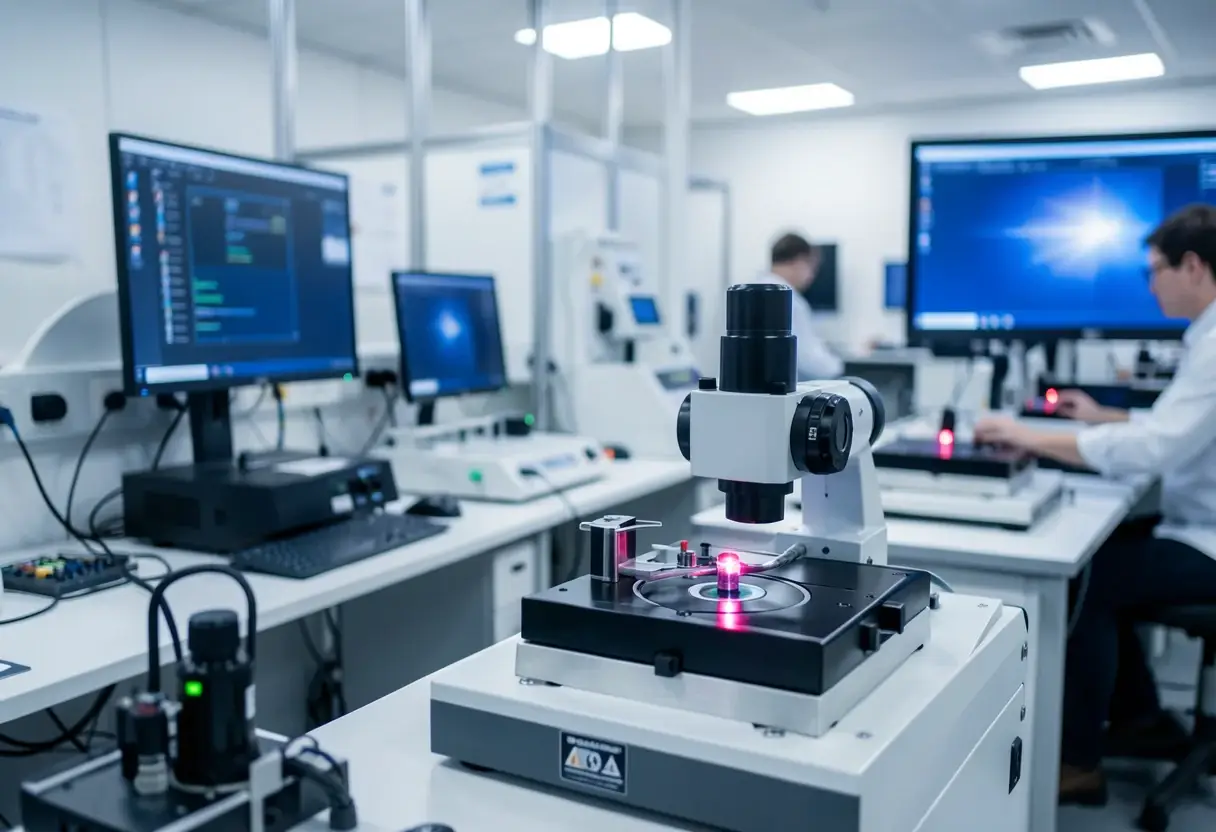
A single light-based quantum processor has performed two very different computations — simulating interacting quantum particles and generating states needed for error correction — without any change to its hardware. The processor, called Clavina, was developed by physicists at Imperial College London together with collaborating institutions, and the results appeared in Nature Photonics on 31 July 2026.
The achievement matters because light has long presented quantum engineers with a paradox. Photons, the particles that make up light, carry quantum information extremely well precisely because they rarely interact with one another. Yet those very interactions are what many quantum calculations require. Building a versatile machine from light alone has therefore proven difficult.
Why is a programmable photonic processor unusual?
Most processors built from light are designed around one fixed task. Adapting them to a different problem can demand substantial hardware changes, which slows the technology's evolution. Clavina, whose name its designers borrowed from the piano-like clavichord, takes a different route: it borrows the architecture of an ordinary computer, which delegates graphics and artificial intelligence to specialized components rather than a single fixed unit.
A central control unit directs information through a programmable optical network (a reconfigurable arrangement of components that routes and manipulates light) and through specialized modules. The optical network handles linear operations, which manipulate light without requiring photons to interact. The modules supply nonlinear operations, which force those interactions and expand the range of possible calculations. Because researchers can recombine these components, the processor can change its function without being rebuilt from scratch.
Dr. Shang Yu of Imperial College London, the study's lead author and a Marie Skłodowska-Curie Fellow, said: "We set out to build a photonic quantum processor that provides a step change in functionality over our previous designs. Our new architecture 'Clavina' is scalable, modular and extensible, allowing different functional modules to be used depending on the computational task we wish to perform."
What did the demonstrations show?
The team tested Clavina on two problems that stretch very different muscles.
The first was a simulation of the Bose-Hubbard model, a well-known problem in condensed matter physics (the study of matter in its solid and liquid forms) that describes how quantum particles interact. These calculations involve many-body interactions, in which the behavior of multiple particles must be tracked together. They remain challenging even for superconducting quantum computers, the leading rival technology.
Dr. Jinzhao Sun of Queen Mary University of London explained: "The versatility of our hardware enables us to integrate nonlinear operations and linear operations. We use these operations to perform simulations involving many-body interactions, which are also restricted on superconducting quantum computers."
The second demonstration tackled error correction, one of quantum computing's central obstacles. Quantum systems are fragile, and noise can corrupt calculations. One promising defense uses specially structured quantum states that encode information so errors become easier to spot and fix. Among the most valued are Gottesman-Kitaev-Preskill (GKP) states, but producing them with light has been hard because earlier methods worked probabilistically — researchers could not reliably generate the states on demand. With Clavina, the team demonstrated a far more consistent method.
This does not amount to a fully error-correcting quantum computer, and the researchers do not claim one. Dr. Raj Patel, a UKRI Future Leaders Fellow who leads Imperial's photonic quantum computing program, said the architecture can also generate other exotic states, including Schrödinger cat states. "The nonlinear operations in our architecture provide a universal gate set at the physical level which is required for the future implementation of bosonic error-correcting codes," he said. A universal gate set (the complete kit of basic operations from which any quantum computation can be assembled) is a prerequisite for future error-correction schemes that encode information in states of light.
Could one machine serve many problems?
The architecture stretches beyond the two demonstrations. Co-author Ying Dong of China Jiliang University said: "Previously, researchers would have to build photonic hardware tailored to a specific task. The ability to switch in different functional modules in our architecture enables a single set of hardware to perform multiple functions without overhauling the design. Clavina can solve graph problems, simulate quantum systems or generate large entangled states and resource states for error correction."
The findings are preliminary in an important sense: Clavina is a laboratory demonstration of a architecture, not a scaled machine, and the path from it to practical fault-tolerant computing remains long. Still, the work suggests that as quantum systems grow larger and more complex, the ability to change what a quantum computer does may prove just as valuable as increasing its raw power.
via profiles.imperial.ac.uk (Original)
More from Priya Raman
Show full bio
Senior reporter covering people, launches and day-to-day practice in general science news at SciBeat.
549 articles
Nearby plates
- Atom-Thin Materials Could Make Quantum Light Circuits Programmable
- Purdue Tackles Three Big Roadblocks in Light-Powered Quantum Chips
- PaQS benchmark tests what drives photonic quantum performance
- Quantum 'dark horse' anyons hit universal computing milestone
- ETH Zurich Quantum Computer Stores Memory as Tiny Vibrations