Plate Nº 66 · recorded November 9, 2026
Chemistry & MaterialsReported finding
Liquid-Grown Perovskite Films Hit 26.5% Solar Efficiency and Record Low Defects
A eutectic liquid layer heals perovskite crystal defects at 100°C, cutting surface recombination to 0.3 cm/s and delivering 26.5%-efficient solar cells and 26.1%-efficient LEDs.
By Nathan Brooks4 min read787 words
In brief
- Perovskite solar cells built with the new films reached 26.5% efficiency (25.9% certified) and a record-certified open-circuit voltage of 1.208 V for n-i-p designs.
- Surface recombination velocity dropped to 0.3 cm/s, the lowest ever reported for lead halide perovskites and comparable to passivated silicon.
- Charge-carrier lifetime hit roughly 295 microseconds, among the longest ever measured in perovskite thin films.
- Heating to about 100°C melts a MACl–zinc halide eutectic at grain boundaries, where atoms diffuse about 10,000 times faster than in solids.
- The study, published in Science, was led by Sungkyunkwan University with UC San Diego, Princeton and KRICT.
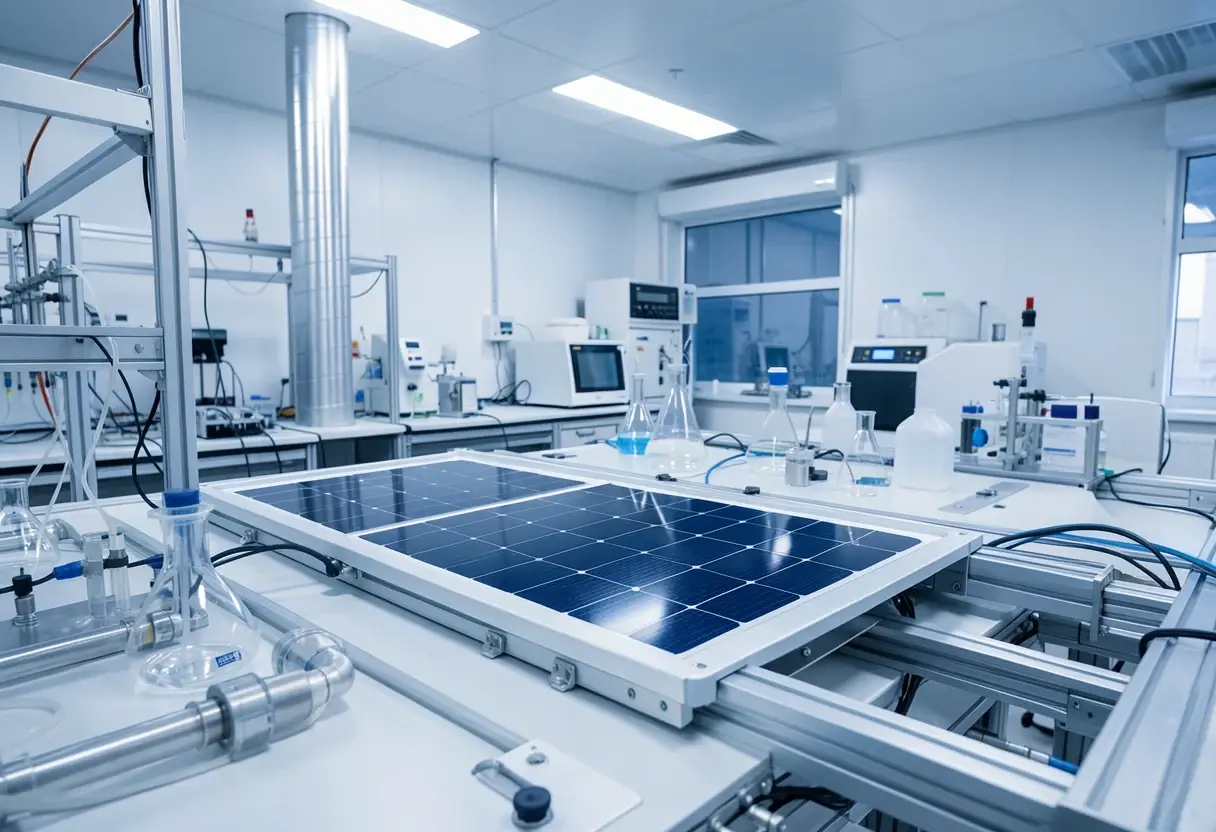
A perovskite solar cell built on liquid-healed crystals has reached 26.5% power conversion efficiency — 25.9% certified — along with a certified open-circuit voltage of 1.208 V, a record for devices with the same n-i-p architecture. The work, published in the journal Science, comes from a team led by professor Seong Sik Shin of the SKKU Advanced Institute of Nanotechnology (SAINT) at Sungkyunkwan University, working with the Korea Research Institute of Chemical Technology (KRICT), the University of California, San Diego, and Princeton University.
The numbers behind the efficiency gain are just as striking. The films showed a charge-carrier lifetime of roughly 295 microseconds — among the longest ever reported for perovskites. And surface recombination velocity, a measure of how many light-generated charges get lost at surface defects, fell to 0.3 cm/s, the lowest value on record for lead halide perovskites.
That last figure matters because it puts a cheap, solution-processed material in the same league as silicon. "We reduced the surface recombination velocity to 0.3 cm/s, the lowest reported for perovskite thin films, demonstrating that solution processing can achieve surface quality comparable to that of silicon," said Dr. Seongsik Nam of Sungkyunkwan University, co-first author of the study. "As we have also demonstrated strong performance over large areas, we expect this technology to help accelerate the commercialization of perovskite solar cells."
Why do perovskite films normally underperform?
Perovskites are cheap to make and simple to process, which is why they're leading candidates for next-generation solar cells and LEDs alike. The catch comes during manufacturing. When the liquid precursor solution solidifies into a film, microscopic crystal grains form and merge — and their seams, the grain boundaries and surfaces, tend to accumulate defects.
Those defects trap or destroy photogenerated charge carriers — the electrons and holes that carry current. The result is devices that lose performance and age faster than their raw material potential suggests.
How does the liquid trick fix it?
The team's solution borrows from metallurgy: the eutectic phenomenon, where a mixture of two substances melts at a far lower temperature than either component alone. The researchers combined methylammonium chloride (MACl) with a zinc halide (ZnX₂), two materials with relatively high individual melting points. Mixed together, the blend turns liquid at a much gentler temperature.
When the researchers warmed the perovskite film to around 100°C (212°F) — roughly the temperature of boiling water — the mixture sitting at the grain boundaries melted into a thin liquid layer. In liquid form, atoms diffuse about 10,000 times faster than in a solid. That speed lets small grains rapidly merge into larger, cleaner crystals with fewer defects.
The process is self-cleaning, too. MACl, which helps crystal growth, simply evaporates away during thermal annealing. The remaining zinc migrates to the grain boundaries and actively suppresses defects there. The result: films the authors describe as the highest quality reported to date for perovskite thin films, with surface quality comparable to the best passivated silicon.
One film, two devices
The efficiency headline isn't limited to solar power. The team built an LED with the exact same device architecture, and it hit an external quantum efficiency of 26.1% — a measure of how efficiently a device converts electrons into photons.
In other words, a single structure works both as a power generator that absorbs light and as a light emitter. Professor Shin framed the breakthrough in method terms: "This study is the world's first to develop a crystal-growth method based on a volatile eutectic mixture that fundamentally reduces defects in perovskites. Beyond realizing both a highly efficient solar cell and an LED within a single device architecture, the process requires no expensive specialized equipment."
He added that the approach should extend beyond solar cells and LEDs "not only in various optoelectronic devices, including displays and photodetectors, but also across the wider field of materials science."
Who did what
The study was jointly led by corresponding authors professor Shin, professor David P. Fenning of UC San Diego, and professor Dane W. deQuilettes of Princeton. Co-first authors are Nam, Dr. Jason J. Yoo of KRICT, and Dr. Connor J. Dolan of UC San Diego.
The paper appears as Jason J. Yoo et al., "Volatile eutectics to tailor crystallization for perovskite optoelectronics," Science (2026), DOI: 10.1126/science.aeb4554.
As always with lab-stage records, caveats apply: certified efficiency came in slightly below the lab measurement, at 25.9%, and long-term durability at scale remains the field's open question. But with no specialized equipment required and strong performance already shown over large areas, this liquid-assisted route marks a serious step toward commercial perovskite devices.
via phys.org/rss-feed/ (Source)
More from Nathan Brooks
Show full bio
Market editor covering companies, deals and strategy in general science news at SciBeat.
325 articles
Nearby plates
- Optical effects can mimic molecular changes in perovskites
- Atomic Motion Could Push Solar Cells Beyond Conventional Limits
- Perovskite quantum wells hold spins 300 times longer at room temperature
- Iodide Coating on Platinum Boosts Solar Hydrogen Output
- Caltech Chip Steers Light in 74 Femtoseconds Using Light Alone