Plate Nº 27 · recorded October 15, 2026
Space & AstronomyReported finding
Milky Way's Planetary Systems Sort Into Two Families, Study Finds
Astronomers studying 300 Milky Way planetary systems found two distinct families, set by host star mass: compact multi-planet systems or wide, unstable ones.
By Marcus Bennett4 min read728 words
In brief
- Astronomers studied 300 of the best-characterized planetary systems in the Milky Way.
- The peer-reviewed study appeared in Nature Astronomy on October 13, 2026.
- Less massive stars host compact systems with more, smaller planets; more massive stars host wider systems with fewer, heavier planets.
- Wider systems are unstable from birth, with collisions and ejections, according to INAF's Danae Polychroni.
- Co-authors include Diego Turrini (ISSI) and Camilla Danielski (University of Valencia).
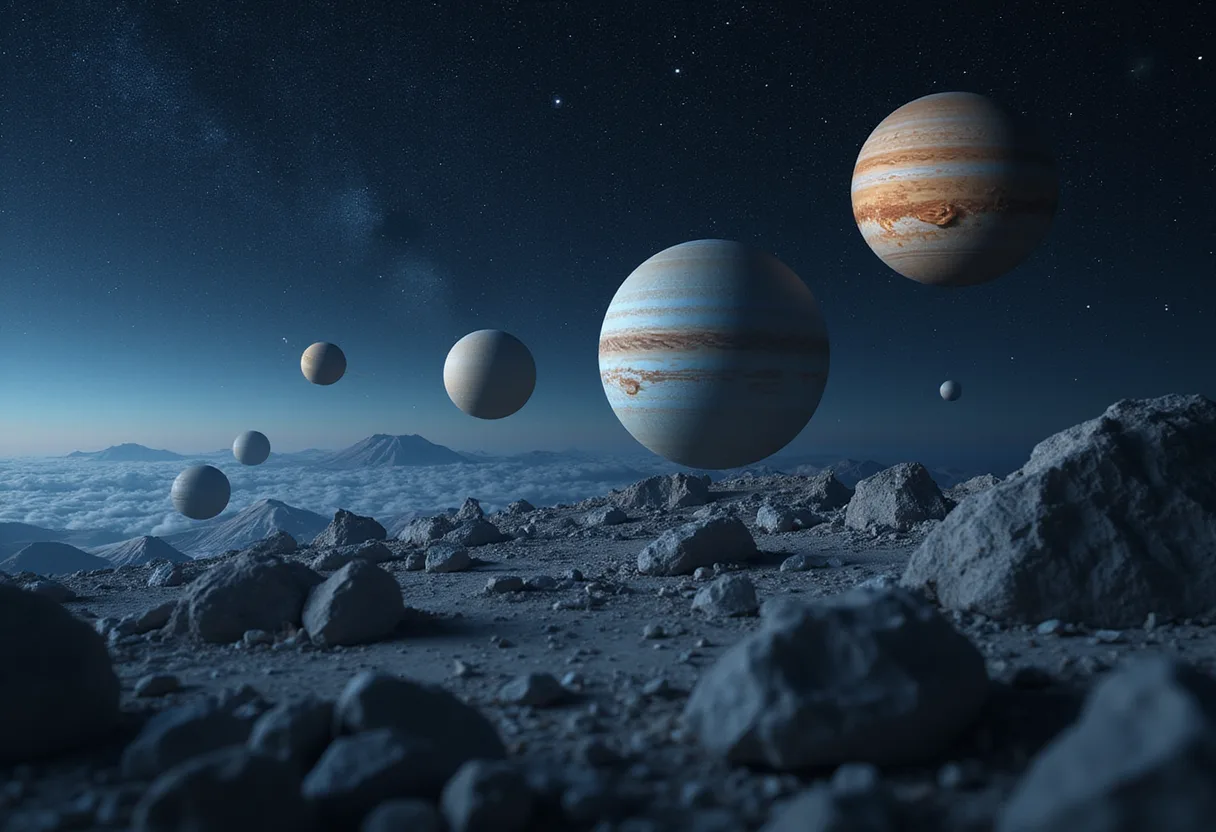
Astronomers have analyzed 300 of the best-characterized planetary systems in the Milky Way and concluded that they fall into two distinct families, each shaped by the mass of its host star. The team, from the International Space Science Institute (ISSI), announced the result on October 13, 2026, and published the study the same day in the peer-reviewed journal Nature Astronomy.
The finding matters for anyone who models how planets form. If the pattern holds, the star a planet orbits is not just a backdrop but a predictor of the system's mass, width, planet count and orbital history. That is a new constraint on formation models — and a shortcut for anyone hunting potentially habitable worlds.
What are the two families?
The researchers found that less massive stars tend to host planetary systems that are smaller in mass and width but contain more planets. More massive stars tend to host wider, more chaotic systems with fewer but heavier worlds. In plain terms: the amount of material in the cloud of gas and dust that forms the star appears to decide which family results.
The first family, the compact system:
- Host stars as massive as our sun, or less massive, with similar or lower amounts of heavy elements
- Planets that are less massive and similar to each other — the researchers call them "peas in a pod"
- Orbits packed tightly close to the host star
- A dynamic history that is less violent and closer to that of our solar system
The second family, the wider system:
- Host stars more massive than our sun, with a higher proportion of heavy elements
- Fewer but more massive planets
- Orbits that are wider and more varied
- A violent history with possible collisions and ejections
Not everything about the compact family is small. It tends to hold more planets than its wider counterpart, and its orderly layout leaves less room for gravitational upheaval.
Why do wider systems turn unstable?
The wider systems showed evidence of planetary collisions and ejections that left survivors on varied orbits. Danae Polychroni of INAF explained the mechanism:
"The scenarios that best reproduce the dynamical properties of the family of wide and massive systems are those in which the systems are unstable from birth. The greater abundance of material from which planets form around their host stars causes them to be born too large, preventing the system from remaining stable."
In other words, the same material surplus that builds big planets also destabilizes them. The planets that survive the resulting gravitational interactions end up scattered across more varied orbits.
What does the study change for practitioners?
The team framed the work around a long-standing question about whether planetary system traits are fixed at birth or sculpted by later evolution. Co-author Diego Turrini of the International Space Science Institute said:
"The fundamental question we started from was: What determines the characteristics of planetary systems as we see them today? Are they established at birth or sculpted by evolution over time? The truth, in the end, turned out to lie somewhere in the middle. Our results show that there is a genetic link between planetary systems and their stars, and that, depending on the star around which they are born, this link also determines their fate."
The authors flag a real limitation. Co-author Camilla Danielski of the University of Valencia said the hardest part of the analysis was "determining whether the two families of planetary systems were real or just an illusion created by the technological limits of current observational techniques." Selection effects, she said, ultimately acted as "the tip of the iceberg, revealing the existence of much deeper structural diversities between these systems."
That caveat is worth keeping in view. The sample covers 300 well-characterized systems, and the two-family split emerged after the researchers worked to separate real structure from observational bias — but preliminary patterns in a finite sample can shift as detection techniques improve.
What comes next?
The astronomers hope that understanding which stars produce which planetary systems will sharpen the search for planets that could host life. If a star's mass and heavy-element content predict the architecture around it, observers can target the compact, orderly family — the one closest to our own solar system's layout — with more confidence.
The host star, it seems, signs its name on everything that orbits it.
via nature.com (Original)
More from Marcus Bennett
Show full bio
News editor covering regulation, policy and their impact on general science news at SciBeat.
252 articles
Nearby plates
- Star Caught Slowly Snacking on a Brown Dwarf 300 Light-Years Away
- MIT Team Finds a Star Slowly Eating Its Companion for Billions of Years
- Hubble Finds Stellar Winds Weaken Sharply in 29 Metal-Poor Stars
- Millions of Planets Could Orbit Supermassive Black Holes, Simulations Show
- A Star Is Slowly Eating Its Companion — and Could for Billions of Years