Plate Nº 21 · recorded October 10, 2026
Chemistry & MaterialsReported finding
MIT Team Turns Ammonia Into Pure Hydrogen at 200–300°C
MIT researchers used electricity to extract high-purity hydrogen from ammonia at 200–300°C, far below conventional cracking temperatures, publishing the results in Nature.
By Elena Vasquez4 min read871 words
In brief
- MIT's electrochemical method extracts pure hydrogen from ammonia at about 200–300°C, versus over 500°C for conventional cracking.
- The study, led by Rui Zeng and corresponding author Yogesh Surendranath, appears in the journal Nature.
- The system couples a palladium separation membrane with a hydrogen-generating electrode through a molten hydroxide electrolyte.
- The method also works on methylcyclohexane, a liquid organic hydrogen carrier.
- The U.S. National Science Foundation funded the research.
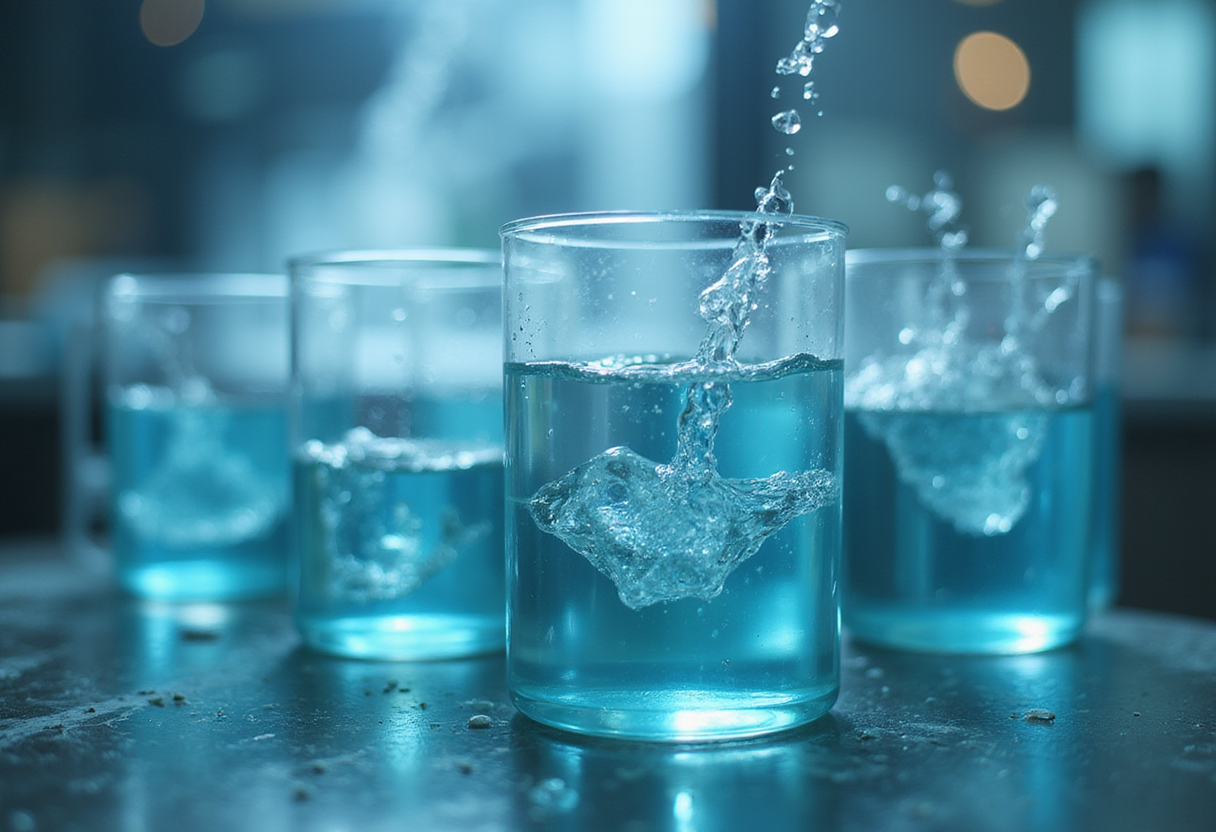
MIT researchers have shown that electricity can pull pure hydrogen out of ammonia at roughly 200 to 300 degrees Celsius — several hundred degrees cooler than the 500-plus degrees that conventional ammonia cracking demands. In a study published in Nature, they demonstrate a single electrochemical process that both extracts the hydrogen and concentrates it into a high-purity stream, with no separate purification step.
For anyone hoping to build a hydrogen economy, that combination matters. Hydrogen powers fuel cells, semiconductor fabrication lines, and chemical plants, but the gas itself is awkward to move. Compressing or liquefying it is expensive and energy-hungry. Storing hydrogen inside a liquid chemical — and releasing it only where and when it is needed — has long looked like the practical alternative.
Why is ammonia a promising hydrogen carrier?
Ammonia (NH₃) is already produced and shipped over long distances at industrial scale as a liquid, which makes it an attractive delivery vehicle for hydrogen. The problem comes at the destination. "Cracking" ammonia into hydrogen and nitrogen conventionally requires temperatures above 500 degrees Celsius to reach useful reaction rates. Even then, the output is a mixture: the hydrogen must be separated from nitrogen and any unreacted ammonia before it can feed a fuel cell or a chip fab.
"We wanted to ask whether we could use electrical inputs to drive what would otherwise be an unfavorable dehydrogenation reaction, and simultaneously do it in a way that would separate the hydrogen from the hydrogen carrier, so that it would be very pure and could be used directly in a fuel cell," says Yogesh Surendranath, the Donner Professor of Science and professor of chemistry and chemical engineering at MIT and the study's corresponding author.
How does the electrochemical pump work?
The design couples three components:
- A ruthenium-cesium catalyst that breaks the ammonia apart, releasing hydrogen.
- A palladium-based membrane that lets only hydrogen pass through, blocking everything else in the reaction mixture.
- A molten hydroxide electrolyte — a hot, salt-like conductor — on the far side of the membrane.
The electrochemical gradient across the membrane acts like a vacuum cleaner for hydrogen: it pulls the gas through, splits it into protons and electrons, and sends those particles along two different paths. Protons travel through the molten electrolyte; electrons flow through an external circuit. At a second electrode, the two recombine as pure hydrogen gas.
"Using this electrochemical process, we're able to do this active pumping of hydrogen from a low concentration to a high concentration," Surendranath says. Because the membrane is selective, the system produces a concentrated hydrogen stream directly — no downstream purification, and no extra energy bill for that step.
The pumping does a second job as well. Continuously removing hydrogen shifts the reaction environment, pushing the dehydrogenation forward even in conditions where accumulated hydrogen would normally slow it down. That is what allows the process to run at 200–300 degrees Celsius instead of above 500.
What did the study actually demonstrate?
In the Nature paper, the researchers — led by first author Rui Zeng, an MIT postdoc who is now a professor of materials science and engineering at Harbin Institute of Technology in Shenzhen, China — show the approach generating highly concentrated, pure hydrogen streams from two different carriers:
- Ammonia, the industrially established option.
- Methylcyclohexane, a member of a class of compounds called liquid organic hydrogen carriers (LOHCs), which store hydrogen in liquid form.
The team sees the technique serving transportation — cars, buses, ships — as well as semiconductor and electronics manufacturing, where pure hydrogen raises production yields and reduces surface defects.
"We have shown the ability to use electrochemistry to drive thermodynamically uphill and kinetically difficult dehydrogenation reactions," Surendranath says. "The concepts we learned here could in principle be translated further, and we're actively working on translating it to other important dehydrogenation reactions."
What are the limitations?
The work is a laboratory demonstration, and two practical hurdles stand out. Palladium, the membrane's key material, is an expensive precious metal, so the researchers are now working on ways to cut how much of it the design needs. They are also tackling the engineering challenge of scaling the process up from the bench to industrial sizes, and extending it to other dehydrogenation reactions of industrial interest.
Independent experts see real promise. Curtis Berlinguette, a professor of chemistry and chemical and biological engineering at the University of British Columbia who was not involved in the research, called the method "a powerful new way" to obtain pure hydrogen from ammonia and other carriers.
"By using electricity to pull hydrogen through the membrane as it is released, they accelerate the dehydrogenation of ammonia and liquid organic hydrogen carriers while simultaneously producing a purified hydrogen stream," Berlinguette says. "This is an important advance for the energy sciences because it opens a credible pathway for transporting hydrogen in stable chemical carriers and releasing it where and when it is needed."
The U.S. National Science Foundation funded the research. Whether the process can escape the lab and reach fueling stations and fabrication plants will depend on the answers to the cost and scale-up questions the MIT team is now chasing — but the chemistry, at least, now has a working proof of concept.
via MIT News (Source)
More from Elena Vasquez
Nearby plates
- Palladium Membrane Lets Hydrogen Through and Keeps Water Out
- New Electrode Design Breaks Energy Barrier in Green Ammonia Production
- Iodide Coating on Platinum Boosts Solar Hydrogen Output
- Sulfur-Powered Material Splits Water Into Hydrogen Using Sunlight
- Porous Crystals Could Triple How Long Liquid Hydrogen Lasts in Tanks