Plate Nº 79 · recorded October 10, 2026
Space & AstronomyReported finding
NASA Backs Mission to Probe Mysterious Moon Pit for Hidden Cave
NASA selected a Planetary Science Institute-led project on October 5, 2026, to determine whether the Marius Hill Pit on the Moon opens into an underground lava tube, with findings relevant to lunar geology and future astronaut shelter.
By Priya Raman3 min read654 words
In brief
- NASA selected the GIMLI project on October 5, 2026, led by Than Putzig of the Planetary Science Institute.
- GIMLI will deploy four instruments at the Marius Hill Pit: ground-penetrating radar, active-source seismic sensors, a gravimeter, and cameras.
- Partners include Honeybee Robotics (a Blue Origin company), the Norwegian Space Agency, Boise State University, Johns Hopkins University, the Lunar and Planetary Institute, and the University of Oslo.
- Active-source seismic methods have not been used in planetary science since NASA's Apollo missions conducted the first lunar seismic surveys.
- Lava tubes could provide astronauts natural radiation shielding and a record of the Moon's volcanic past preserved in exposed pit walls.
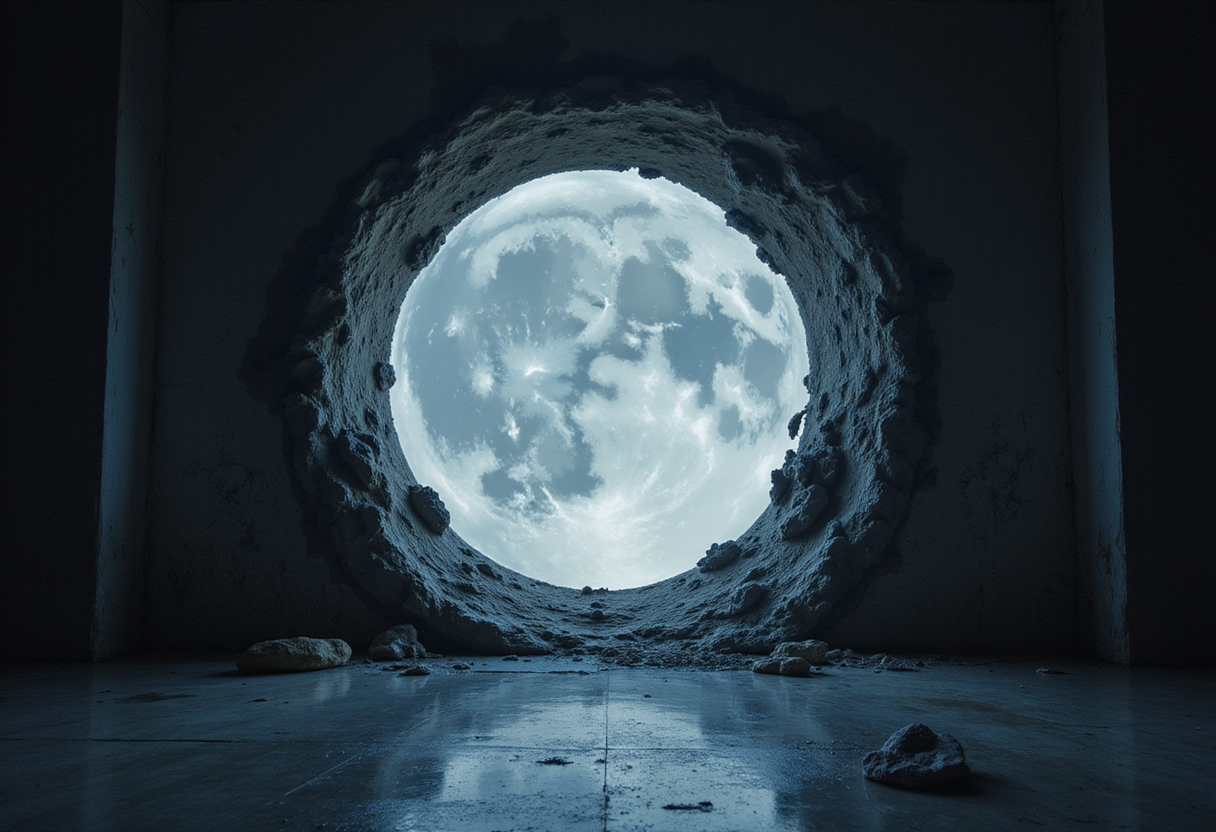
NASA selected a Planetary Science Institute-led project, announced October 5, 2026, to determine whether the Marius Hill Pit on the Moon opens into an underground lava tube. The mission, called GIMLI, will send ground-penetrating radar, seismic sensors, and a gravimeter to the lunar surface.
What is the Marius Hill Pit?
The Marius Hill Pit is one of several openings on the Moon that may lead into ancient volcanic tunnels known as lava tubes. It sits within one of the most volcanically varied regions of the lunar surface. Its walls already expose layers of regolith and buried lava flows.
If a lava tube extends from the opening, researchers believe it could rival similar features on Earth in size, though no direct measurement exists yet.
How will GIMLI search beneath the surface?
GIMLI — short for Geophysical Instruments for Marius Lunar pit Investigation — combines four measurement techniques on a single lander-and-rover payload:
- Ground-penetrating radar to map structures below the regolith
- Active-source seismic sensors that generate their own vibrations, a technique not used in planetary science since NASA's Apollo missions
- A gravimeter to detect density anomalies that suggest hidden voids
- Cameras to photograph the pit walls and surrounding terrain
Honeybee Robotics, a Blue Origin company, will build much of the hardware. The Norwegian Space Agency will provide the ground-penetrating radar. Co-Investigators come from Boise State University, Johns Hopkins University, the Lunar and Planetary Institute, and the University of Oslo.
The full payload rides on a lander and rover supplied through NASA's Commercial Lunar Payload Services (CLPS) initiative, under the Payloads and Research Investigations on the Surface of the Moon (PRISM) program.
Could the mission matter even without a cave?
Yes. Even if GIMLI finds no lava tube, its measurements will address a separate question: how did the Marius Hill Pit form? The walls expose rock layers normally buried deep in the crust.
"Confirming a substantial lava tube would give us an insight into how volcanism operated on the Moon," said Gareth Morgan, PSI Senior Scientist and Deputy Principal Investigator on GIMLI.
"Lava tubes are a common feature of basaltic volcanism on Earth, so identifying them on the Moon means we could use knowledge of such terrestrial caves to better understand lunar history," Morgan added.
Who leads the project?
Than Putzig, PSI Associate Director and Senior Scientist, heads the investigation.
PSI Director and CEO Amanda Hendrix framed the project as a logical next step after years of orbital work. "GIMLI represents the type of ambitious planetary science that PSI was built to pursue," Hendrix said.
"Than and his team are taking a scientific question we've been studying from orbit and have developed a way to investigate it directly on the Moon," she added.
Putzig emphasized the personal appeal of reviving a dormant technique. "It's long been a desire of mine to reintroduce intentional active-source seismic methods to planetary science, as it has essentially not been done since the Apollo astronauts conducted the first seismic surveys on the Moon," he said.
"Combining that method with ground-penetrating radar and gravity measurements makes it all the more exciting," Putzig added, "as these methods together will allow us to get a much better understanding of subsurface properties — including the anticipated detection of a lava tube extending away from the Marius Hills pit."
Why do lunar caves matter for astronauts?
A confirmed lava tube would solve a practical problem for crewed missions. The lunar surface exposes astronauts to radiation and dramatic temperature changes between day and night.
Underground voids maintain a roughly constant temperature and block radiation. They could shelter crews without hauling heavy building materials from Earth.
The mission could also reshape how scientists study the Moon's volcanic history. Researchers can examine the exposed layers in the pit walls to determine how lava flowed across and beneath the surface and whether individual eruptions were separated by long intervals.
via psi.edu (Original)
More from Priya Raman
Show full bio
Senior reporter covering industry trends and analytics at SciBeat.
207 articles
Nearby plates
- NASA Picks PSI-Led Team to Probe Possible Cave Beneath Lunar Pit
- NASA Picks Three Missions to Find Caves, Ice and Hazards for First Moon Base
- Apollo 14 and 16 sampled unusually thin lunar soil
- MOONS instrument captures first observations at Paranal Observatory
- Asian Water Tower Loses 24 Billion Tonnes of Groundwater a Year