Plate Nº 53 · recorded October 10, 2026
Science Policy & FundingReported finding
NSF commits $90 million to three new science and technology centers
The NSF will invest $90 million over five years to launch three new Science and Technology Centers tackling turbulence, 3D DNA organization, and human-robot adaptation, with about $6 million annually each.
By James Calloway3 min read554 words
In brief
- NSF will invest $90 million over five years across three new Science and Technology Centers.
- Each center will receive approximately $6 million annually for an initial five-year period, with the option to compete for five more years.
- TEMPEST at Michigan State University will study turbulence for fusion energy and national security applications.
- GENIE at Northwestern University will engineer the 3D organization of DNA to counter diseases including Alzheimer's, cardiovascular disease, and cancer.
- The NSF STC program has operated continuously since 1987.
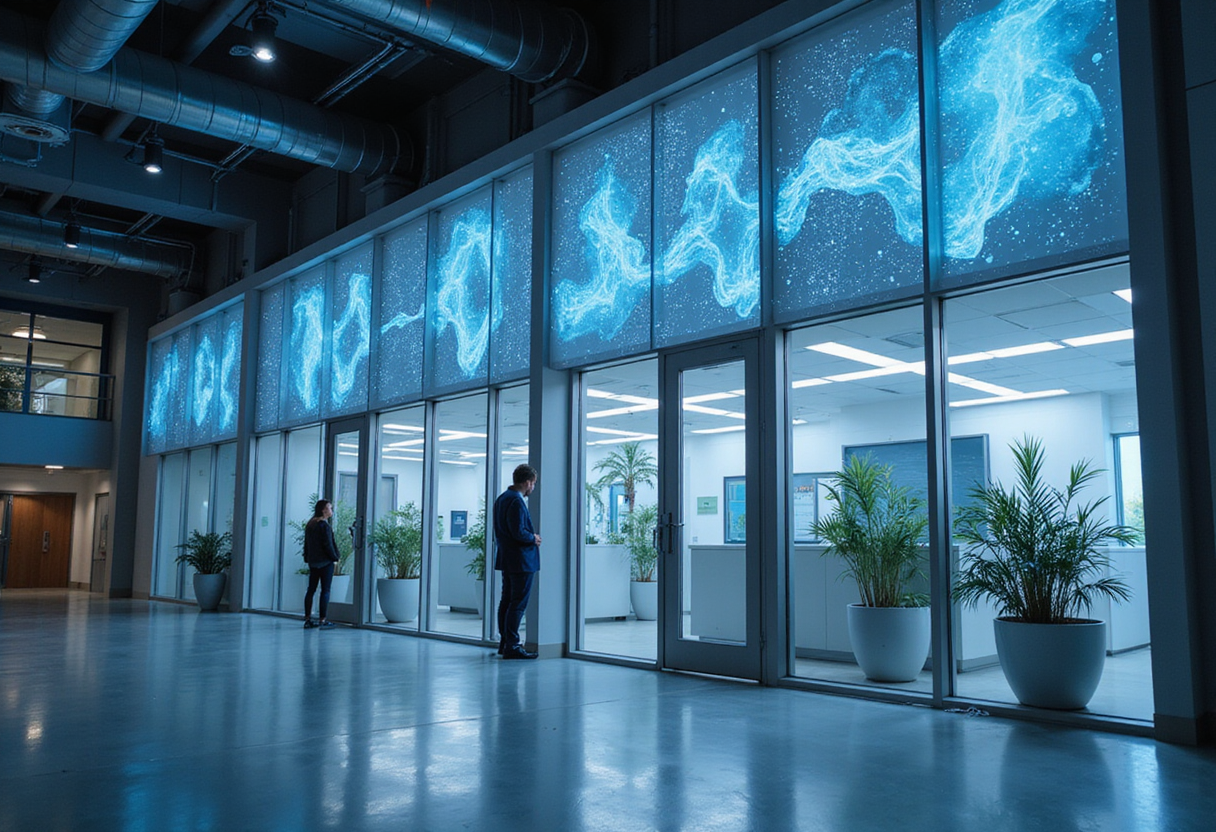
The U.S. National Science Foundation will spend $90 million over five years to launch three new Science and Technology Centers focused on turbulence, genome engineering, and human-robot collaboration.
Each center will receive about $6 million per year for an initial five-year period and may compete for up to five additional years of support. The funding was announced as part of the foundation's 2026 STC class.
"Maintaining the United States' leadership in science and technology requires bold research, strong partnerships, and a skilled workforce," said Brian Stone, who is performing the duties of NSF Director. "These Science and Technology Centers will help American researchers seize those opportunities, accelerate scientific discovery, and develop the talent and technologies needed to turn innovation into solutions that benefit the American people."
What will the turbulence center investigate?
The Center for Transformative Explorations in Multi-Physics and Engineering of Scientific Turbulence (TEMPEST) will operate from Michigan State University. Its researchers will tackle turbulence — the chaotic, multiscale motion of fluids and plasmas that remains one of physics' hardest problems.
Turbulence plays a critical role in fusion energy and national security applications. Despite decades of work, scientists still cannot reliably predict how complex turbulent systems behave across vastly different scales.
TEMPEST will combine advanced experiments, mathematical modeling, high-performance computing, and AI. The team aims to build more accurate, physics-grounded models that could speed fusion energy development and strengthen the scientific foundations of national security technologies.
How will the genome center approach cell aging?
The Center for Genome Intelligence Engineering (GENIE), led by Northwestern University, will focus on the three-dimensional organization of DNA inside cells. That physical arrangement helps determine each cell's identity and function.
Disruptions in 3D DNA organization contribute to illnesses including Alzheimer's disease, cardiovascular disease, and cancer. GENIE researchers plan to develop new tools for 3D DNA engineering.
Their long-term goal: help cells and tissues withstand damage, restore lost functions, and return to a healthier state. The center expects its work to drive advances in biotechnology and biomedicine.
Why study robots that adapt to people?
The Center for Human and Robot Co-Adaptation, based at the University of Texas at Austin, will explore how robots and humans can securely adjust to one another as service and assistive robots spread into homes, hospitals, workplaces, and public spaces.
Researchers will combine robotics, AI, and human-factors engineering. They want robots with what the NSF calls "embodied intelligence" — systems that can learn from people, read their needs, and physically and cognitively adapt to changing environments and different users.
The center's near-term applications include independent living, healthcare, and other human-centered services.
A program with a long track record
The NSF STC program began in 1987. Since then, its centers have helped spawn new fields, catalyzed industry partnerships, advanced breakthrough technologies, and trained generations of students and researchers.
STCs support large-scale, transformational research that opens new areas of discovery. By linking universities, national laboratories, industry, and government partners, the centers tackle high-risk challenges that single labs cannot.
The 2026 class aligns with recent White House and Office of Science and Technology Policy guidance, including "Fiscal Year 2027 Administration Research and Development Budget Priorities and Cross-Cutting Actions" and "Ushering in a New Golden Age of American Innovation: Fiscal Year 2028."
via whitehouse.gov (Original)
More from James Calloway
Show full bio
Staff writer covering marketplaces and e-commerce at SciBeat.
205 articles
Nearby plates
- NSF Unveils New Metascience Office and $300 Million X-Labs Push
- NSF Names Three X-Labs Topics, Opens AI-for-Physical-Systems Call
- National Science Foundation's Future in Limbo as Trump Eyes Cuts
- NSF Trims Hundreds of Science Programs by Up to 30%
- NSF Reportedly Cuts Research Programs to Fund New Tech Initiative