Plate Nº 77 · recorded October 12, 2026
PhysicsReported finding
Nuclear Clock in Vienna Hits One-Second-in-30-Million-Year Precision
Researchers in Vienna built the world's first self-stabilizing nuclear clock, precise to about one second per 30 million years, though optical atomic clocks still lead.
By Nathan Brooks3 min read585 words
In brief
- The Vienna-built nuclear clock achieves precision of roughly one second lost per 30 million years.
- It is the world's first self-stabilizing nuclear clock.
- The clock still trails the best optical atomic clocks in precision.
- Laser frequency shifts directly affect the clock's rhythm, so self-stabilization is the key innovation.
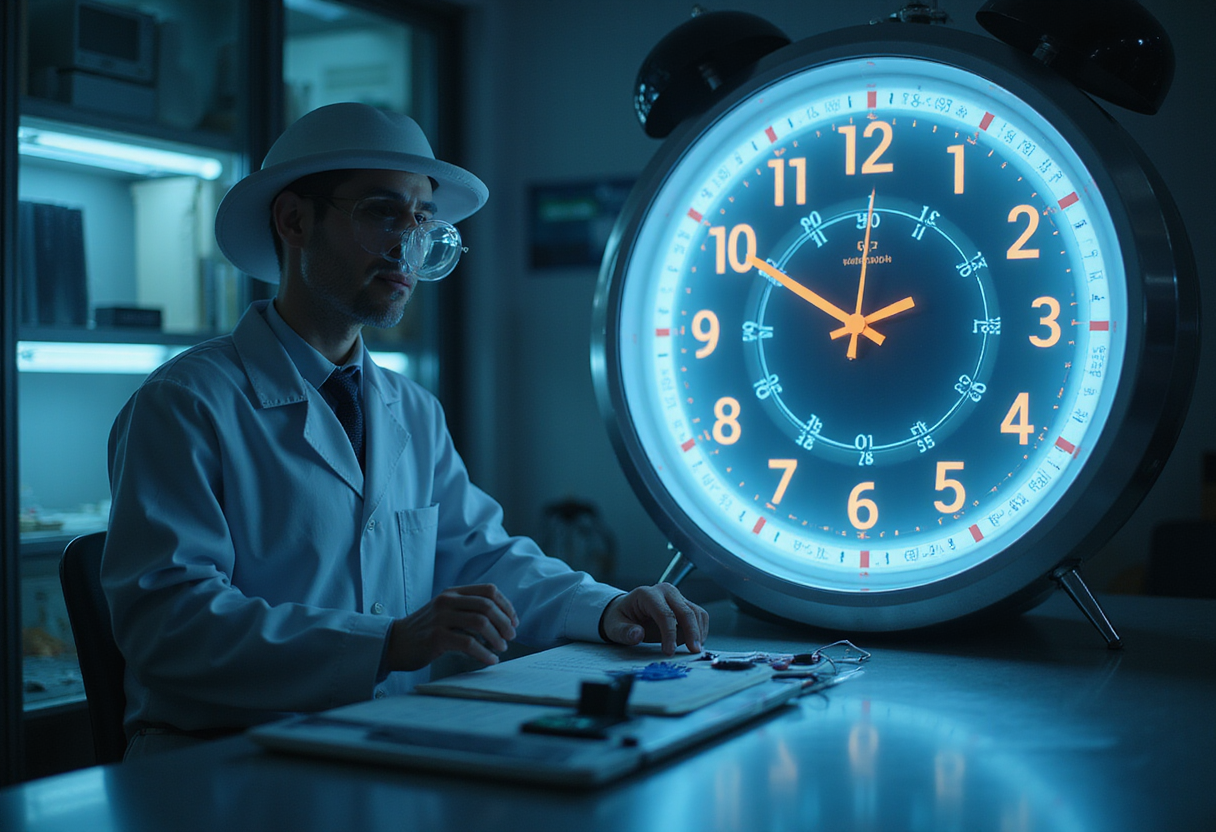
A new nuclear clock built in Vienna keeps time with a precision equivalent to losing roughly one second every 30 million years. The device is the world's first self-stabilizing nuclear clock, and it represents a major step toward a new generation of timekeeping technology.
The achievement, reported by researchers in Vienna, pushes nuclear clockmaking from a theoretical concept into working hardware. Still, the new clock does not yet outperform the best conventional atomic clocks, which remain the most precise timekeeping devices ever built.
What makes this clock "nuclear"?
Most ultra-precise clocks today are atomic clocks. They rely on electrons in atoms responding to light at extremely well-defined frequencies, and lasers tuned to those frequencies act as the clock's ticking mechanism.
A nuclear clock works differently. Instead of tracking transitions of electrons, it tracks transitions inside the atomic nucleus — the dense core of the atom. Nuclear transitions are, in principle, far less sensitive to external disturbances such as stray electromagnetic fields, which is why scientists have long pursued them as a route to even more stable timekeeping.
The Vienna team has now demonstrated this approach in a self-stabilizing device — a clock that can correct its own drift without constant external adjustment.
Why is laser stability the central problem?
For any clock driven by laser light, precision lives and dies with the laser. Even a slight shift in the laser's frequency changes the clock's rhythm, much as a slightly stretched spring would change the pace of a mechanical watch.
The researchers tackled this by designing a system in which the clock continuously monitors its own timing and feeds corrections back to the laser. This self-stabilization is what allows the Vienna device to hold its extraordinary precision — about one second of drift over 30 million years — without falling out of step.
How does it compare with existing clocks?
Despite the headline figure, the new nuclear clock still trails the best optical atomic clocks, which currently define the frontier of precision timekeeping.
That gap matters for context. Optical atomic clocks, which use visible light rather than microwaves to drive their ticking, already achieve stability at or beyond the level demonstrated in Vienna. The significance of the nuclear result is therefore not that it breaks a precision record — it does not — but that a fundamentally new type of clock now works at a competitive level for the first time.
What could more precise clocks enable?
Ultra-precise clocks are not just laboratory curiosities. They already underpin satellite navigation systems, telecommunications networks, and financial timestamping. Devices with still greater stability could sharpen all of these applications.
Nuclear clocks hold particular scientific promise because nuclear transitions are less easily disturbed than electronic ones. In principle, that robustness could allow clocks to run more reliably in real-world conditions, and could let researchers use clocks as sensitive probes of fundamental physics — for example, testing whether the constants of nature drift slowly over time.
How preliminary is the result?
The Vienna device is a first-generation prototype, and the field is young. Researchers will need to refine the laser systems and the stabilization techniques before nuclear clocks can challenge optical atomic clocks for the title of the world's most precise timekeeper.
For now, the milestone stands on its own terms: a self-stabilizing nuclear clock, built and demonstrated for the first time, already keeping time to within a second over 30 million years. The race to build a better clock has a new contender.
via google.com (Original)