Plate Nº 19 · recorded November 15, 2026
Science Policy & FundingReported finding
Scientists Call for a Moratorium Before Lunar Industry Takes Off
Researchers propose a temporary halt to lunar industrialization, warning that early infrastructure could lock in unfair access and cause irreversible damage.
By Priya Raman3 min read638 words
In brief
- Florian Rabitz (Vilnius University) and Xiao-Shan Yap (Utrecht University) published their case for a lunar moratorium in Global Environmental Politics.
- International space law already prohibits national sovereignty claims over the Moon.
- The proposal targets four concerns: environmental protection, scientific research, cultural significance and fair resource access.
- No lunar project has yet been shown to cause damage; the paper is a policy argument about future risk.
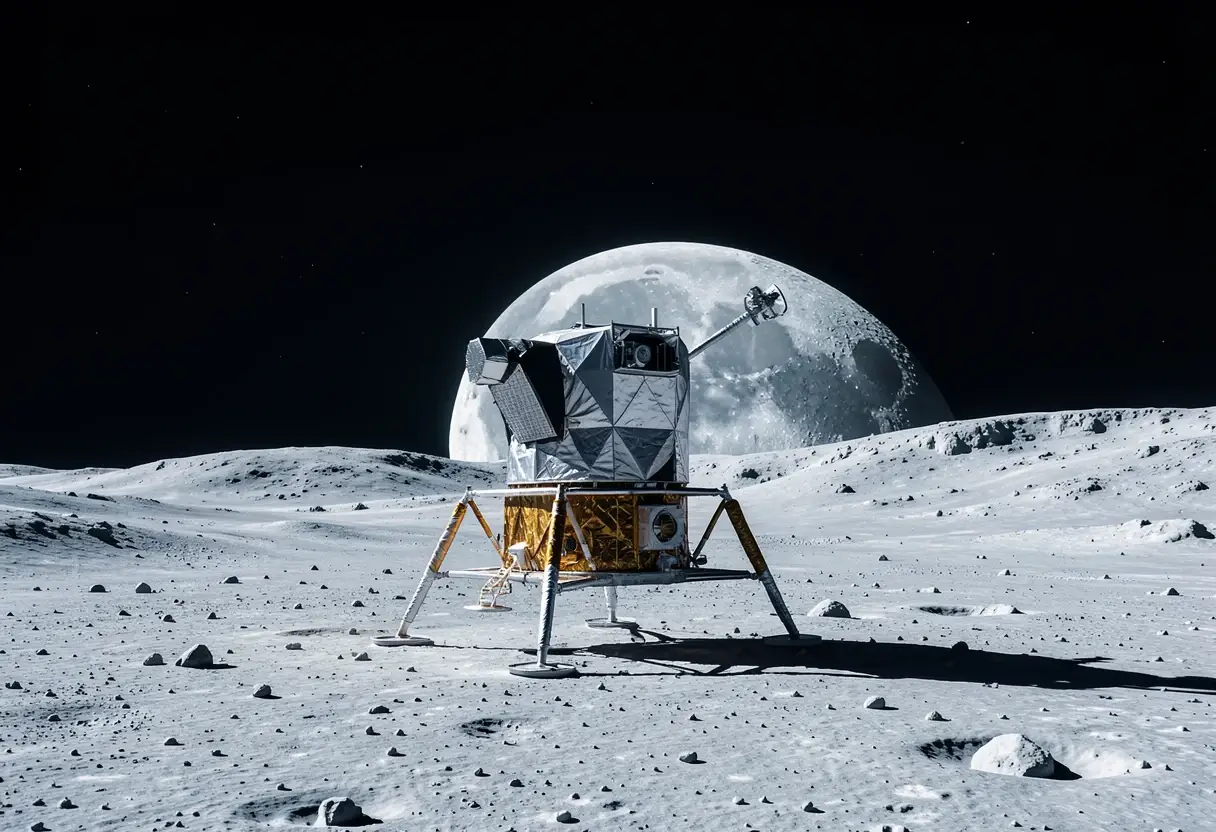
Two researchers are calling for a temporary halt to large-scale lunar development, warning that irreversible damage to the Moon could occur before humanity agrees on any meaningful rules. Their proposal, published in the journal Global Environmental Politics, arrives as several countries and private companies prepare to build new infrastructure on the lunar surface.
Florian Rabitz of Vilnius University and Xiao-Shan Yap of Utrecht University examined the risks of lunar industrialization and the case for a moratorium, defined as a temporary suspension of activity. Their argument rests on four pillars: environmental protection, scientific research, cultural significance and fair access to resources.
Why does a barren Moon need environmental protection?
The Moon has no forests or oceans, but that does not mean industrial activity would be harmless. Large projects could permanently alter important sites and interfere with ongoing scientific investigations. The researchers point to features that plants and animals do not define: geological records, undisturbed surfaces and locations suitable for astronomy may all be difficult or impossible to restore once changed.
A place does not need living things to carry environmental value. Once a pristine stretch of lunar regolith (the loose material covering the Moon's bedrock) is bulldozed or a scientifically rich site is occupied, no treaty can rebuild it.
Who gets the best spots on the Moon?
Some lunar sites are especially attractive because of their access to sunlight, resources or scientific features. If several missions want the same location, early decisions about access could have consequences far beyond any single project.
The researchers raise a familiar concern: countries or companies that build major facilities first could gain practical advantages over everyone else. International space law prohibits nations from claiming sovereignty over the Moon, yet the authors argue that existing arrangements may not prevent powerful players from dominating access through infrastructure alone.
In practice, possession may accomplish what law forbids. Whoever constructs the first permanent facilities at the most desirable locations could control them without ever filing a territorial claim.
What would a moratorium actually do?
A temporary pause, the authors suggest, would give governments, scientists and the public time to debate which activities are acceptable and to develop clearer safeguards. They frame the Moon's value in broad terms: its shared importance to people around the world is not limited to the minerals or other resources that could eventually be extracted.
Implementing the pause would require political agreement and careful definitions of which activities fall under it. The researchers acknowledge that securing cooperation among major space powers would be difficult. Supporters may see the moratorium as a chance to set fair rules; others may worry that restrictions could delay exploration and useful research. Those trade-offs remain part of an open policy debate.
The authors insist that public participation matters regardless. Decisions about the Moon, they argue, should not be left entirely to the governments and companies with the resources to reach it first.
How firm is the evidence behind the warning?
This is a policy proposal, not an experimental finding. No specific lunar project has yet been shown to cause damage. The paper is an argument about future risk, and its central claim is that decisions made now could determine who benefits from the Moon and what future generations are able to study.
The limitations are real. A moratorium depends on voluntary buy-in from states whose interests may diverge sharply, and the paper offers no enforcement mechanism beyond international negotiation. Its power lies in framing the question rather than resolving it.
The stakes come down to timing. The central question, as the authors pose it, is whether humanity can develop space responsibly before irreversible choices are made — and they believe the debate needs to happen while there is still time to set meaningful limits.
The window is open, for now.
By Priya Raman
via knowridge.com (Source)
More from Priya Raman
Show full bio
Senior reporter covering people, launches and day-to-day practice in general science news at SciBeat.
402 articles