Plate Nº 20 · recorded October 10, 2026
Space & AstronomyReported finding
Sunflower antenna layout fails key test for SKA-Low telescope
A 256-antenna prototype in Western Australia confirmed a 125 MHz sensitivity dip, forcing engineers to abandon the sunflower-inspired Vogel layout for SKA-Low.
By Marcus Bennett3 min read685 words
In brief
- Engineers ruled out the sunflower-inspired Vogel layout after tests confirmed a sensitivity loss at 125 MHz.
- The AAVS3 prototype in Western Australia tested 256 dual-polarized antennas under real-sky conditions.
- SKA-Low will link 512 stations across roughly 75 km and observe frequencies from 50 to 350 MHz.
- Repeated antenna spacings of about 2.4 meters caused interference patterns that reduced sensitivity.
- The findings, published in 2026, informed the modified 'Perturbed Vogel' layout and the AA0.5 construction milestone.
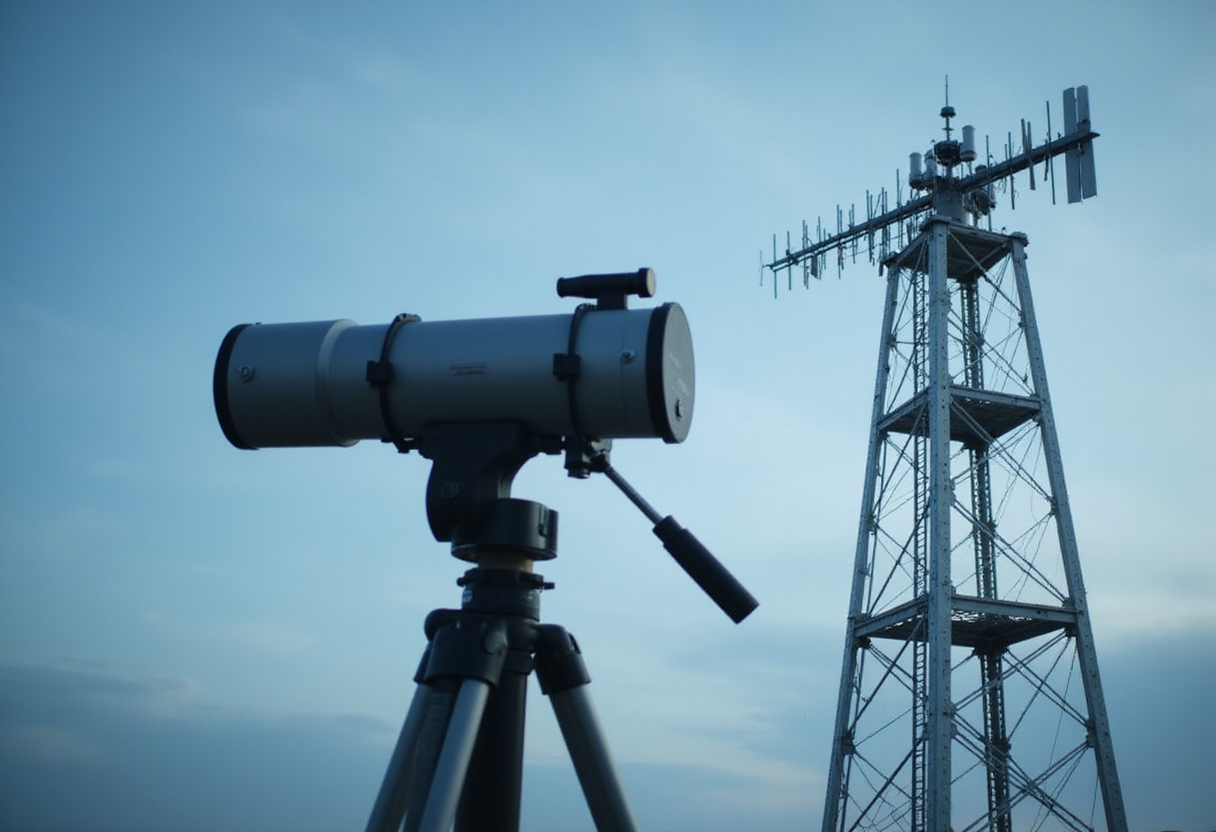
Engineers have ruled out a sunflower-inspired antenna layout for the SKA-Low radio telescope after a prototype test confirmed a built-in sensitivity loss at 125 MHz. The finding, from a real-sky test of a 256-antenna prototype station in Western Australia, means the world's most sensitive low-frequency radio telescope will be built with a modified design instead.
The results appear in the Journal of Astronomical Telescopes, Instruments, and Systems, in a study led by Dr. Shin'ichiro Asayama of the SKA Observatory.
What is SKA-Low and why does antenna placement matter?
SKA-Low is a radio telescope now under construction in Western Australia. It will observe frequencies between 50 and 350 MHz, and when finished it will link 512 stations spread across an area roughly 75 km (47 miles) wide. Within each station, many small antennas work together as if they were a single large dish, so the arrangement of antennas directly shapes what the telescope can detect.
Antennas placed too close together can interfere with one another — a problem radio engineers call mutual coupling. This interference grows stronger below about 150 MHz, squarely within SKA-Low's operating range.
Why copy a sunflower?
An earlier prototype station, called AAVS2, scattered its antennas in a pseudo-random pattern to avoid unwanted signal artifacts. To better control mutual coupling, researchers at the observatory proposed something more elegant: a spiral pattern modeled on the seed arrangement in a sunflower head, known as the Vogel layout. Spacing antennas this way should reduce interference between neighbors while keeping the station's collecting power intact.
To test the idea under real conditions, the SKA Observatory built a new prototype station, AAVS3, with 256 dual-polarized antennas arranged in the sunflower pattern. The team tested it both as a signal-combining beamformer and as an imaging array, pointing it at the sun, bright cosmic radio sources, the galactic plane and several pulsars.
The researchers also developed two ways to calibrate the station — that is, to correct the raw data so they accurately reflect the sky. The simpler method used the sun as a known reference point. The more thorough approach combined the sun with a sky-brightness model and detailed antenna response profiles, and unlike the sun-only method, it also worked at night.
What went wrong at 125 MHz?
Simulations run while AAVS3 was being built predicted a loss of sensitivity directly overhead at around 125 MHz. The team traced the cause to repeated antenna spacings of about 2.4 meters (8 feet) throughout the sunflower pattern. These repeating distances create interference patterns that reduce sensitivity. The older, scattered AAVS2 layout showed no such problem.
Observations confirmed the prediction. When the galactic plane passed directly overhead, the images clearly showed the same dip in sensitivity at 125 MHz. That confirmed the problem was a built-in consequence of the antenna geometry, not a flaw in the equipment or in the analysis method.
A separate check of sensitivity at 230 MHz showed the more thorough calibration method worked well: nighttime measurements closely matched predictions. Daytime measurements showed larger gaps, most likely because unusually high solar activity during the observations made the sun's brightness harder to predict accurately.
What happens next?
Because of the confirmed sensitivity loss, engineers ruled out the original sunflower layout for the finished telescope. Further simulations led them to a modified version, called "Perturbed Vogel," which keeps antennas spaced far enough apart to avoid mutual coupling while removing the repeating pattern that caused the 125 MHz dip. Testing that new layout falls outside the current study.
Even so, the AAVS3 results give SKA-Low's teams practical guidance for building and calibrating stations during construction. Combined with lessons from AAVS2, this work has directly shaped the observatory's testing process and supported a key construction milestone, known as AA0.5, which marks the first stations coming online.
The study demonstrates a broader point for instrument builders: a design that looks optimal in theory and in simulation still needs on-sky verification before it is locked into a multi-year construction campaign.
via Phys.org Space & Astronomy (Source)
More from Marcus Bennett
Nearby plates
- Twelve dying radio galaxies spotted fading faster than expected
- First 'Quadruple-Double' Radio Galaxy Found with Four Jet Bursts
- A Mysterious Radio Signal Pointed at a Super-Earth. Was It Aliens?
- Heavy methanol turns up around a baby star 1,000 light-years away
- Astronomers find what may be the most powerful radio galaxy ever