Plate Nº 12 · recorded November 17, 2026
PhysicsReported finding
Two Atomic Clocks, One Mountain, and 25 Nanoseconds a Day
NIST physicists hauled an optical clock above 4,300 meters on Mount Blue Sky to measure gravitational redshift—25 nanoseconds per day—in a possible record-setting test of Einstein.
By James Calloway4 min read814 words
In brief
- A clock 2,500 meters higher ticks about 25 nanoseconds per day faster, the gravitational redshift NIST's R2P2 team is measuring on Mount Blue Sky.
- Optical lattice clocks reach 18 digits of precision—sensitive to elevation differences of about a centimeter—and would take ~30 billion years to drift one second.
- The 2020 Tokyo Skytree test held the terrestrial redshift record; the Galileo satellite accident of 2014 set the overall record.
- A decision on redefining the second with optical clocks is expected in 2030; ytterbium is a contender.
- The team lost its free-space laser link to moths, then collected days of high-quality data after resealing the telescope box.
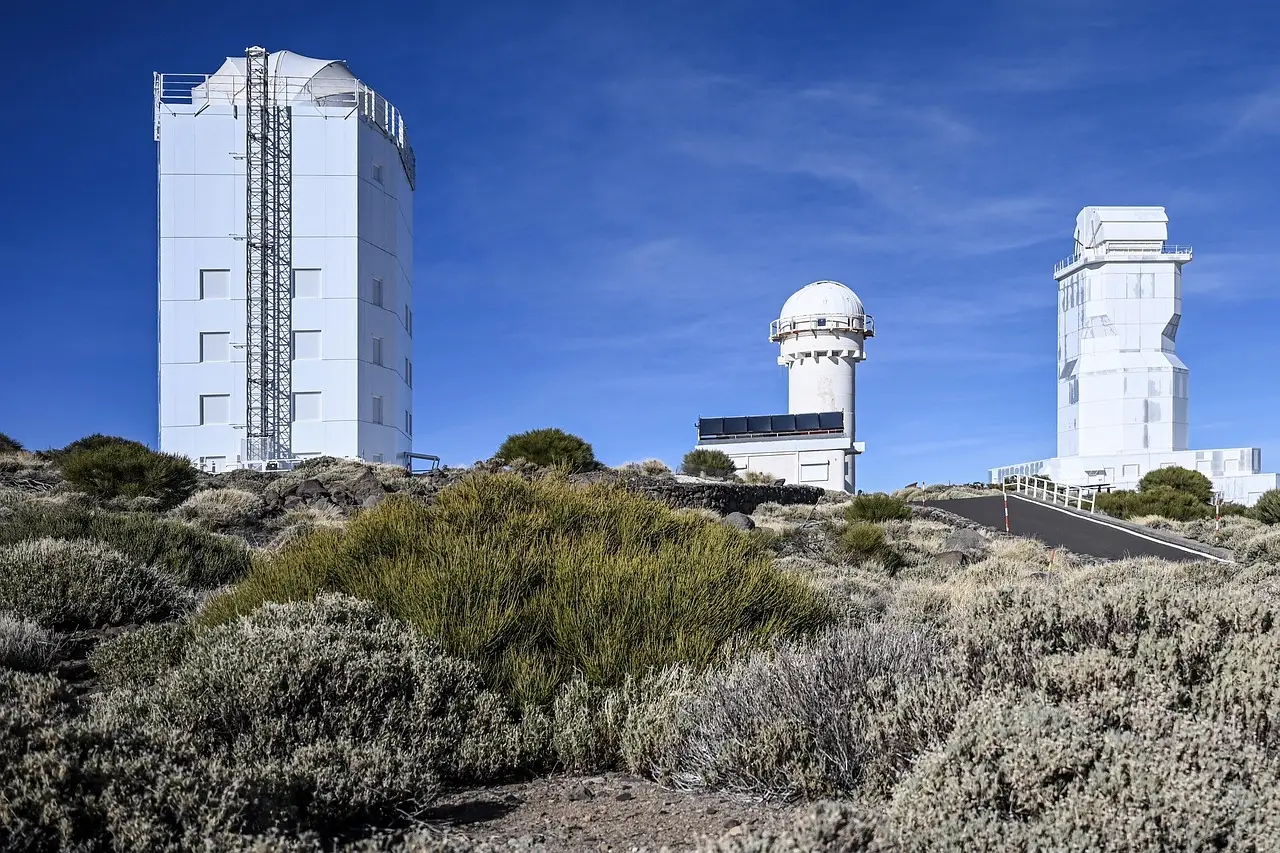
A clock on a mountain ticks about 25 nanoseconds per day faster than its twin 2,500 meters below, and this past summer a team from the National Institute of Standards and Technology spent 15 short weeks on Mount Blue Sky in the Rockies trying to catch that sliver. That's the whole prize: 25 billionths of a second, the gravitational redshift that Einstein's general relativity predicts and that experiments have confirmed on Earth since 1959.
Physicists Andrew Ludlow and Laura Sinclair lead the effort, called the Relativistic Redshift Peak-to-Plains collaboration, or R2P2. This was their third field season. The mountain offers something no lab can: a large vertical separation with road access. There's no fiber optic line from the summit to NIST in Boulder, so a laser beam crosses open air to a telescope on a school district building north of Denver, and fiber carries the signal the remaining 70 kilometers to the lab. Rain, wildfire smoke, clouds, and even someone walking near a relay telescope can bend or wobble the beam. "Every time we deploy, there's some kind of interesting adventure to solve," Sinclair said.
How do you build a clock this precise?
All clocks count the repetitions of an oscillator — a pendulum in a mechanical clock, cesium atoms in the clocks that currently define the second. Ludlow's clock uses ytterbium, whose transition oscillates at about 518 trillion cycles per second, giving far finer ticks. The best cesium clocks would drift by one second over roughly 300 million years; the most accurate optical lattice clocks would take around 30 billion.
The process works like this. A tiny oven heats ytterbium into a vapor — "almost like a teakettle of ytterbium where we're shooting a vapor out the end," Ludlow said. Lasers cool the atoms to about a millionth of a degree above absolute zero, trap thousands of them in pockets of red laser light, and a yellow clock laser drives their oscillation. A frequency comb converts the ticks to a telecom wavelength of 1,560 nanometers for the trip, sending the signal both ways over the same path so the team can cancel much of the noise it picks up. "Nature made the atoms identical," Ludlow said, so once every other influence is accounted for, the remaining mismatch should be gravity itself.
Portability costs precision. The mountain clock fits into 10 to 20 percent of the lab version's volume, three racks instead of a full room, with a weaker lattice laser and less stable clock laser. Commercial components shed heat differently at altitude. During the reporter's mid-June visit, the team was struggling to cool atoms enough to load them into the lattice. Two weeks later came a less subtle problem. "We literally had bugs in our system," Sinclair reported. Moths got into the telescope box and knocked out the free-space link. She removed them and resealed the box with tape and cling wrap.
What does this change for mapping?
Here the caveats pile up fast. The researchers have collected days' worth of data, not yet the published measurement; the analysis will show whether they reached their target precision. Previous tests made trade-offs. Galileo satellites that entered eccentric orbits by accident in 2014 produced the most precise redshift measurement to date, and a 2020 Tokyo Skytree experiment compared clocks across 450 meters at 18 digits of accuracy. R2P2 extends the ground separation beyond 2,500 meters.
The bigger promise is relativistic geodesy — using clock comparisons to measure Earth's gravitational potential directly. Derek van Westrum of NOAA, whose team is building the North American-Pacific Geopotential Datum of 2022, says clocks could fill the gap at scales of hundreds of kilometers, where floodplain models currently carry the largest error bars. "When you're constructing a levee, you want to make sure it's parallel to the actual geopotential surface, not just flat," he said.
But the field is young. Transportable optical clocks emerged only about a decade ago, with operational versions at Germany's National Metrology Institute and RIKEN in Japan. Christian Lisdat, who heads the German group, notes that free-space linking, unlike fiber, remains "a different story." Van Westrum was blunter: miss 10 ticks and you're off by a decimeter, nearly as bad as the old height system.
Theoretical physicist Sergei Kopeikin of the University of Missouri calls the effort "among the most demanding precision-measurement experiments currently being undertaken." In a separate development, the international body that defines measurement units resolved in October to keep working toward redefining the second with optical clocks, with a decision expected in 2030. Ytterbium is a contender. If that happens, the mountain experiment will have been a small step toward a world where clocks double as gravity-measuring instruments. For now, the summit clock ran, the link held, and the moths lost.
via scientificamerican.com (Source)
More from James Calloway
Show full bio
Staff writer covering regulation, policy and their impact on general science news at SciBeat.
474 articles
Nearby plates
- NASA's Swift Observatory Ends 21-Year Mission of Cosmic Rapid Response
- Physicists Design a Clock That Could Tick Through Two Times at Once
- A Mysterious Radio Signal Pointed at a Super-Earth. Was It Aliens?
- Astronomers Detect Most Distant Fast Radio Burst, 10 Billion Years Old
- Simons Observatory Goes Fully Online With 63,000-Sensor Camera