Recorded November 27, 2026
Space & AstronomyReported finding
592 Meteor Blast Scars Recast Venus as a Slowly Resurfaced World
Radar scars from 592 meteor airbursts cover at least 2.7% of Venus, and their clustering suggests lava buried the surface region by region rather than in one sudden global reset.
By Nathan Brooks4 min read713 words
In brief
- 592 airburst scars mapped on Venus cover at least 2.7% of the surface
- Study published November 27, 2026, in AGU Advances by T. J. Austin et al.
- Simulated lava burial patches were 2,000–6,000 km across to match the clustering
- 359 real scar sites showed closer neighbors than 10,000 random simulations
- One radar scar spans an outer halo of 180 km around a 20 km dark center
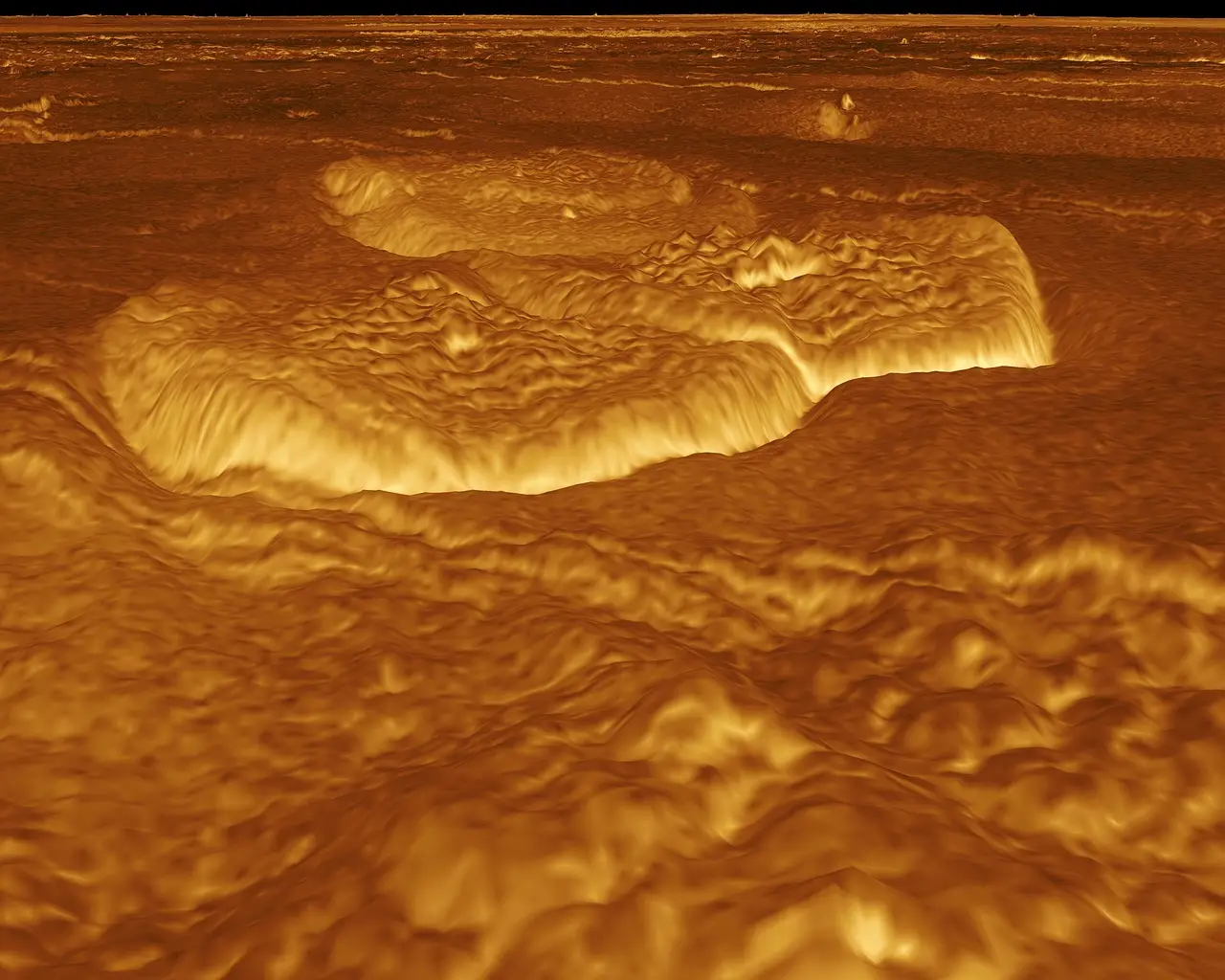
Venus may not have repaved itself in one catastrophic burst of volcanism after all. A new survey of 592 radar scars from exploding meteors, covering at least 2.7% of the planet's surface, suggests lava buried the ground region by region over a much longer stretch of geologic time.
T. J. Austin of Arizona State University and colleagues published the work on November 27, 2026, in AGU Advances. The scars come from airbursts — space rocks that detonate in Venus's dense atmosphere before reaching the ground.
What did the radar images show?
One Magellan spacecraft radar image shows a dark spot roughly 20 kilometers (12 miles) wide sitting inside two bright halos. The fainter outer halo spans some 180 kilometers (110 miles), with no obvious crater at the center. The team suspects a space rock exploded in the atmosphere and created the whole pattern.
An airburst only needs to alter the ground's texture to leave a radar-visible mark. Its fireball can reach the surface and melt rock, which could explain smooth, radar-dark centers. Farther out, blast winds may sweep sand aside and expose rougher ground that bounces a stronger radar echo back to the spacecraft. To spot these features, the researchers looked for concentric rings or rays spreading from a common center.
Not every scar is obvious. At one site, a dark scar shows up clearly on a plain and between highland ridges, but fades on the ridges themselves. Wind can also smear debris from a crater-forming impact over an older scar. In one case, two dark centers share a single bright halo — likely one incoming rock that fragmented and exploded in pieces, which the team counted as one event.
Why do the scars cluster?
Here's the puzzle. Venus's roughly 1,000 impact craters sit scattered at random, but the airburst scars cluster together. That mismatch caught the researchers' attention.
The standard story says heat built up inside Venus until eruptions buried nearly the entire surface during a geologically brief interval. Under that scenario, every region would have collected fresh craters for the same amount of time, so the craters should look uniform. But the craters are so widely spaced that regional eruptions could have covered the gaps between them across a much longer period instead.
The team put the numbers to work. It compared 359 scar sites on mapped plains — outside known blankets of windblown impact debris — against 10,000 simulations that scattered the same number of points randomly across those same plains. The real scars had closer neighbors than chance could readily explain.
What can lava erase?
Next, the researchers simulated random scar accumulation and periodically erased every mark inside a randomly placed circle, each circle representing ground buried by lava. Land that escaped burial longer collected more scars, and the surviving marks clustered there — just like on the real planet.
The modeling showed the buried patches needed to be roughly 2,000 to 6,000 kilometers (1,200 to 3,700 miles) across to reproduce the observed clustering. To picture that scale, a patch near the upper end would span the width of the United States. Patches near the smaller end also match earlier simulations of Venus's craters.
Lava could bury a thin airburst scar completely while only partly filling a crater and leaving its rim visible, which helps explain why the two maps look so different. "The spatial distribution of airburst scars seems incompatible with a uniform surface age," the researchers write.
What are the caveats?
The findings are preliminary in one respect: the researchers can't yet rule out erosion. Streaks extending from some dark scars suggest wind is carrying sediment away, and if erosion runs faster on some plains than others, even same-age surfaces could keep different numbers of scars.
One Magellan image shows bright lava flows meeting the edge of a dark splotch, but a sharper view would help distinguish a partly buried airburst scar from material that wind or lava deposited there in the first place.
The catalog and modeling software are publicly available for follow-up work. Future radar maps of Venus will be able to combine scar records with crater counts and sharpen models of the planet's crustal renewal and interior volcanic activity.
via phys.org/rss-feed/ (Source)
More from Nathan Brooks
Show full bio
Market editor covering companies, deals and strategy in general science news at SciBeat.
624 articles
Nearby plates
- Mars's Oddest Cloud May Be Even Odder Than We Thought
- Webb Telescope Spots Mars-Sized Worlds Smashing Together
- Webb Telescope Witnesses Planet-Smashing Collisions Around Young Stars
- Deepest Explosive Underwater Eruptions Ever Found Discovered in Mariana Trench
- Explosive eruption found 6,000 meters down in Mariana Trench