Plate Nº 27 · recorded October 1, 2026
Space & AstronomyReported finding
Webb Telescope Witnesses Planet-Smashing Collisions Around Young Stars
Astronomers using the James Webb Space Telescope studied 21 rare extreme debris disks, finding mineral clues that distinguish giant impacts between Mars-sized bodies from smaller moon-scale crashes.
By Marcus Bennett5 min read1,052 words
In brief
- Only about 1% of young stars show observable extreme debris disks, a short-lived phase of violent collisions during planet formation.
- One-third of the 21 disks studied are silica-rich, pointing to high-energy impacts between Mars-sized bodies; the rest suggest smaller moon-scale collisions.
- Silica-rich disks appear only around stars younger than 300 million years, matching the estimated formation window of Earth and the moon.
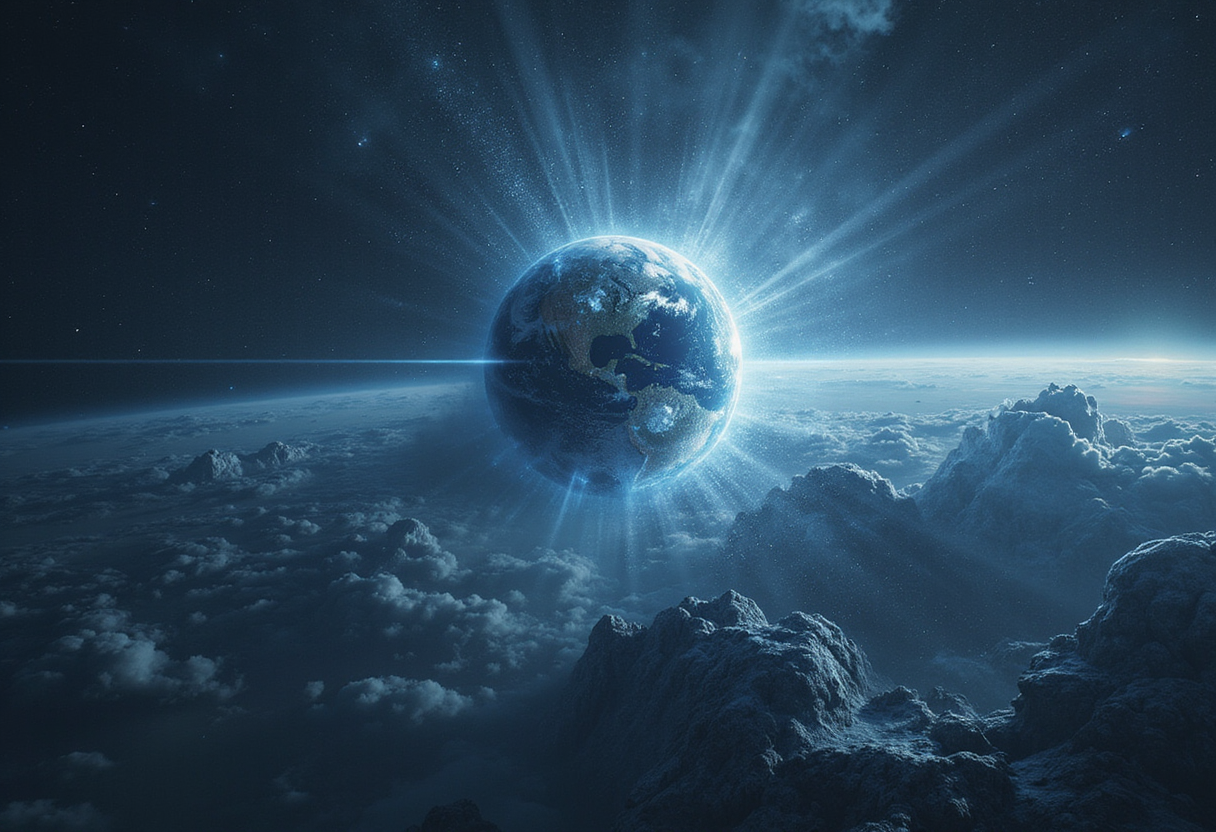
Some 4.5 billion years ago, according to prevailing theory, a Mars-sized body called Theia struck the young Earth. The impact vaporized enormous amounts of rock and flung debris into space, and some of that material eventually clumped together to form the moon. Astronomers have now used NASA's James Webb Space Telescope to study a class of young stellar systems caught in the middle of similarly violent upheavals — and to measure just how much energy those collisions carry.
The findings, published Thursday in The Astrophysical Journal, come from a team led by Kate Su of the Space Science Institute in Boulder, Colorado. They offer new clues about the composition and evolution of planetary systems in their most chaotic stage.
A dusty signature of turmoil
The environment around a star changes as the system ages. It begins as a gas-rich protoplanetary disk — the swirling birthplace of planets — and later thins into a gas-poor debris disk, a sparse belt of rock and dust left over after planet formation. NASA's retired Spitzer Space Telescope, while studying debris disks, identified an unusual subclass that astronomers call extreme debris disks. These systems carry unusually large amounts of warm dust packed close to the star, in the zone where rocky planets orbit in our own solar system.
Theory predicts that such systems should be common. Observations say otherwise. Based on the data collected so far, scientists estimate that only about 1% of young stars show detectable signs of this phase — making it a rare and fleeting window into the violent endgame of planet building. Our own solar system may well have passed through it.
Despite the rarity, Su's team assembled a sample of 21 extreme debris disks: five drawn from Spitzer's archival data and 16 observed with Webb, including 12 never before studied and follow-up looks at four of Spitzer's targets.
"This is the first time we have gathered enough systems to truly understand this subclass that we call extreme debris disks," said Su, the paper's lead author. "Before Webb, we had limited information. We knew that they are weird and very different from the typical cold debris disks that we know, like Vega and Fomalhaut. Now that we have more data, we can pin down what these disks represent for planet formation and evolution."
Three telltale properties
From the mid-infrared spectra gathered by Webb and Spitzer — light at wavelengths longer than the human eye can see, which warm dust emits strongly — the team confirmed that extreme debris disks share three defining traits: dust grains smaller than those in protoplanetary or classic debris disks, a high concentration of warm dust near the star, and irregular variations in brightness over time.
To figure out what drives these properties, the researchers examined the mineral makeup of the dust. They sorted their sample into two groups: silica-rich and silica-poor. On Earth, volcanic glass such as obsidian is a familiar silica-rich material, while the silica-poor mineral forsterite appears as green sand grains on some Hawaiian beaches. Which category a disk falls into reveals what kind of collisions are churning out the debris, and may explain why some disks flicker in infrared brightness.
"To just see their mid-infrared emission and beautiful spectral features with Webb, which allowed us to identify their compositions, was the most exciting thing for me," said co-author Agnes Kospal of Konkoly Observatory in Budapest, Hungary. "We have no other way to study these planetary embryos directly because they are too small."
Reading the scale of the crashes
The minerals tell a story of impact energy. Roughly one-third of the disks in the sample are silica-rich, pointing to high-energy collisions between Mars-sized bodies in which a significant fraction of the material is vaporized. The remaining two-thirds are silica-poor, indicating more modest crashes — grazing collisions between moon-sized objects.
The two groups also differ in timing. Silica-rich disks appear only around stars younger than 300 million years, while silica-poor disks persist across a wide range of stellar ages and often fluctuate more dramatically in brightness. The team proposes that this variability comes from fresh debris evolving rapidly, shifting its orbit and undergoing additional impacts.
Echoes in our own backyard
The results reach back to our solar system's own history, which may have included more than one extreme debris disk phase.
"How rocky planets formed and giant planets evolved are part of the broader story of the solar system's formation. It's all one story," said Su. "Our work on extreme debris disks helps us bring together the big picture of what we currently understand."
The timeline fits neatly. Simulations suggest that terrestrial planets like Earth should form within the first few hundred million years of a solar system's life — the same window in which the observed silica-rich disks occur. That estimate aligns with the calculation that Earth and the moon formed roughly 100 million years after the sun did, with the moon likely born from the collision between Earth and a Mars-sized impactor.
The silica-poor disks may echo an even later chapter. If the older silica-poor systems and their random bursts of infrared brightness do reflect orbital instability, that pattern would be broadly consistent with the Late Heavy Bombardment hypothesis, in which the giant planets migrated significant distances, gravitationally scrambled the orbits of smaller bodies, and triggered waves of catastrophic collisions — collisions that would produce exactly the short-lived, dust-rich phases we see in extreme debris disks.
The researchers are careful about what the sample can and cannot yet prove. "Of course, there are many things we still don't know about these disks," said co-author Attila Moor, also of Konkoly Observatory. "We expect no silica-rich systems among older extreme debris disks. We only have three disks in our sample that fit that age criterion, so it'll be nice to observe more of these systems to confirm our hypothesis."
With only 21 systems in hand, several conclusions remain provisional. But the Webb data mark the first time astronomers can compare enough of these violent environments side by side — and begin reconstructing, from scattered mineral dust, the collisions that built and battered worlds like our own.
via Phys.org Space & Astronomy (Source)
More from Marcus Bennett
Nearby plates
- Earth and Mars Were Built From Different Cosmic Recipes
- Simulations Reconstruct How the First Stars Forged the Universe
- Simulations Trace First Stars to Chemical Clues in Today's Universe
- Faint Young Stars Suggest Messier 74 Is Nearly Twice as Large as Thought
- Astronomers Find First Stellar Stream Beyond the Milky Way