Plate Nº 18 · recorded November 18, 2026
Space & AstronomyReported finding
Webb Telescope Ties Galaxy Winds to Shutdown of Star Formation
JWST observations show gas outflows at 'cosmic noon' were more abundant and powerful than thought, linking black-hole winds to the shutdown of star formation.
By Marcus Bennett3 min read654 words
In brief
- JWST observed links between galactic outflows and star-formation quenching 8–12 billion years ago, at 'cosmic noon.'
- The review appears in Astrophysics and Space Science and is on arXiv (DOI: 10.48550/arxiv.2610.19182).
- Outflows are gas flows driven by supernovae or supermassive black hole outbursts, and are more abundant and powerful than expected.
- Most outflowing galaxies at cosmic noon stayed in equilibrium rather than quenching; triggers may include mergers and radio jets.
- If the Milky Way had quenched then, our 5-billion-year-old solar system would not exist.
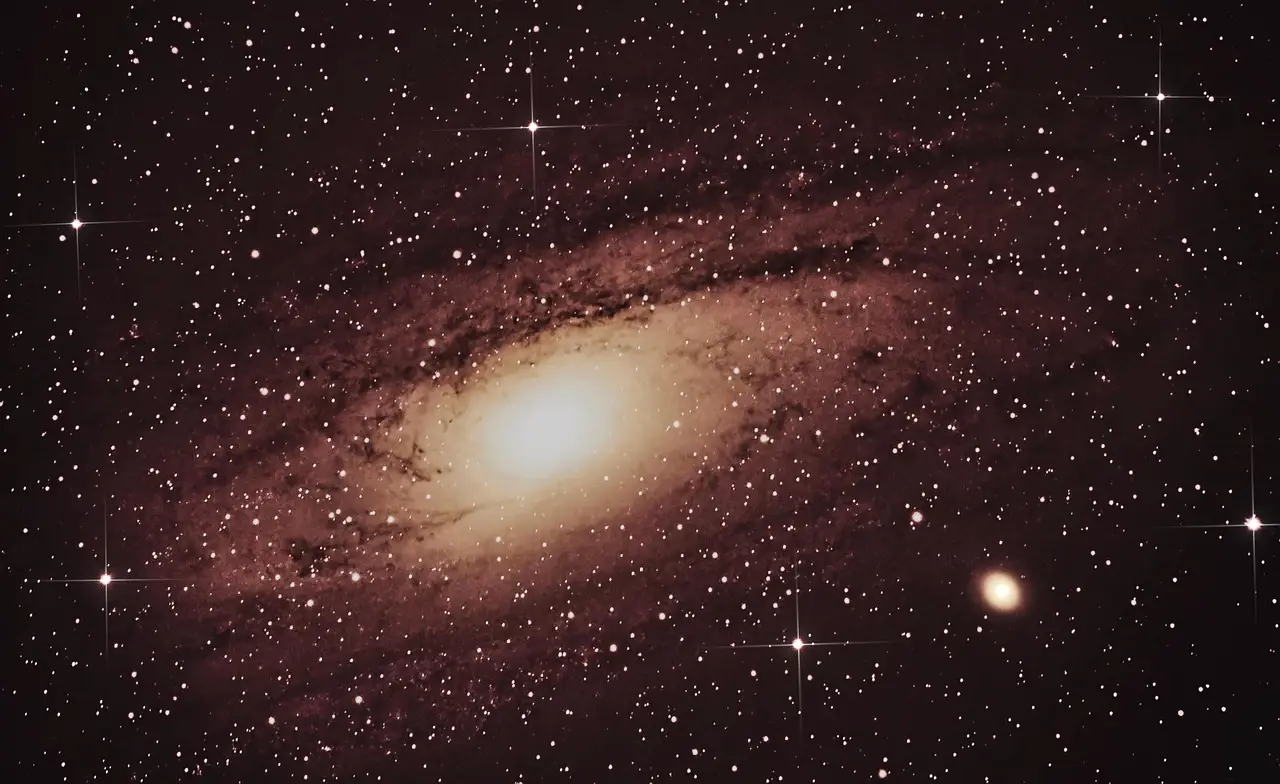
Roughly 8 to 12 billion years ago, at the era astronomers call "cosmic noon," massive galaxies blew out vast rivers of gas that shut down their own star production — and NASA's James Webb Space Telescope has now caught the process in action.
A new study, led by Rebecca Davies of Swinburne University of Technology in Melbourne and co-authored by Sirio Belli of the University of Bologna, links outflows from a massive galaxy's central core to the rapid shutdown, or "quenching," of star formation during that peak epoch. The paper will appear as an invited review in the journal Astrophysics and Space Science and is available now on the arXiv preprint server (DOI: 10.48550/arxiv.2610.19182).
The headline finding: outflows are more common and more energetic than astronomers had assumed. "These JWST observations have revealed that outflows are more abundant and more powerful than we thought, suggesting that the evolution of galaxies is strongly impacted by outflows," Belli said by email.
What are outflows, and how do they stop stars forming?
Outflows are large-scale flows of gas moving from inside a galaxy to outside it. Supernova explosions can drive them, and so can energetic outbursts from supermassive black holes at galactic centers.
The mechanism is straightforward in outline. Galaxies are normally rich in gas. When that gas is cold enough, it collapses under its own weight into dense clouds, and new stars form inside them. An outflow ejects that raw material, leaving the galaxy with nothing to build stars from.
"Growing supermassive black holes at the centers of galaxies drive powerful winds, blowing away gas that would otherwise form stars," Davies said. "With JWST, we can measure the amount of cold star-forming gas being ejected." JWST has also shown that outflows powered by accretion onto supermassive black holes are linked to rapid quenching.
Quenching itself can occur two ways, Davies explained: a galaxy either runs out of gas entirely, or its gas becomes too hot or turbulent to collapse into star-forming clouds. Belli added one candidate mechanism — the central supermassive black hole releasing a large amount of energy that removes or heats the gas.
As such galaxies age, their active galactic nuclei become relatively quiet, much like Sagittarius A*, the Milky Way's own central black hole. Even so, Davies notes, our galaxy's black hole produced a major flare a few million years ago, smaller outbursts only a century or two ago, and still flickers almost daily as hot gas swirls just outside it.
What remains unknown?
The key open question is what triggers outflows powerful enough to quench a galaxy outright. Outflows are very common in massive galaxies at cosmic noon, yet most of those galaxies are not quenching, Davies pointed out. In the typical case, the outflows simply hold the galaxy in equilibrium and stop it from converting all its gas into stars too quickly. Candidate triggers for the most extreme outflows include galaxy mergers and radio jets launched by the central black hole.
Why does this matter for planets like ours?
Quenching carries consequences beyond stars. "When galaxies are quenched, the formation of new stars and planets is shut down, with strong repercussions on the probability of developing habitable systems," Belli said.
The Milky Way illustrates the stakes. If it had been quenched at cosmic noon, it would likely not have formed many new stars in the last 10 billion years — and our solar system, only 5 billion years old, would not exist, Belli said. Yet runaway star formation brings its own hazards, including large numbers of stellar explosions that could harm the habitability of planets. The connection between galaxy-scale processes and planetary habitability, he noted, is only now being investigated.
For now, the review cements a shift in the field: galactic winds, long suspected, now have measured heft. Gas outflows, not gravity alone, appear to set the pace of star birth.
via phys.org/rss-feed/ (Source)
More from Marcus Bennett
Show full bio
News editor covering regulation, policy and their impact on general science news at SciBeat.
493 articles
Nearby plates
- Black hole jets reach far beyond galaxies, shaping their fate
- Black Hole Jets May Decide Whether Galaxies Keep Making Stars
- Dense Galaxy Groups Lose Over Half Their Star-Forming Gas
- Undergrad uncovers three isolated galaxies that stopped making stars
- Crowded Galaxies Lose Up to 80 Percent of Their Star-Forming Gas