Plate Nº 75 · recorded October 10, 2026
Space & AstronomyReported finding
Black hole jets reach far beyond galaxies, shaping their fate
A new study stacking DESI and LOFAR data from hundreds of galaxies found hydrogen gas glowing primarily along narrow jets from supermassive black holes, the clearest evidence yet that these jets help decide whether galaxies keep forming stars.
By Marcus Bennett4 min read701 words
In brief
- H-alpha signal grew clear and strong when stacked along jet axes of hundreds of active galaxies observed by DESI and LoTSS.
- The circumgalactic medium stretches 10 to 20 times the size of a galaxy's visible disk.
- Host galaxies can hold roughly 100 billion solar systems, while supermassive black holes themselves span only about a solar system in size.
- Glow peaked both close to the galaxy and near the CGM's outer edge, hundreds of thousands of light-years away.
- The peer-reviewed study was published in Astrophysical Journal Letters in 2026 (DOI: 10.3847/2041-8213/ae9cbd).
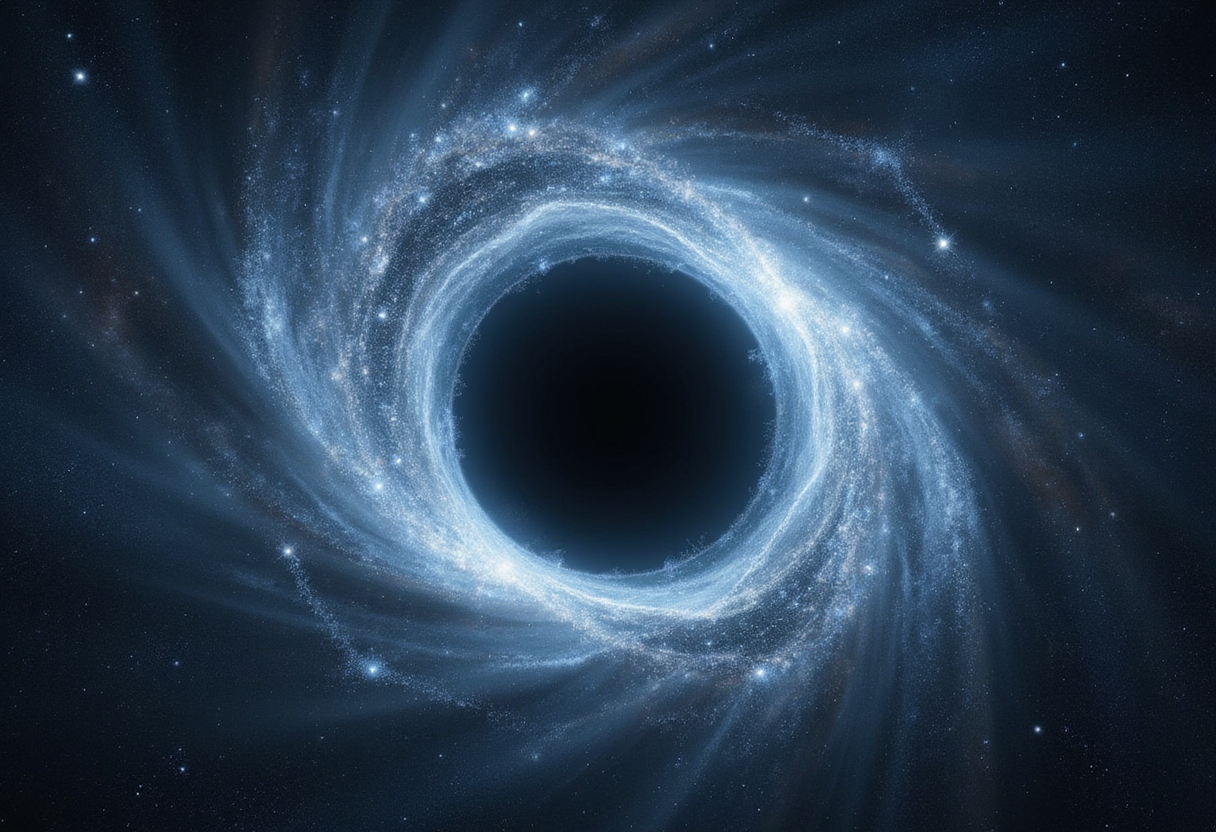
Black hole jets reach far enough from their host galaxies to alter the gas reservoirs that feed new star formation, according to a study in Astrophysical Journal Letters that combined observations from the Dark Energy Spectroscopic Instrument (DESI) and the LOFAR Two-meter Sky Survey (LoTSS).
The team detected a telltale glow from ionized hydrogen, known as H-alpha, primarily along narrow jet paths shooting out of supermassive black holes rather than uniformly around the galaxies. The pattern offers some of the clearest observational evidence so far that jets — in addition to radiation or winds — can determine whether a galaxy stays active in forming stars or goes quiet.
What is the long-standing mystery?
Every large galaxy, including the Milky Way, sits inside a vast envelope of gas called the circumgalactic medium, or CGM. This reservoir of raw material stretches 10 to 20 times the size of the visible galaxy.
In principle, that gas could keep feeding star formation indefinitely. Yet galaxies produce only a fraction of the stars the available fuel would suggest. Something must heat or disturb the reservoir before it cools and falls inward. The new study points directly at jets as a leading candidate.
How do such small black holes shape such enormous galaxies?
A supermassive black hole anchors nearly every large galaxy. These objects span roughly the size of our solar system, while their hosts hold around 100 billion such systems. Matter falling onto a black hole can release enormous amounts of energy.
"The surprising question is: how can something so small energetically impact something so enormous?" said Namrata Roy, an assistant professor at the Raman Research Institute in India and a former ASU Exploration Prize Postdoctoral Fellow.
To find out, Roy, lead author Sanchayeeta Borthakur of Arizona State University, and colleagues stacked data from hundreds of galaxies with active jets. They mapped H-alpha glow using DESI spectra and cross-matched the galaxies with LoTSS radio images of their jets. Averaged around the full circle of a galaxy, the signal stayed weak. Aimed along the jet axis, it became clear and strong.
Why did past searches miss the signal?
Earlier studies averaged light from every direction around a galaxy and saw nothing distinctive. The new analysis split the data by jet orientation. H-alpha appeared strongest at two locations along each jet: close to the galaxy, where the jet first strikes the CGM, and far out near the CGM's outer edge, where the jet dumps most of its energy.
A jet therefore behaves less like a lamp and more like a flashlight, lighting up only the gas along its path.
"This is a pathbreaking result that solves the long-standing mystery of how black holes influence galaxies, their stars and life as we know it!" said Borthakur, an associate professor in ASU's School of Earth and Space Exploration.
What does the magnesium check show?
To test whether jets, rather than local star formation, drive the directional glow, the team examined a second tracer: magnesium absorption, which marks cooler gas. Magnesium appeared isotropically — equally strong in every direction — with no link to jet orientation.
The contrast suggests the cool gas reservoir already wraps the galaxy evenly on all sides. Only the hot, ionized component lights up along the jet. The researchers caution that the result is statistical rather than a direct image of any single system, and confirmation with deeper observations is still pending.
Why does the finding matter?
By heating and stirring gas throughout the CGM, jets can prevent the reservoir from cooling and feeding new stars. The process acts as a brake on galaxy growth and may push a galaxy toward a quieter phase.
"What excites me most is the scale of the connection," Roy said. "A black hole is incredibly small compared to a galaxy, but its impact can reach hundreds of thousands of light-years, far into the galaxy's outer reaches. The jet carries the energy outward, and the gas lights up along its path."
Co-authors include Timothy Heckman of Johns Hopkins University and Tanmay Singh of Arizona State University. The peer-reviewed paper appeared in Astrophysical Journal Letters in 2026, with DOI 10.3847/2041-8213/ae9cbd.
via Phys.org Space & Astronomy (Source)
More from Marcus Bennett
Nearby plates
- Black Hole Jets May Decide Whether Galaxies Keep Making Stars
- Black holes grow normally even in bulgeless galaxies, study finds
- Black Hole Winds Pack 100 Times More Power Than Scientists Expected
- Millions of Planets Could Orbit Supermassive Black Holes, Simulations Show
- Undergrad uncovers three isolated galaxies that stopped making stars