Plate Nº 58 · recorded October 10, 2026
Space & AstronomyReported finding
Black holes grow normally even in bulgeless galaxies, study finds
A study of 2,435 galaxies found that 546 bulgeless systems feed their central black holes as effectively as bulged ones, challenging the idea that mergers drive black hole growth.
By Nathan Brooks3 min read614 words
In brief
- 2,435 galaxies with actively feeding black holes were analyzed using DESI data
- 546 of those galaxies (about 22%) were classified as bulgeless
- The paper appears in the Monthly Notices of the Royal Astronomical Society
- Bulgeless galaxies grew their black holes at rates comparable to bulged galaxies
- DESI expects spectra for roughly 40 million galaxies in coming years
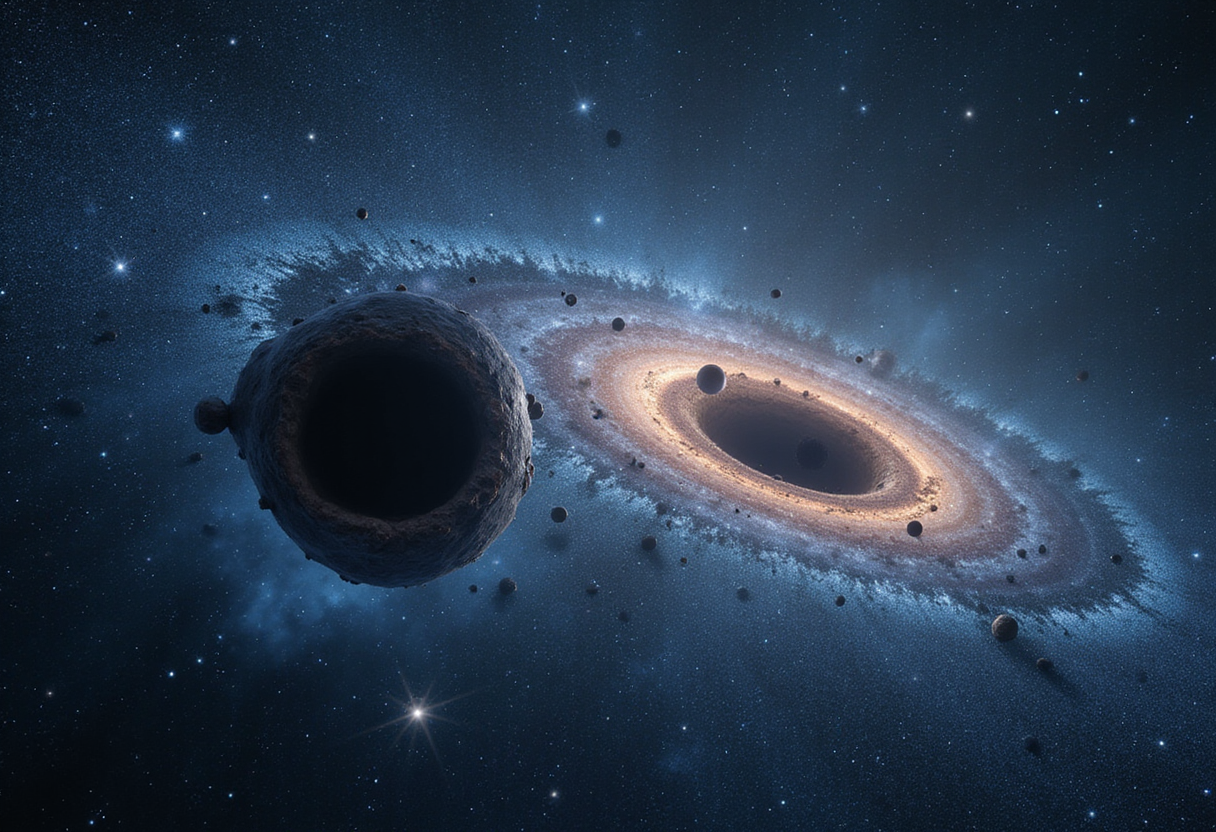
Astronomers have identified 546 "bulgeless" galaxies that still manage to grow supermassive black holes, in a study of 2,435 galaxies with actively feeding black holes.
The finding, drawn from data collected by the Dark Energy Spectroscopic Instrument (DESI), suggests that black holes do not need violent galaxy mergers to grow. The research appears in the Monthly Notices of the Royal Astronomical Society.
What did the team find?
The astronomers compared black hole growth rates in two groups of galaxies: those with a central stellar bulge and those without one. Both groups hosted actively feeding black holes. The result implies that bulgeless galaxies can fuel their central black holes just as effectively as bulged ones.
Why does this matter?
For decades, the standard picture linked black hole feeding to galaxy mergers. When two galaxies collide, gravitational forces funnel gas toward the center. That gas feeds the black hole and packs stars into a new bulge. The two processes appeared to march in step across cosmic time.
The new result breaks that lockstep. By the old logic, bulgeless galaxies should host small or quiet black holes. Instead, they host feeding black holes at rates that match their bulged neighbors. Something quieter must be delivering gas to the center.
What is a "bulgeless" galaxy?
A galactic bulge is the dense cluster of older stars packed at the center of many spiral galaxies, including our own Milky Way. "Bulgeless" galaxies lack this central swelling — flat pancakes rather than fried eggs. About 22% of the DESI sample, 546 of 2,435 galaxies, fell into this category.
How did they measure black hole growth?
DESI does not image black holes directly. Instead, the instrument splits each galaxy's light into a spectrum — a fingerprint of wavelengths. Astronomers read it to gauge how fast gas and stars swirl around a galaxy's core. Faster central motion usually means a more massive black hole pulling on nearby material.
Signs of glowing, heated gas around the core — emission lines in the spectrum — flag a black hole that is actively feeding. The team sorted 2,435 galaxies with active feeding signatures into bulged and bulgeless groups. Feeding strength matched between the two.
What mechanisms might explain quiet growth?
The researchers point to several candidates. Cold streams of gas can flow along filaments of the cosmic web — the large-scale scaffolding of matter that spans the universe — and drip into a galaxy's center without a major collision. Internal instabilities in a gas-rich disk can also push material inward. Stellar winds from older stars may contribute a smaller trickle.
None of these channels builds a dense bulge, yet each can in principle feed a black hole. The mechanisms shift gas slowly rather than through a single dramatic event.
What are the limits of the study?
The analysis relies on feeding signatures, not direct mass measurements. A black hole that is currently swallowing gas may not represent a typical growth phase for its host. The sample, while large, still draws from an early DESI data release.
The team also notes that "bulgeless" covers a spectrum. Some galaxies in the sample may harbor tiny, hard-to-detect bulges that future high-resolution imaging could reveal.
What's next?
DESI remains mid-survey. Within a few years, the collaboration expects spectra for roughly 40 million galaxies. A larger bulgeless sample will let astronomers measure growth rates more precisely and test whether the trend holds across cosmic time.
If it does, theorists will need to fold quieter fueling channels into models of how black holes and galaxies co-evolve. The picture may shift from rare, violent mergers to a steadier rain of gas across billions of years.
via Phys.org Space & Astronomy (Source)
More from Nathan Brooks
Nearby plates
- Black hole jets reach far beyond galaxies, shaping their fate
- Black Hole Jets May Decide Whether Galaxies Keep Making Stars
- Millions of Planets Could Orbit Supermassive Black Holes, Simulations Show
- Undergrad uncovers three isolated galaxies that stopped making stars
- Astronomers Find First Stellar Stream Beyond the Milky Way