Plate Nº 51 · recorded November 11, 2026
Space & AstronomyReported finding
Dense Galaxy Groups Lose Over Half Their Star-Forming Gas
Galaxies in a dense group 7 billion light-years away retain only 20-40% of the molecular gas of isolated peers, revealing how crowded environments quench star formation.
By Nathan Brooks3 min read607 words
In brief
- Group galaxies retain only 20-40% of the molecular gas of comparable isolated galaxies.
- The studied group, COSMOS-Gr30, lies about 7 billion light-years away and holds at least 44 galaxies.
- The universe's star formation peaked roughly 10 billion years ago and has declined since.
- Observations used the NOEMA interferometer and the IRAM 30m telescope, published in Astronomy & Astrophysics (2026).
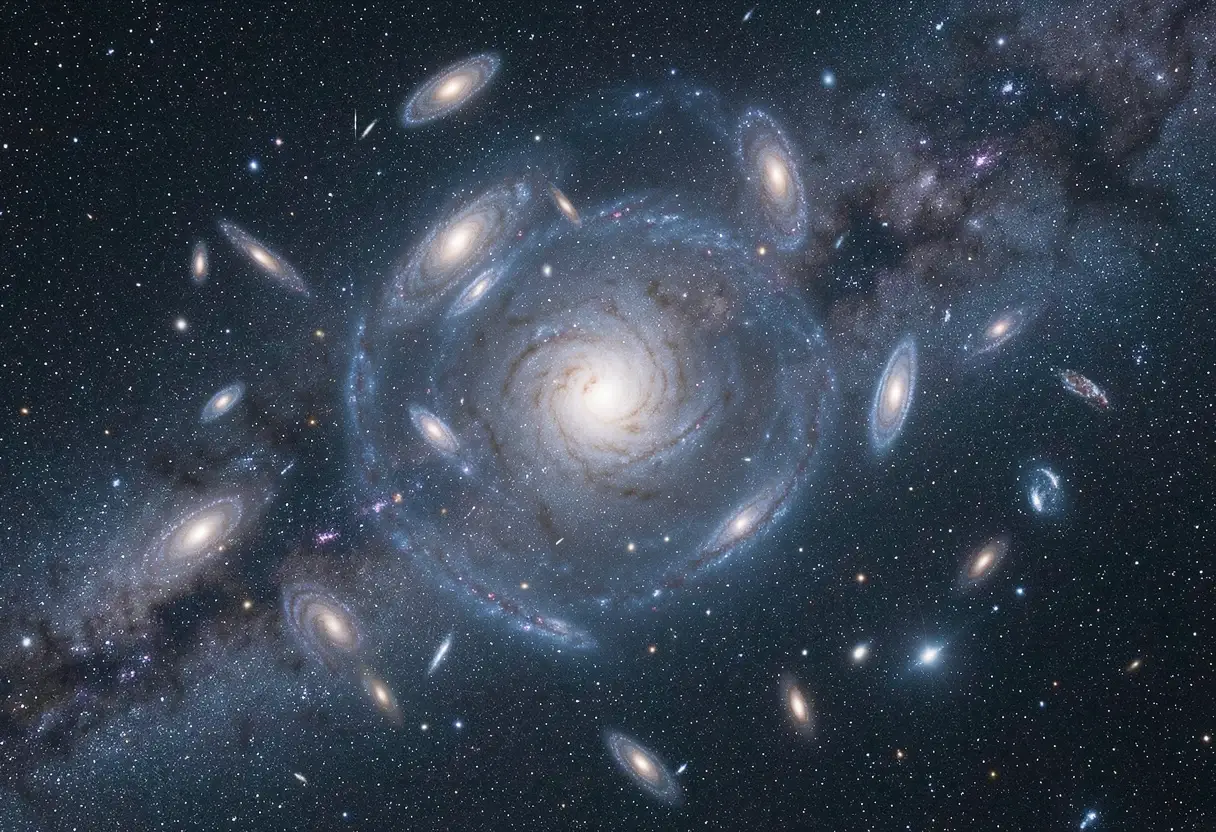
Galaxies packed into dense cosmic groups hold, on average, only 20% to 40% of the molecular gas found in similar isolated galaxies. That's the headline finding of an international study led by Jonathan Freundlich of the University of Strasbourg's Astronomical Observatory, published in the journal Astronomy and Astrophysics (DOI: 10.1051/0004-6361/202661635).
In plain terms, galaxies living in crowded neighborhoods have lost more than half of their fuel for making stars. Molecular gas — cold clouds of molecules, mainly hydrogen, tracked by astronomers through carbon monoxide (CO) emission — is the raw material from which stars form. Less gas means fewer new stars.
Why does lost gas matter for star formation?
The universe's star-making heyday came about 10 billion years ago. Since then, the rate of new star formation has dropped sharply — and the decline defines cosmic history. Astronomers attribute it to several factors: gas being blown out or heated by stellar winds and black holes, a shrinking supply of fresh gas, internal structural changes, and environmental disruption.
Because most galaxies live in groups, not alone, environmental effects carry outsized weight. Two mechanisms dominate. Tidal forces — the gravitational squeezes galaxies inflict on each other during close passes — can deform them and destabilize their gas. Then there's the hot intergalactic medium, the thin gas filling the space between galaxies, which strips gas away and blocks new supplies from arriving.
Despite that role, direct measurements of molecular gas inside galaxy groups remain rare. That gap is what this study set out to close.
What did the team actually observe?
The researchers pointed two instruments at COSMOS-Gr30, a remarkably dense galaxy group about 7 billion light-years away, containing at least 44 galaxies. The tools: the NOEMA interferometer (the Northern Extended Millimeter Array) in the French Hautes-Alpes, and the IRAM 30-meter telescope near Granada, Spain. Both detect the faint millimeter-wavelength glow of CO, which serves as a tracer for molecular hydrogen that's otherwise hard to see.
The distance matters. Looking 7 billion light-years out means looking 7 billion years back in time, to a pivotal epoch roughly halfway between the universe's star-formation peak and today. It's a moment when the machinery of cosmic decline was already turning.
COSMOS-Gr30 offered an unusually good laboratory for another reason: it sits at the intersection of several cosmic web filaments — the thread-like structures along which galaxies cluster. Earlier observations with the MUSE instrument on ESO's Very Large Telescope (VLT) had already revealed a large amount of ionized gas — gas stripped of electrons — floating between the group's galaxies.
The new NOEMA and IRAM 30m measurements filled in the other half of the picture. Combined, the data map both the cold gas inside galaxies and the gas surrounding them, letting the team catch the environmental quenching mechanisms — the processes that shut down star formation — essentially in the act.
How solid is the result?
The study demonstrates that even at intermediate cosmic epochs, galaxy groups actively drain their members of cold molecular gas. That's a significant data point, but it rests on a single group. The authors themselves frame COSMOS-Gr30 as a test case; extending observations to a broader sample of groups will be essential before the finding can be generalized.
For now, the numbers tell a clear story about one crowded neighborhood: group membership costs galaxies most of their gas, and with it, their future stars.
Publication: J. Freundlich et al., "Probing the molecular gas content of galaxies in an over-dense group at z ∼ 0.7: A test case for environmental quenching," Astronomy & Astrophysics (2026).
via phys.org/rss-feed/ (Source)
More from Nathan Brooks
Show full bio
Market editor covering companies, deals and strategy in general science news at SciBeat.
325 articles
Nearby plates
- Crowded Galaxies Lose Up to 80 Percent of Their Star-Forming Gas
- Star formation halved in 4.5 billion years — hydrogen barely budged
- Hubble Finds Stellar Winds Weaken Sharply in 29 Metal-Poor Stars
- Black Hole Jets May Decide Whether Galaxies Keep Making Stars
- Undergrad uncovers three isolated galaxies that stopped making stars