Plate Nº 85 · recorded November 11, 2026
Space & AstronomyReported finding
Tiangong team sets cold record with a seven-second atom cloud
Researchers on China’s Tiangong station released a rubidium-87 atom cloud that expanded slowly enough to yield a 9.7-picokelvin equivalent temperature and stayed detectable for seven seconds.
By Marcus Bennett4 min read772 words
In brief
- The released rubidium-87 cloud produced a 9.7-picokelvin equivalent temperature and stayed detectable for 7 seconds.
- The result was nearly 4 times lower than the 38-picokelvin record set by a German-led drop-tower team in 2021.
- The condensate held about 23,000 atoms at 3.1 nanokelvins, with nearly 90% in the condensate state.
- After a 1.175-second trap-release sequence, expansion speeds were 70–88 micrometers per second.
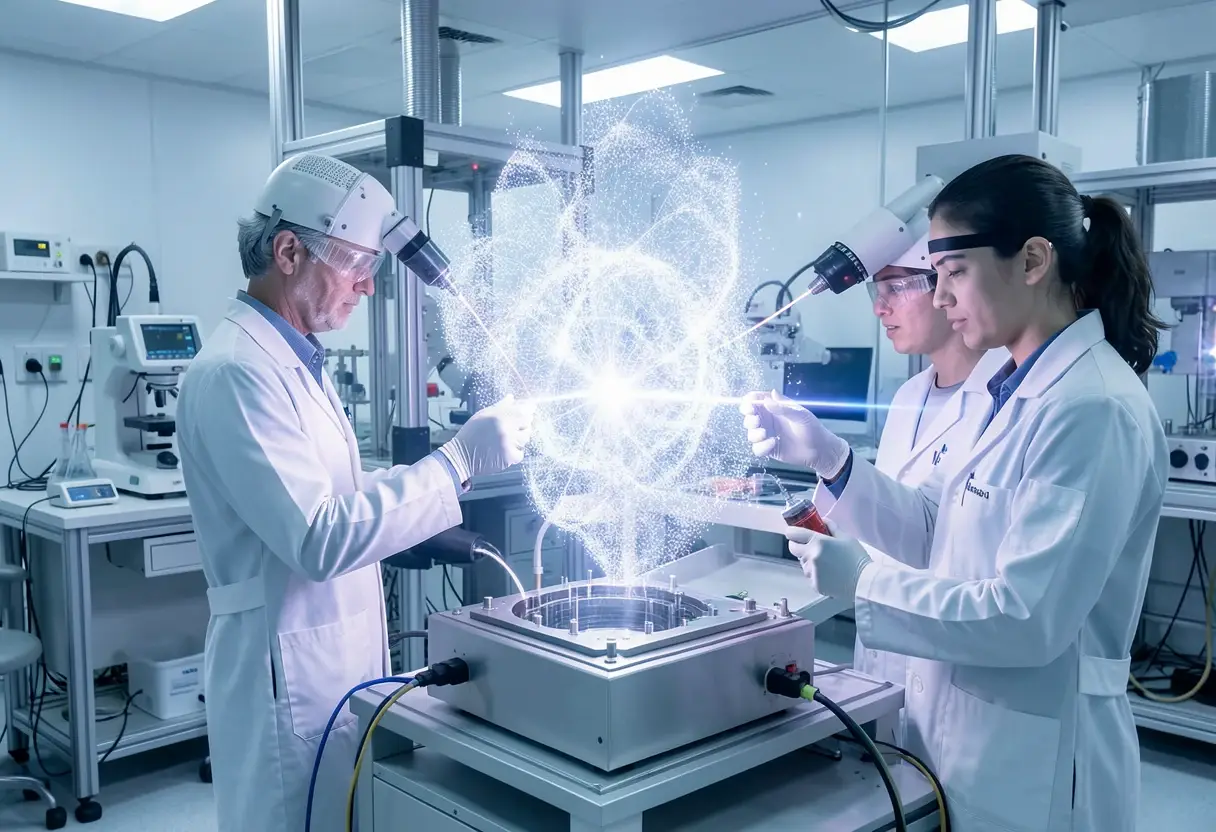
A rubidium-87 atom cloud released aboard China’s Tiangong space station yielded an equivalent temperature of 9.7 picokelvins and remained detectable for seven seconds, researchers reported in the journal Science.
The 9.7-picokelvin figure did not describe the station’s temperature or the cloud’s ordinary thermodynamic temperature. It expressed the energy associated with the cloud’s expansion after release; less energy produced slower spreading.
The result was nearly four times lower than the previous record of 38 picokelvins. Its equivalent temperature was also about 280 billion times below the roughly 2.7-kelvin glow left by the Big Bang that fills space.
“The 7 seconds is an even more important figure of merit than the 10 picokelvin,” said Holger Mueller, an atomic physicist at the University of California, Berkeley, who told Science. In plain terms, Mueller treated observation time as a more useful measure of performance than temperature alone.
What does the temperature record actually mean?
Absolute zero, about minus 273.15 degrees Celsius, is the lowest possible temperature; nothing can become colder. At the opposite theoretical limit, physics permits 1.417 × 10³² °C—142 nonillion degrees Celsius, or 1.4 followed by 32 zeroes.
At extremely low temperatures, many atoms can occupy the same quantum state and behave collectively, like one enormous matter wave. Physicists call this state a Bose-Einstein condensate, named for Satyendra Nath Bose and Albert Einstein, who predicted it in the 1920s.
Scientists first created a Bose-Einstein condensate in a laboratory in 1995, and that experimental milestone later earned a Nobel Prize in Physics. Gravity makes the extremely weak traps needed for further cooling harder to maintain on Earth, so researchers have used brief weightlessness in drop towers and eventually orbit.
NASA’s Cold Atom Laboratory created the first condensate in Earth orbit in 2018. Later experiments aboard the International Space Station reached picokelvin energy scales. In 2021, a German-led drop-tower team reached the previous 38-picokelvin record but observed the freely expanding atoms for only about two seconds.
The Tiangong result combines a lower energy scale with a much longer observation window than earlier ground-based tests.
How did the team cool the atoms in microgravity?
The experiment began with roughly two million rubidium-87 atoms inside the Cold Atom Physics Rack, installed in Tiangong’s Mengtian laboratory module.
Crossed laser beams held the atoms in a tiny trap. The researchers gradually weakened it, allowing the most energetic atoms to escape. The process resembled hot coffee cooling as energetic molecules evaporate from its surface: the remaining atoms had less energy.
Microgravity removed an advantage that gravity normally provides. On Earth, gravity pulls escaping atoms away and makes the cooling process more efficient; in orbit, that assistance disappeared. The team used a magnetic field gradient—a field that changes strength across the trap—to imitate gravity’s useful effect.
They then produced a condensate of about 23,000 atoms at a conventional temperature of 3.1 nanokelvins. Nearly 90 percent of the atoms occupied the condensate.
To push farther, the researchers moved the cloud into a second, wider laser trap and loosened its grip over 1.175 seconds. That reduced the energy the atoms would release as they spread apart.
“Only the interaction energy changes,” coauthor Xuzong Chen of Peking University explained to Science.
When the team released the cloud, expansion speeds reached only about 70 to 88 micrometers per second, depending on direction. The cloud remained observable for seven seconds.
In practical terms, the team used a magnetic field to recover a cooling trick that Earth usually supplies for free.
Why does seven seconds matter more than the record?
A longer observation window could improve atom interferometry, a measurement method in which scientists split and recombine matter waves to reveal tiny changes in motion and forces. The more time the atoms remain available, the greater the potential sensitivity.
Such instruments could test Einstein’s equivalence principle, which says that objects of different composition fall at the same rate in a gravitational field. A heavy bowling ball and a light feather fall at the same speed in a vacuum, Einstein realized, and a body cannot distinguish Earth’s pull from the push of an accelerating rocket.
Any convincing deviation from the equivalence principle would provide a major clue to physics beyond current theories.
The Tiangong team also hopes to create arrays of laser light that mimic the structure of crystals and help investigate superconductivity, the flow of electricity without resistance. The record matters because it gives physicists more time to measure minute effects predicted by theories of gravity and matter.
via zmescience.com (Source)
More from Marcus Bennett
Show full bio
News editor covering regulation, policy and their impact on general science news at SciBeat.
370 articles
Nearby plates
- Tiangong cools atoms to a record-low temperature in space
- NASA Powers Up Roman Telescope's 300-Megapixel Camera
- Physicists Create Mini 'Big Bang' Using Surprisingly Small Atoms
- Lava World 280 Light-Years Away Reflects 75% of Its Star's Light
- Subaru Telescope measures Comet Encke's 7-by-3-kilometer nucleus