Plate Nº 50 · recorded October 1, 2026
Space & AstronomyReported finding
Life on Enceladus? Two Studies Boost the Odds on Saturn's Icy Moon
Two new studies suggest Enceladus' ocean is more habitable than thought, and that future spacecraft could detect biosignatures in its ice plume more easily than expected.
By Marcus Bennett4 min read868 words
In brief
- Two peer-reviewed studies published in Science Advances on September 25, 2026, improve the odds of finding life on Saturn's moon Enceladus.
- Plume droplets freeze slowly, separating and concentrating organic compounds into individual ice grains — making potential biosignatures easier for future missions to detect.
- Methane-producing archaea survived and grew in a lab recreation of Enceladus' highly alkaline, carbonate-rich, oxygen-poor ocean.
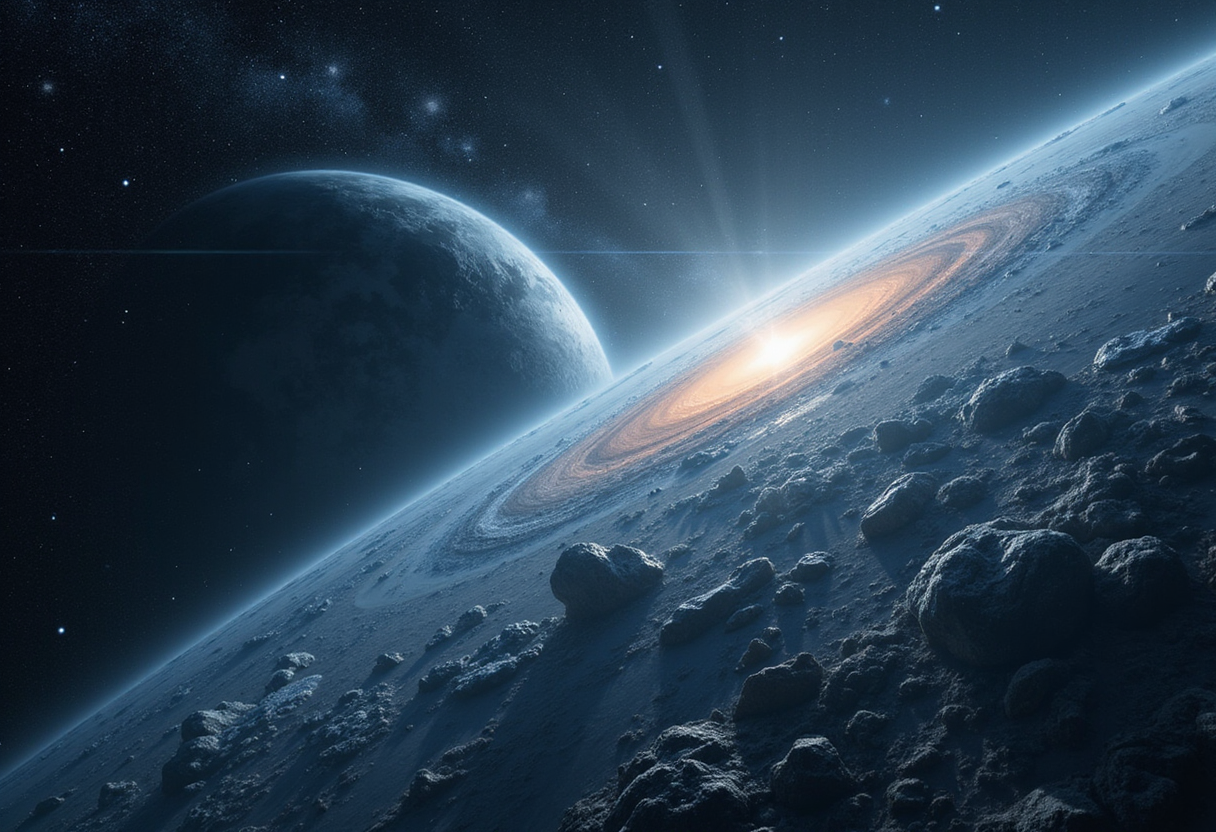
Two new peer-reviewed studies published in Science Advances on September 25, 2026, have strengthened the case that Saturn's moon Enceladus could harbor life. One shows that future spacecraft could detect signs of biology more easily than previously assumed. The other demonstrates that microorganisms can survive in conditions matching the moon's alien ocean.
Researchers at Freie Universität Berlin in Germany announced both results the same day the papers appeared.
Why Enceladus matters
Enceladus is one of the most promising places to search for life in our solar system. Beneath its icy crust lies a salty subsurface ocean. Data from NASA's Cassini spacecraft, which studied Saturn until 2017, has already suggested this ocean is likely habitable — meaning it has conditions that could, in principle, support life.
The two new studies push that picture further.
Study 1: The moon prepares its own samples
The first study, led by planetary scientist Frank Postberg, focuses on the plumes of ocean spray that blast from cracks in Enceladus' icy shell straight into space. Because the moon has essentially no atmosphere, the spray is unaltered on its way out — a direct sample of ocean water.
Scientists previously assumed the droplets in this vapor froze instantly when they reached space. The new analysis suggests the opposite: they freeze slowly. That slow freezing separates the spray's components from one another. Even within a single droplet, salts and organic molecules — carbon-containing compounds of the kind life produces — migrate to different spots. Dissolved sodium chloride, or table salt, separates from sodium carbonate.
The physics helps, too. As droplets race up through the cracks at speeds of up to 620 mph (1,000 km/h), collisions with crack walls shatter them into fragments a few micrometers across — a micrometer being one-thousandth of a millimeter.
The frozen grains form through a two-stage process. Larger, salty droplets freeze slowly inside the vents beneath the surface, sorting their mineral content. Only later, in space, do they break apart into the smaller, chemically purer fragments Cassini actually observed.
"Enceladus actually does a lot of the work for us in preparing samples for analysis that usually take a lot of effort in chemical labs on Earth," Postberg said. "The oceanic constituents are separated from each other and simultaneously concentrated into individual ice particles."
Easier to spot biosignatures
This separation matters because it makes identifying the composition of individual fragments simpler. If life exists on Enceladus, its chemical fingerprints — called biosignatures — might be found in just a small fraction of spray particles. But in those particles, the material would be concentrated and relatively pure. That is close to an ideal scenario for analysis.
"That is great news in the search for life," Postberg said. "Future spacecrafts will have to analyze many individual ice particles in the plume. But if they come across one with microbial material in it, they could identify biosignatures in the particle relatively easy with already available technology."
Study 2: Microbes thrived in a simulated Enceladus ocean
The second study asked a different question: could anything actually live there?
Enceladus' ocean is harsh. It holds little oxygen, contains a very high concentration of carbonate, and is strongly alkaline, with pH values of 10 or 11. For comparison, pure water has a pH of 7, and ammonia solution sits in a similar alkaline range.
The researchers recreated those conditions in the lab, including simulated hydrothermal vents — hot, mineral-rich springs on the ocean floor like those found on Earth. Into this mixture they placed Methanothermococcus okinawensis, a methane-producing archaeon. Archaea are simple single-celled organisms that, unlike bacteria, form their own branch of life; this one lives near hydrothermal vents on Earth's seafloor and needs no oxygen — only hydrogen and carbon dioxide.
The microbes grew. They produced methane using hydrogen generated by water-rock reactions and even adapted their metabolism to cope with scarce carbon dioxide. By contrast, a control group kept in an optimal lab medium at high pH but without dissolved carbon dioxide died.
"This was really a surprise to us," said co-author Nozair Khawaja of Freie Universität Berlin. "This was an experiment for which we did not expect such a successful outcome."
Promising, but not proof
The researchers themselves are careful about what the results mean. Life in a lab flask is not life on Enceladus.
"On Enceladus the specific geochemical conditions might allow one of the oldest known metabolic systems on Earth to work, even in very alkaline environments," Postberg said. "While that doesn't mean that there is life on Saturn's moon, our first study shows that — in the event that there is — future space missions might have a good chance of finding traces if they analyze individual ice grains from Enceladus' plume."
Both studies rest partly on decades-old Cassini data and lab simulations, and neither can confirm whether anything actually lives in the ocean. Until a new mission flies through the plume and analyzes its ice grains directly, the question stays open.
Still, the prospects have improved on two fronts at once: Enceladus' ocean looks more survivable for life as we know it, and detecting that life — if it exists — looks easier than anyone expected.
via science.org (Original)
More from Marcus Bennett
Nearby plates
- Why Watering Plants on the Moon Won't Work Like on Earth
- NASA Picks Three New Payload Suites to Scout Its Future Moon Base
- NASA Picks PSI-Led Team to Probe Possible Cave Beneath Lunar Pit
- Two Suns, One Earthlike Planet? Nearby Star System Might Allow It
- No Jupiter-Sized Planets Found in Historic Nearby Binary System