Plate Nº 17 · recorded November 10, 2026
Earth & ClimateReported finding
Lifeless Earth Simulation Stayed Habitable for 4.5 Billion Years
A 5-billion-year simulation of a lifeless Earth found stable, water-friendly surface conditions — no biology needed, though oxygen never appeared without photosynthesis.
By James Calloway4 min read713 words
In brief
- A University of Washington team simulated a lifeless Earth across 5 billion years of evolution, tracking 19 planetary properties.
- The lifeless planet maintained habitable surface temperatures for 4.5 billion years despite the Sun brightening by about 30 percent.
- The model's lifeless Earth lacked atmospheric oxygen, since oxygen requires photosynthesis.
- The carbonate–silicate cycle alone provided a negative feedback keeping CO2 and temperature in habitable bounds.
- The findings, published in The Planetary Science Journal, do not disprove the Gaia hypothesis, the authors stress.
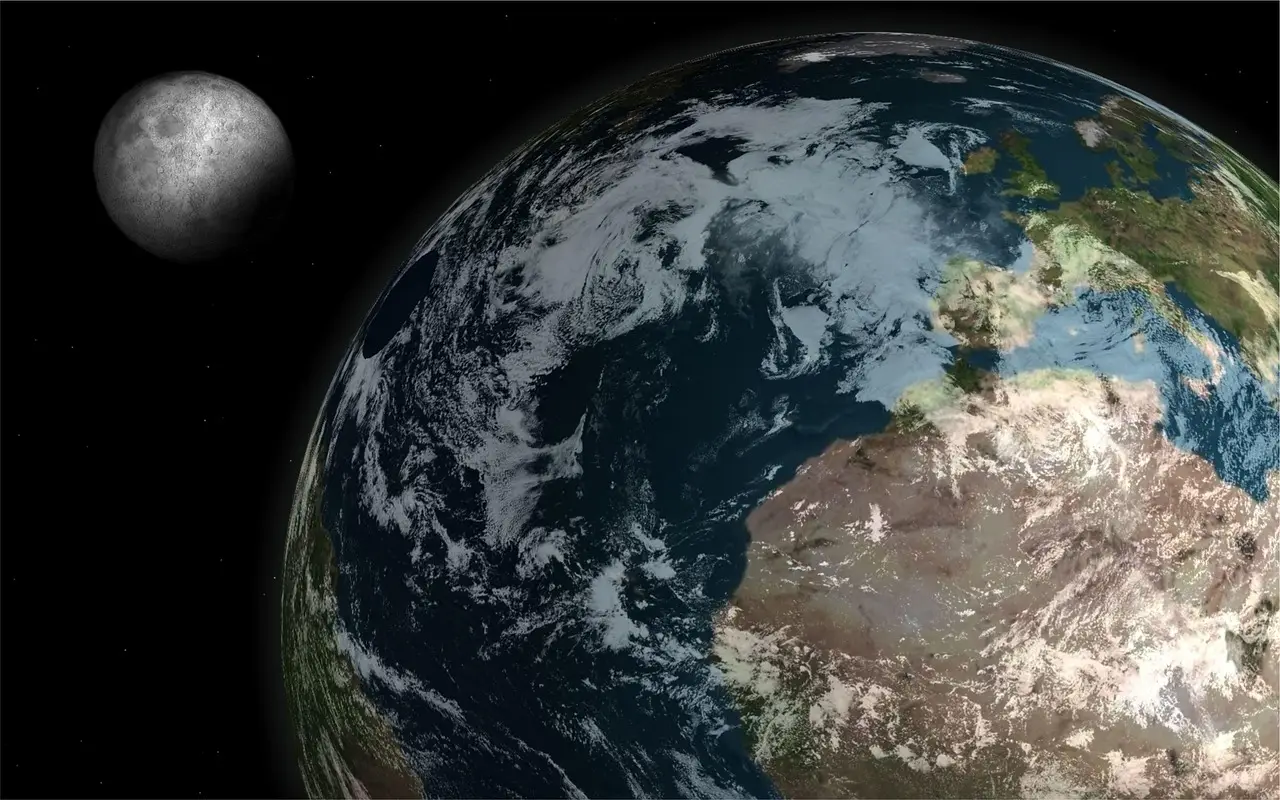
A lifeless Earth could have kept liquid water on its surface for 4.5 billion years — and counting — without any help from biology. That's the headline result of a new simulation study published in The Planetary Science Journal, led by astrobiologist Samantha Gilbert-Janizek at the University of Washington.
The team built a sophisticated computer model of an Earth with no life at all, but with everything else in place: the core, the mantle, the crust, the atmosphere, the oceans, and the incoming sunlight. Then they let it run. In total, the researchers tracked 19 key planetary properties — heat flow, ocean chemistry, surface temperatures — across 5 billion years of evolution, from roughly the time Earth formed to about 500 million years in the future.
The result? Broadly speaking, not that different from the Earth we know. The most striking exception: no atmospheric oxygen. Without photosynthesis, no oxygen. That matters, but less than you'd think.
What does 'habitable' actually mean here?
Astronomers don't define habitability by breathable air. They define it by whether a planet can hold liquid water on its surface. On that score, the simulated lifeless Earth performed surprisingly well, showing water levels similar to our own planet's.
The reason is a purely geological thermostat. In their paper, the team writes that "the carbonate–silicate cycle, driven by the interplay between silicate weathering, volcanic outgassing, and ocean chemistry, provides a robust negative feedback that keeps atmospheric CO2 and surface temperature within habitable bounds despite the Sun's luminosity increasing by approximately 30 percent over 4.5 Gyr."
In plain English: rocks wear down, volcanoes burp out carbon dioxide, and ocean chemistry mediates between the two. This loop regulates the planet's temperature on its own. The Sun got 30 percent brighter over 4.5 billion years, and the lifeless planet still stayed in a temperate range. No biology required.
What does this change for the Gaia hypothesis?
The study is, at heart, a stress test of the Gaia hypothesis — the idea that life and the physical environment interact in ways that maintain a habitable world, a kind of planetary self-regulation. The question the researchers posed was blunt: "Is life required to maintain the long-term habitability of a rocky planet?"
Their answer, based on this model, is no. "Our findings suggest that the abiotic Earth could evolve to a similar state (in terms of global geophysics and climate) to present-day Earth without life, but without abundant atmospheric oxygen," the researchers conclude. "This work thus contributes to the ongoing debate regarding the Gaia hypothesis by suggesting that life and habitability may be somewhat decoupled."
Decoupled. Strong word. But does this kill Gaia? It does not.
The researchers are careful here, and I'll be careful with them. They explicitly state that their findings don't disprove the Gaia hypothesis. They can't rule out that life on real Earth does contribute to processes that enhance climate stability. A model showing life isn't necessary is not the same as a model showing life does nothing.
What are the model's limits?
Plenty, and the authors say so themselves. They acknowledge several simplifications, including assumptions about plate tectonics, atmospheric chemistry, and the processes that regulate Earth's climate. A simulation is a simulation. It's only as good as the assumptions baked into it, and planetary-scale chemistry over billions of years involves a lot of assumptions.
Still, the work has a practical payoff beyond the philosophical one. It could sharpen how we read the atmospheres of distant planets.
"This model can help us see how habitable but non-living planets might mimic living planets," Gilbert-Janizek said. "When we interpret observations of an exoplanet's atmosphere, this tool will help us determine the probability that what we observe indicates life on the surface."
That's the real stakes. If a dead planet can look geophysically like a living one, then spotting life on an exoplanet gets harder — and tools like this one help sort genuine biosignatures from geological mimicry.
One caveat before anyone declares life optional on Earth: this is a single model, with acknowledged simplifications, simulating a planet that doesn't exist. The debate over Gaia continues. But the burden of proof has shifted a little.
via sciencealert.com (Source)
More from James Calloway
Show full bio
Staff writer covering regulation, policy and their impact on general science news at SciBeat.
346 articles
Nearby plates
- Scientists Simulated a Lifeless Earth to Better Hunt for Alien Life
- Ancient Mars Rains May Have Delivered a Life-Starting Molecule
- Ancient Ocean Chemistry Kept Earth Breathing, Study Finds
- Ancient Rain May Have Delivered Life's Building Blocks Across Mars
- Life on Enceladus? Two Studies Boost the Odds on Saturn's Icy Moon