Plate Nº 77 · recorded October 10, 2026
Biology & EvolutionReported finding
A 245-Million-Year-Old Reptile Fossil Keeps Its Stomach, Liver and Gut
A 245-million-year-old fossil of Austronaga minuta preserves the oldest known largely complete reptile digestive system, with a stomach, liver and intestines still visible.
By Elena Vasquez4 min read733 words
In brief
- The fossil is about 245 million years old and preserves the oldest known largely complete digestive system in a reptile.
- The reptile, Austronaga minuta, measured roughly 60 centimeters long and lived during the Middle Triassic.
- The study was published in Science Advances on September 29, 2026.
- Traces of hemoglobin were still detectable in the preserved liver.
- Austronaga was related to archosaurs — the group that includes crocodiles and dinosaurs — not to ichthyosaurs or mosasaurs.
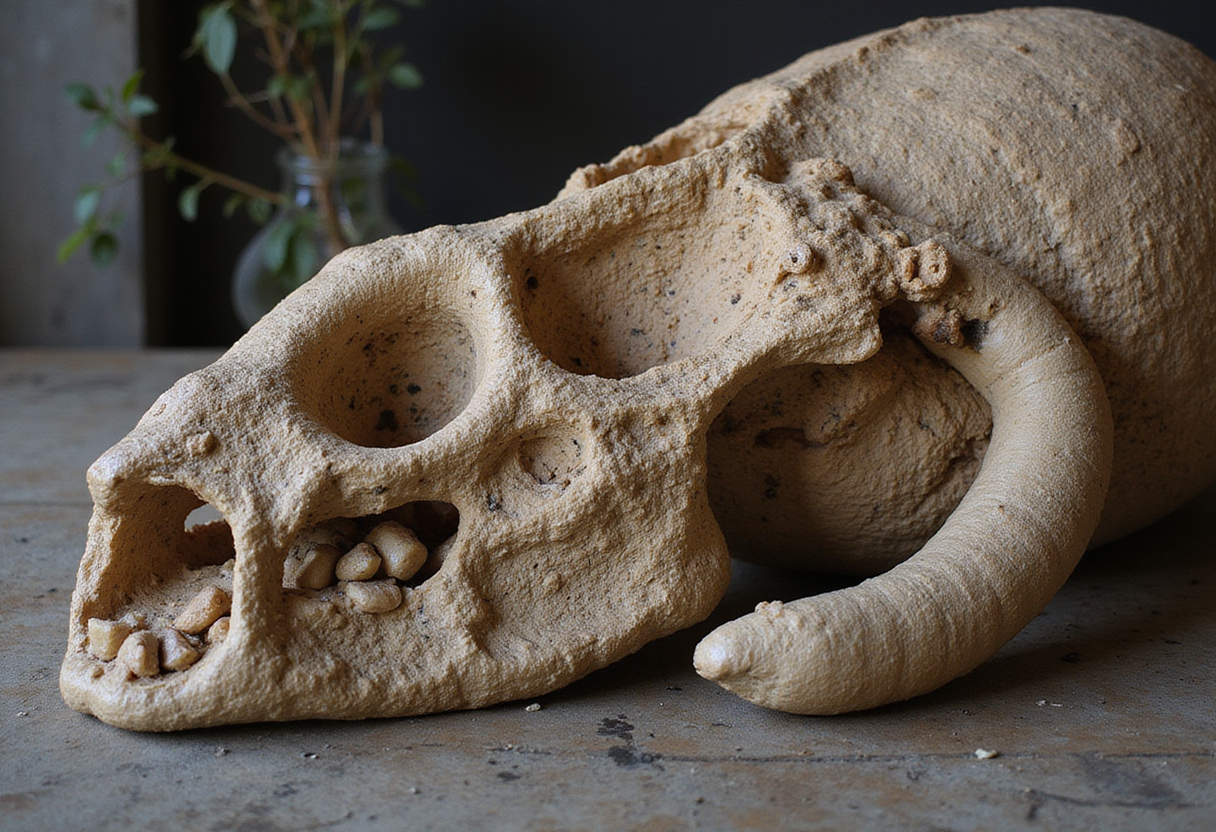
A 245-million-year-old fossil from China preserves the oldest known largely complete digestive system in a reptile — including a stomach, a liver that still carries traces of hemoglobin, and a long intestinal tube.
Researchers from China, Europe, and the USA described the exceptional specimen of the long-necked marine reptile Austronaga minuta in a study published in Science Advances on September 29, 2026. Dr. Stephan Spiekman, a paleontologist at the State Museum of Natural History Stuttgart and the University of Hohenheim, is among the co-authors.
The fossil is nearly complete. It preserves not only most of the animal's skeleton but also large portions of its digestive system — an extraordinarily rare feat of fossilization for a reptile this old. The specimen is held in Beijing.
What makes this reptile unusual?
Austronaga minuta measured only about 60 centimeters long, yet it had an unusually elongated neck and tail. Its anatomy shows it was already highly specialized for swimming during the Middle Triassic. The long tail likely provided propulsion, while extended, fin-like front legs helped with steering and stabilization. Its much smaller hind legs appear to have contributed little to locomotion in water.
That body plan is surprising because of the animal's family tree. Despite using a swimming strategy similar to famous marine reptiles such as ichthyosaurs and giant mosasaurs, Austronaga was not closely related to them. Instead, it belonged to a lineage closely related to land-dwelling archosaurs — the broad reptile group that includes crocodiles and dinosaurs.
"The archosaurs and their ancestors were the most diverse group of reptiles on land during the time of the dinosaurs, but we always thought that their adaptation to life in the sea was limited," said Dr. Stephan Spiekman, who specializes in long-necked marine reptiles. "However, the discovery of Austronaga shows that early representatives of this lineage had already developed complex adaptations to life in the oceans, comparable to those of other, better-known groups of fossil marine reptiles."
How did scientists identify the organs?
The breakthrough came when researchers examined a dark area preserved between the animal's ribs. Closer analysis revealed the material was the remains of a largely intact digestive tract.
The team applied several modern techniques, including UV light photography and mass spectrometry — a method that identifies the chemical composition of materials — to identify multiple internal organs. What they found was striking in its simplicity.
"Compared with the highly specialized body shape of Austronaga, its internal organs seem less modified," said Dr. Wei Wang, lead author of the study and marine reptile expert at the Institute of Vertebrate Palaeontology and Palaeoanthropology in Beijing. "The preserved organs include a large, sac-like stomach at the front, followed by a strikingly red liver in which traces of hemoglobin can still be detected. Behind this is a long, simple tube forming the small and large intestines."
Why does a simple stomach matter?
The contrast between the reptile's sophisticated swimming anatomy and its plain digestive organs carries evolutionary significance.
"While today's birds and crocodiles have a two-part stomach, Austronaga had only a single stomach chamber," explained Dr. Nick Fraser of National Museums Scotland, one of the study's authors. "This shows that the stomachs of archosaurs were initially quite simple and only evolved later in the evolutionary process."
Dr. Fraser added: "It is also striking that Austronaga had a fairly short and uncomplicated digestive tract, very similar to that of today's fish-eating reptiles."
What does the discovery change?
The fossil gives researchers an unusually complete snapshot of both the external and internal anatomy of an early marine reptile. It also provides new evidence for how quickly some relatives of land-dwelling archosaurs developed complex adaptations for ocean life — a capacity scientists had previously underestimated in this lineage.
The research team included scientists from the Institute of Vertebrate Paleontology and Paleoanthropology in Beijing, National Museums Scotland, the State Museum of Natural History Stuttgart, the University of Hohenheim, The Field Museum in Chicago, the Luoping Biota National Geopark, and the University of Zurich.
The work forms part of a broader investigation into the early history of modern reptile groups and the diversity of reptiles in Triassic seas. As with any single specimen, the findings are preliminary in scope, and researchers hope future discoveries will add more detail about the evolutionary history of marine reptiles and their land-dwelling relatives.
via dx.doi.org (Original)
More from Elena Vasquez
Nearby plates
- Winged Dinosaur From China Rewrites Story of How Flight Evolved
- Animals May Have Evolved 200 Million Years Earlier Than Fossils Show
- 518-Million-Year-Old Fossil Rewrites the Starfish Family Tree
- Gobi Desert Fossil Rewrites 40-Year Mammal Evolution Theory
- 240-Million-Year-Old Tanzania Fossil Reshapes Dinosaur Timeline