Plate Nº 76 · recorded October 29, 2026
Space & AstronomyReported finding
A 4.1-Billion-Year-Old Piece of Mars Arrived in the Sahara
A rose-colored rock found in Mali in 2022 turned out to be one of the oldest Martian meteorites ever discovered, altered by water some 4.1 billion years ago.
By Priya Raman4 min read765 words
In brief
- Teghaza 001 formed more than 4.1 billion years ago, making it one of the three oldest Martian meteorites ever found.
- The 800-gram rose-colored rock was discovered in 2022 on a salt plain in Mali.
- It is one of roughly 435 known Martian meteorites on Earth.
- Researchers identified 13 possible origin locations on Mars matching its mineralogy.
- A new in-situ rubidium-strontium method dated the sample using a fragment smaller than a fingernail.
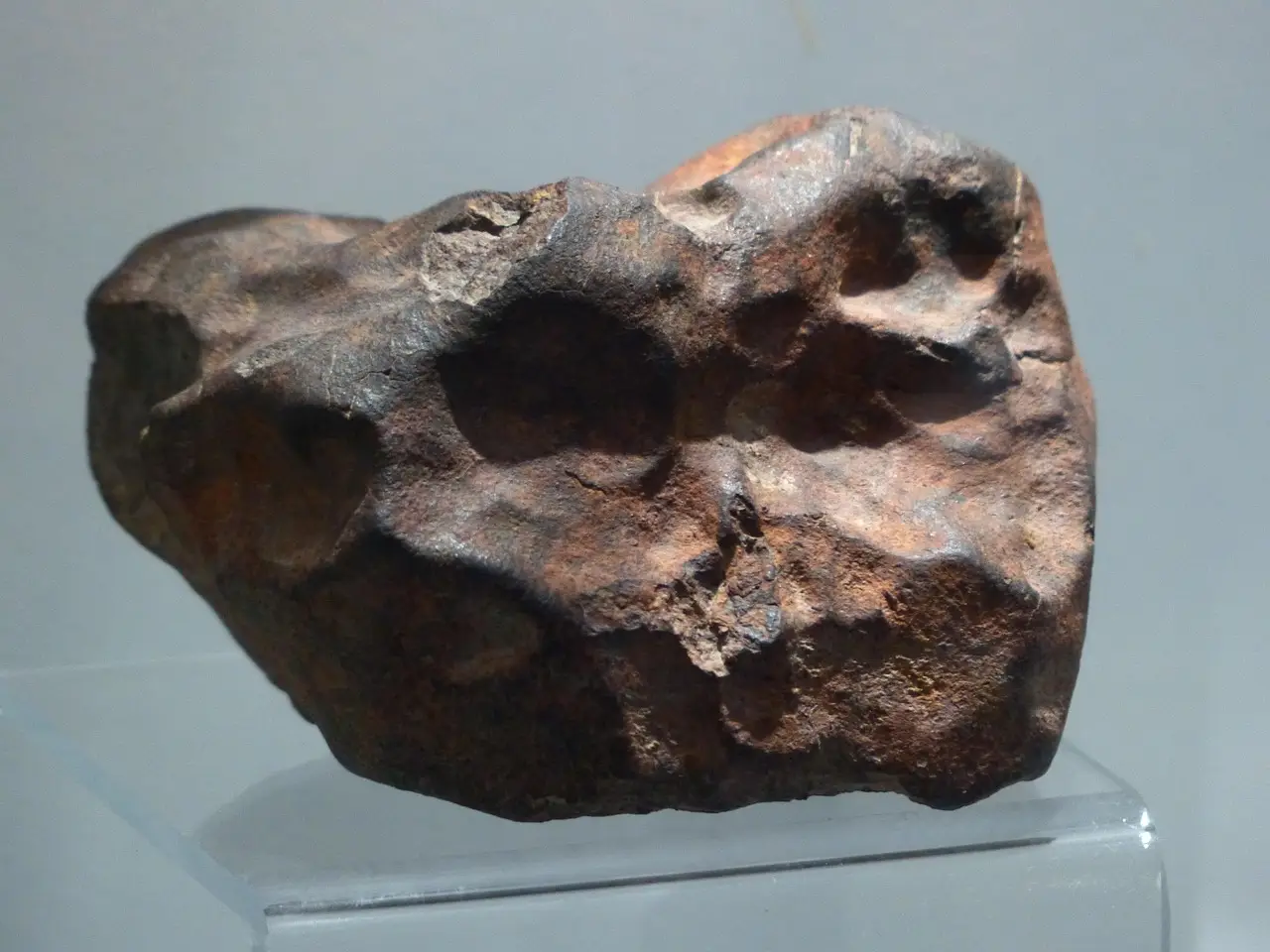
A nearly 2-pound (800-gram) rock picked up in the Sahara Desert in 2022 has proved to be a piece of Mars that formed more than 4.1 billion years ago, making it one of the oldest Martian meteorites ever found on Earth. Named Teghaza 001, after the salt plain in Mali where it was discovered, the rose-colored stone is one of roughly 435 known meteorites from the Red Planet.
The finding appears in a NASA-funded paper published Thursday in the journal Science, in which researchers led by Yang Liu of NASA's Jet Propulsion Laboratory in Southern California offer an initial characterization of the sample. A separate paper published in June in Science Advances detailed the meteorite's water content, offering a look at how water shaped the early Martian surface.
"It was only after we started looking closely that we realized this meteorite is really unique," Liu said. "One of the paper's reviewers called it a Rosetta Stone for Mars."
Why does this meteorite matter?
Teghaza 001 stands apart from other Martian meteorites because of its texture, its extreme age and its unusual mix of igneous minerals — igneous meaning formed from cooled volcanic magma. It ranks among the three most ancient Martian meteorites ever recovered.
The other two record-holder samples offer narrower views of Martian history. One, called ALH84001, is composed almost entirely of a single mineral and is similar in age to Teghaza 001. Another, nicknamed "Black Beauty," formed about 2.1 billion years ago and consists of small volcanic rock fragments.
Unlike those peers, Teghaza 001 contains a blend of igneous minerals that tells a story of how the Martian crust formed from cooling magma and was later altered by subsurface water. Its mineralogy matches terrain that NASA's Mars Reconnaissance Orbiter (a spacecraft surveying the planet from orbit) has observed in the cratered southern highlands.
"This is really our first piece of Martian crust from a part of Mars we've never had a sample of before," said Lee Saper, the paper's second author, who conducted the research as a postdoctoral scholar at JPL and is now a scientist at NASA's Ames Research Center. "It records interactions of water and rock and maybe even an imprint of the Martian atmosphere as it was losing water."
No one will ever know exactly where the meteorite originated. Still, the paper identifies 13 candidate locations on Mars that match its mineralogy and chemistry.
How did scientists date a rock from another planet?
Like all Martian meteorites, Teghaza 001 reached Earth the long way: an impact blasted it off the Red Planet's surface, and its trajectory eventually delivered it to the Sahara, where collectors spotted it against the barren landscape. Researchers verified its Martian origin by matching its mineral and chemical components to data from NASA missions, including the Viking landers and the Curiosity and Perseverance rovers.
Researchers at the University of New Mexico had already classified it as Martian using oxygen isotopes (chemical fingerprints that distinguish planetary bodies), which matched those of other Martian meteorites. The rock appeared to be a shergottite, the most common class of Martian meteorite — so common that Liu, an expert in planetary samples, nearly declined to study it.
She took a look anyway, and found odd textures and minerals she had never seen before. Among them were zircon crystals, which record how a rock formed and allow geologists to date it precisely.
Caltech coauthor Francois Tissot then applied a novel in-situ rubidium-strontium dating method (a technique that measures radioactive decay within individual mineral grains) pioneered by his team. Unlike bulk analysis, which dissolves an entire sample, the technique consumed a piece of Teghaza 001 smaller than a fingernail while delivering extreme precision, preserving rare material for future studies.
"Right now, we are one of very few labs in the world able to perform this kind of age-dating, and the first to date such an ancient Martian meteorite," Tissot said. "Our hope is to pave the way for dating even more Martian meteorites, or samples returned from other planets, their moons, and asteroids."
What comes next?
The dating results startled Liu: Martian water had altered the rock around 4.1 billion years ago, meaning it originally formed even earlier. Clues in its oxygen isotopes, texture and chemistry point to a far more dynamic water cycle on early Mars than expected.
These are preliminary findings from an initial characterization, and the authors want the wider scientific community to interrogate the sample. "We've only scratched the surface," Liu said.
via science.org (Original)
More from Priya Raman
Show full bio
Senior reporter covering people, launches and day-to-day practice in general science news at SciBeat.
280 articles
Nearby plates
- Perseverance Finds Early Mars Hosted Complex, Hot Water Systems
- 3.1-Billion-Year-Old Rocks Show Water Fueled Early Volcanoes
- Oklahoma's Hidden Meteor Crater Is 100 Million Years Younger Than Thought
- The phoenix planet: Astronomers spot a world rebuilt from stellar ashes
- A Famous 2-Billion-Year-Old Signal From Early Earth May Be Local, Not Global