Plate Nº 78 · recorded November 12, 2026
Space & AstronomyReported finding
A Giant Star Flares Every 113 Days. Chandra May Have Found Why
A giant star has erupted 27 times since 2012 on a 113-day clock. Chandra caught one flare 100x brighter in X-rays — hinting at a hidden neutron star or black hole.
By James Calloway3 min read644 words
In brief
- Star AT 2016blu in galaxy NGC 4559, 30 million light-years away, has erupted 27 times in visible light between 2012 and 2026.
- Flares recur roughly every 113 days; the star has at least 33 times the Sun's mass.
- During a March 2026 flare, Chandra saw the source at least 100 times brighter in X-rays than in 2001-2002 observations.
- Researchers propose a neutron star or black hole companion pulls gas from the giant each close pass, heating it into X-rays.
- Published in The Astrophysical Journal; the companion's identity remains unresolved with only one close X-ray observation.
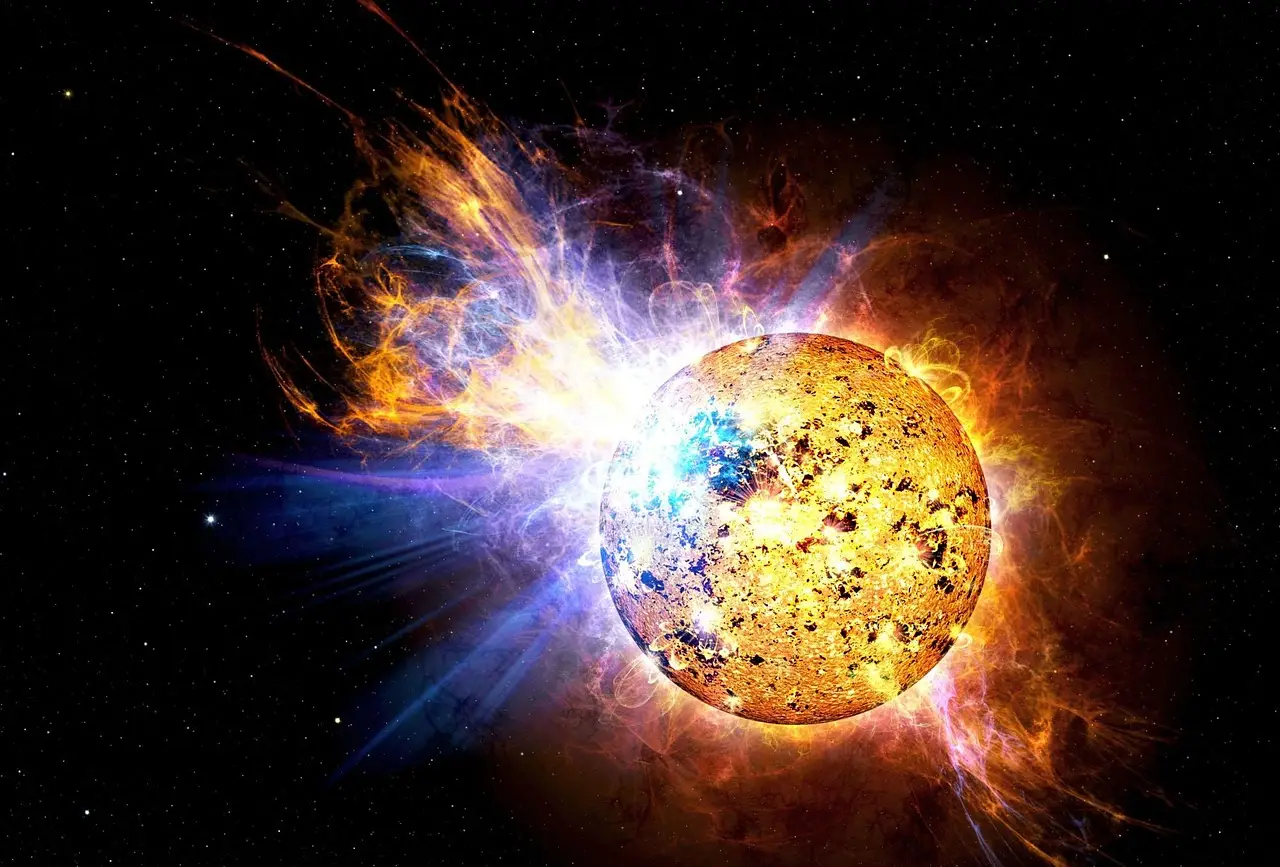
A giant star 30 million light-years away has erupted 27 times since 2012, and NASA's Chandra X-ray Observatory finally caught one of those flares in the act — and it was at least 100 times brighter in X-rays than it was two decades ago.
That burst, recorded during a flare in March 2026, is the strongest evidence yet that something invisible is tugging on the star. Astronomers suspect a neutron star or a black hole, circling the giant in a stretched-out orbit, pulls gas from it at every close pass.
But hold that thought. One X-ray snapshot is exactly that: one snapshot.
What is this star, and what is it doing?
The flaring object, called AT 2016blu, sits in the spiral galaxy NGC 4559. It carries at least 33 times the mass of our Sun — heavy enough that it should eventually explode and be done with it. Instead, it keeps flaring up and fading back, over and over, without destroying itself.
The team counted 27 eruptions in visible light between 2012 and 2026, using observations from professional surveys and amateur astronomers. That amateur contribution matters more than it might sound like; without the crowd of small telescopes, the pattern would be far sparser.
The flares turned out to run on a schedule, arriving roughly 113 days apart. That clock gave researchers what every astronomer wants: a prediction they could act on. Knowing when the next flare should fire, they pointed Chandra at the star at the right moment.
What did Chandra actually see?
X-rays, mostly. During the March 2026 flare, the source blazed at least 100 times brighter in X-rays than it had in observations from 2001 and 2002. Chandra's sharp vision also let the team separate this signal from a second, unrelated source sitting close by on the sky — a detail a blurrier telescope would have fumbled.
Here's the proposed mechanism, published in The Astrophysical Journal. A compact companion — a neutron star, the dense leftover core of an exploded star, or a black hole, whose gravity heats gas as the gas falls in — swings near the giant on a long, elliptical orbit.
Each close pass lets the companion siphon gas off the giant. That gas, falling inward, heats up and radiates X-rays. Dense gas farther out absorbs some of that energy and glows in visible light.
That picture neatly explains the star's strange stamina. Every encounter strips away more gas, producing a fresh flare, without needing a new explosion each time. The star survives its own tantrums.
X-rays earn their keep here precisely because visible light can't tell the whole story. A telescope watching only the bright optical flare sees the effect on surrounding gas but misses the hotter region powering it.
What does this change for astronomers?
For now, less than the headlines might suggest. The observation does not settle whether the companion is a neutron star or a black hole, and it gives researchers exactly one close X-ray look at a flare. A single data point makes for a hypothesis, not a verdict.
The team says watching several more outbursts would show how reliably the X-ray and visible-light signals rise together. That correlation, or lack of it, may reveal what kind of object is doing the pulling.
Still, the clock and the X-ray burst give astronomers a concrete way to test the hidden-companion idea the next time the star brightens. With flares arriving about every 113 days, the next test is never far off — and this time, researchers know where to aim.
Skeptic's note: "at least 33 solar masses" and "at least 100 times brighter" are both lower bounds, not measurements. The uncertainties run one direction. That's common in astronomy, and it's worth remembering before anyone declares the mystery solved.
via knowridge.com (Source)
More from James Calloway
Show full bio
Staff writer covering regulation, policy and their impact on general science news at SciBeat.
346 articles
Nearby plates
- Chandra Catches Hidden Black Hole Fueling 'Supernova Impostor'
- NASA’s 16-image gallery maps black holes, star births and collisions
- Gamma-ray burst's engine fired for 27 days, shattering the record
- Black Hole Winds Pack 100 Times More Power Than Scientists Expected
- Record 10-Minute X-Ray Flash Traced to a Collision of Dead Stars