Plate Nº 90 · recorded November 10, 2026
Space & AstronomyReported finding
Chandra Catches Hidden Black Hole Fueling 'Supernova Impostor'
Every 113 days a giant star 30 million light-years away flares like a supernova and survives. Chandra data point to a hidden black hole or neutron star companion.
By Elena Vasquez4 min read791 words
In brief
- A giant star erupts roughly every 113 days and has produced at least 27 optical bursts since 2012.
- Chandra data from March 2026 show the star system at least 100 times brighter in X-rays than in 2001-2002.
- The star, AT 2016blu, lies about 30 million light-years away in galaxy NGC 4559 and weighs at least 33 suns.
- This is the first X-ray detection of this class of erupting stars and the first with a black hole or neutron star companion.
- The study appears in The Astrophysical Journal (DOI: 10.3847/1538-4357/ae9a86).
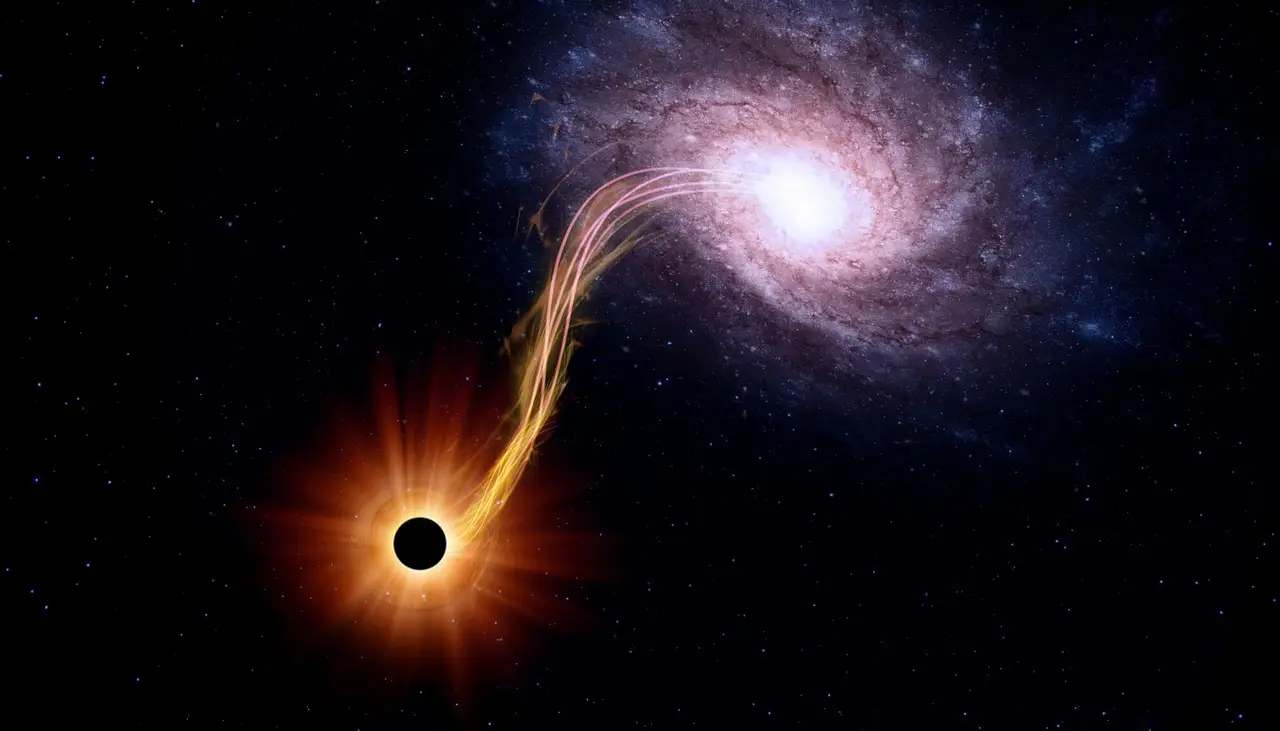
A giant star 30 million light-years from Earth has erupted at least 27 times since 2012, roughly once every 113 days, and NASA's Chandra X-ray Observatory has now found the likely cause: a hidden black hole or neutron star tearing material from the star every time the two swing close together.
The discovery, published in The Astrophysical Journal, marks the first X-ray detection of this class of erupting stars. It is also the first such object found with a black hole or neutron star companion.
The star, called AT 2016blu, lives in the spiral galaxy NGC 4559. It weighs at least 33 times as much as the sun. It belongs to a group known as luminous blue variables — hot, massive stars that swing wildly in brightness. Eta Carinae is the most famous member of that family.
AT 2016blu is a special case. Its brightness spikes are so extreme they mimic supernova explosions, in which a massive star collapses and hurls its material into space. But this star survives. It has flared and faded about three times a year for well over a decade. Astronomers call it a "supernova impostor."
Why did the eruptions puzzle astronomers?
"For 15 years, astronomers have been watching this star get really bright and then dim again on a regular basis," said Mojgan Aghakhanloo of the University of Virginia in Charlottesville, who led the study. "Until we were able to get Chandra data at the right time, we couldn't figure out what was making this happen."
The confusion ran deep. "This star's behavior was confusing at first because it kept acting like a supernova, but clearly it's not because it keeps surviving these outbursts about three times a year," said co-author Núria Torres-Albà, also of the University of Virginia. "To understand the cause of these eruptions, we realized we needed X-ray data that was timed so that we'd observe the star when it was in an outburst."
The team had a hypothesis about the engine behind the flashes. "We suspected that the bright repeating flashes at optical wavelengths might actually be powered by periodic blasts of high-energy X-rays," said co-author Nathan Smith of the University of Arizona in Tucson. "The dense gas surrounding the system is heated by the X-rays and then glows in the optical."
In short: the star's visible light show may be secondhand glow, heated by invisible X-ray blasts.
What did Chandra actually see?
Chandra was essential for a simple reason. It is the only X-ray telescope with sharp enough vision to separate AT 2016blu from another bright X-ray source sitting nearby on the sky.
The team timed the observations carefully. They needed Chandra to look exactly when the star was in outburst.
Between 2012 and 2026, astronomers tracked the star's brightness using the Katzman Automatic Imaging Telescope, the Las Cumbres Observatory Global Supernova Project, and observations from the American Association of Variable Star Observers — including data from more than 30 amateur astronomers. When those monitors showed a fresh outburst in early 2026, the team triggered Chandra through its "Target of Opportunity" program, which reserves telescope time for special events. The observations came in March 2026.
The payoff: Chandra data from March 2026 showed AT 2016blu at least 100 times brighter in X-rays than in Chandra observations from 2001 to 2002, taken before the outbursts began.
What powers the blasts?
The best explanation is gravity. The star and its companion travel an oval-shaped orbit. At closest approach, material the star has ejected gets captured by the black hole or neutron star. That gas then orbits the compact object at speeds close to the speed of light, heating up so much that it blazes in X-rays. Some of that energy heats the dense surrounding gas, which glows in visible light — the bursts astronomers see from Earth.
The system is bright enough in X-rays to qualify as a candidate ultra-luminous X-ray source. These are rare, powerful sources that astronomers have not fully explained. Current thinking holds that some contain neutron stars and others black holes. Many of them also change brightness dramatically, which hints at a possible link between these sources and violent eruptions like AT 2016blu's.
The find may pay off elsewhere, too. Astronomers suspect that some of the brightness changes stars show before true supernova explosions come from massive stars orbiting compact objects or other massive stars. This system gives them a working example to study.
The takeaway: a star that faked its own death for 15 years turns out to have a dark, dense partner stealing its material — caught red-handed by an X-ray telescope.
via phys.org/rss-feed/ (Source)
More from Elena Vasquez
Show full bio
Correspondent covering money, funding and market shifts around general science news at SciBeat.
384 articles
Nearby plates
- A Giant Star Flares Every 113 Days. Chandra May Have Found Why
- Black Hole Winds Pack 100 Times More Power Than Scientists Expected
- NASA’s 16-image gallery maps black holes, star births and collisions
- First Clean X-Ray Map Reveals Supernova Remnant Near Milky Way's Black Hole
- Webb Telescope Reveals Hidden Stars in NGC 7129, 3,300 Light-Years Away