Plate Nº 19 · recorded October 10, 2026
Space & AstronomyReported finding
Webb Telescope Reveals Hidden Stars in NGC 7129, 3,300 Light-Years Away
Webb's infrared view of NGC 7129, 3,300 light-years away, exposes hidden protostars and a massive central star whose jets carve a 3.5-light-year cavity in its birth cloud.
By Elena Vasquez4 min read717 words
In brief
- Webb revealed numerous dust-hidden stars in NGC 7129, a stellar nursery 3,300 light-years from Earth.
- The central star LkH(alpha) 234 weighs 5 to 8 solar masses and shows the image's largest diffraction pattern.
- Outflows from the central star carved a golden cavity roughly 3.5 light-years across.
- Infrared light pierces dust that scatters or absorbs visible light, exposing protostars on the region's right side.
- A photodissociation region forms where the stars' energy breaks hydrogen molecules into atoms.
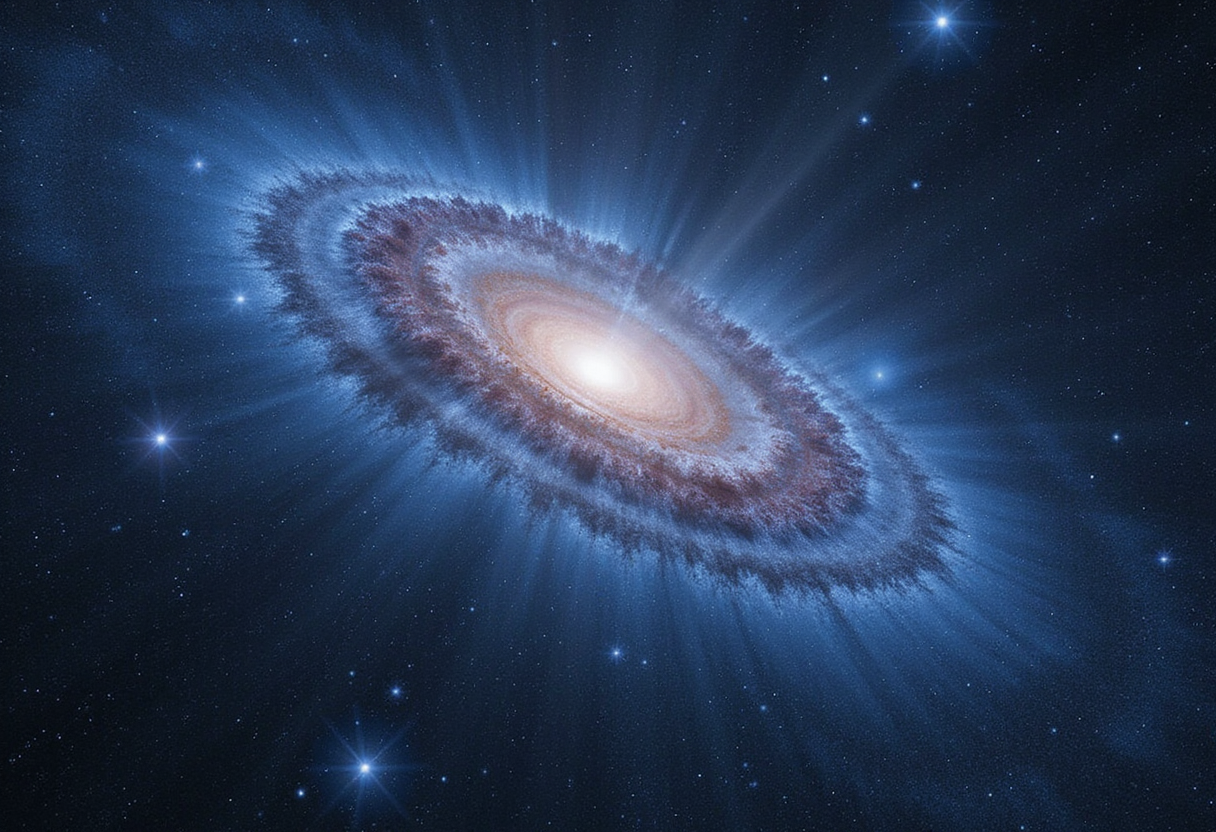
The James Webb Space Telescope has revealed numerous stars previously hidden by dust in the stellar nursery NGC 7129, a region of active star formation located 3,300 light-years from Earth. The observatory captured infrared light, which penetrates the dense matter that scatters or absorbs other types of light, exposing a chaotic scene of young stars carving cavities, compressing gas, and triggering fresh star formation.
The new image shows a region crowded with stellar objects at wildly different stages of their lives, giving astronomers an unusually clear opportunity to study how stars shape the surroundings they were born in.
What dominates the image?
The region's luminous central star, LkH(alpha) 234, anchors the scene. It displays the image's most prominent diffraction pattern — the eight-pronged spike effect characteristic of Webb's optics — and weighs roughly 5 to 8 times the mass of our Sun. It is the most massive and most mature star in the cluster, because more massive stars form and evolve the fastest.
LkH(alpha) 234 is what astronomers call a pre-main-sequence star. In plain terms, it has nearly finished gathering mass from its birth cloud and is now contracting under its own gravity, which drives its temperature upward. Eventually it will fuse hydrogen in its core, just as the Sun does today.
How is the star reshaping its nursery?
The central star's influence is most visible in a golden cavity to its left, spanning about 3.5 light-years. Outflows from an earlier stage of the star's life cycle carved this cavity into the dense molecular cloud of hydrogen that surrounds it.
The physics works two ways, with both the outflows and the star's light energising the gas and making it glow. Much of that hydrogen has been blown away entirely. But a large fraction has also been compressed — and that compression creates the conditions for even more stars to form, meaning the star is partly triggering its own successors.
A few of these young stars are visible inside the cavity. Several are also pre-main-sequence stars that generate stellar winds — streams of charged particles pushing outward. Where those winds plough into the energetic surrounding gas, they form bow shocks: curved zones of compressed gas, visible near the stars, that mark each star's own smaller cavity.
Together, the central star and its embedded neighbours heat the environment, pushing against the colder, denser molecular gas around them. This creates a boundary called a photodissociation region — a zone where ultraviolet light breaks hydrogen molecules apart into individual atoms. By controlling the heating, cooling, and chemistry in this zone, the star cluster dictates how the molecular cloud will gradually erode over millions of years.
What is happening on the right side?
The region to the right of LkH(alpha) 234 tells a different, equally violent story. The clumpy, flame-like matter shown in red conceals objects far younger than the stars in the golden cavity: protostars.
The protostar stage comes before the pre-main-sequence stage, beginning after a molecular cloud of gas and dust first compresses and fragments. As protostars pull in matter and gain mass, they eject outflows of superheated material. These outflows slam into the dense grey cocoon wrapping each protostar, producing shocks that give the region its textured appearance.
The red glow itself is a product of that same interaction, produced in much the same way as the outflows from the central star that carved the golden cavity on the left. Multiple outflows from multiple stars overlap from Webb's vantage point, which is why the scene appears so chaotic.
Why does this image matter?
NGC 7129 functions as a natural laboratory containing stars at every phase of early stellar life: protostars still feeding on their birth clouds, pre-main-sequence stars contracting and heating up, and a massive central star already blasting its environment with light and outflows.
The image also captures fainter features scattered across the field — several background galaxies appear among the stars, a reminder that Webb's infrared gaze reaches far beyond this single cloud.
By showing how stellar jets, winds, and radiation simultaneously erode and compress a molecular cloud, the observation gives astronomers a detailed case study of the feedback loops that govern star formation across the galaxy.
via ESA Space Science News (Source)
More from Elena Vasquez
Nearby plates
- Hubble Finds Stellar Winds Weaken Sharply in 29 Metal-Poor Stars
- Webb Telescope Witnesses Planet-Smashing Collisions Around Young Stars
- Hubble catalogue reveals 30,000 baby stars in N44 superbubble
- A Star Is Slowly Eating Its Companion — and Could for Billions of Years
- Astronomers Find First Stellar Stream Beyond the Milky Way