Plate Nº 50 · recorded October 10, 2026
Chemistry & MaterialsReported finding
A New Recipe Makes 'Impossible' Metal Nitride Nanocrystals
A University of Chicago team has turned nearly a dozen previously unworkable metal nitrides into nanocrystals, opening paths to flexible LEDs, printable electronics, and improved medical implants, according to a study published in Nature on August 30, 2026.
By Elena Vasquez4 min read700 words
In brief
- Study published in Nature on August 30, 2026, DOI 10.1038/s41586-026-10801-3
- Team synthesized nanocrystals from nearly a dozen previously unworkable metal nitrides, including gallium nitride, titanium nitride, niobium nitride, and molybdenum nitride
- Led by Dmitri Talapin of UChicago and Argonne National Laboratory; first author is graduate student Ruiming Lin
- Method uses molten salts as the liquid medium combined with a temperature-and-ammonia-pressure "sweet spot"
- Funded by the U.S. Department of Energy, Samsung QD Cluster Collaboration, National Science Foundation, and Air Force Office of Scientific Research
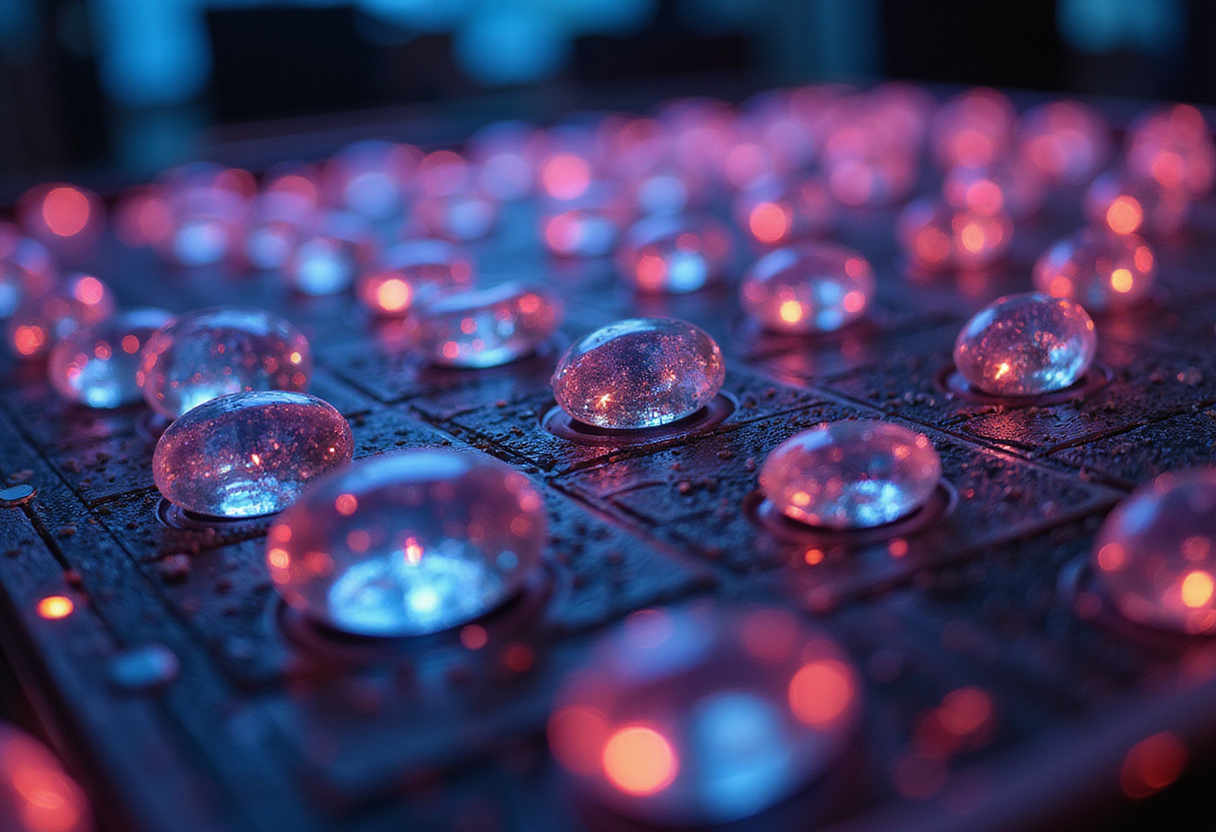
Chemists at the University of Chicago have synthesized nanocrystals from nearly a dozen metal nitrides — including gallium nitride, titanium nitride, and niobium nitride — that previously resisted miniaturization, according to a study published on August 30, 2026 in Nature.
The team, working with Argonne National Laboratory, reports a new chemical recipe that turns stiff, hard-to-process metal nitrides into nanocrystals small enough that millions could fit on a fingernail. Metal nitrides already appear in LED bulbs, laptop displays, medical implants, industrial catalysts, and superconductors.
Nanocrystals have powered breakthroughs before. Quantum dots, a closely related class of nanocrystals, helped earn the 2023 Nobel Prize in Chemistry. Until now, only a narrow set of starting materials had yielded usable nanocrystals, leaving many practical compounds off the menu.
"We were able to show how to make a series of nearly a dozen materials that could not be synthesized by traditional methods," said Ruiming Lin, a UChicago graduate student and first author on the paper.
Why are metal nitrides so hard to shrink?
Metal nitrides form when metals bind to nitrogen. The resulting compounds are strong, biocompatible, heat-tolerant, and corrosion-resistant — qualities that make them valuable across consumer electronics and medical devices.
Those same qualities also make them stubborn. As crystals grow, ions must rearrange freely before locking into place. Strong metal-nitrogen bonds block that movement.
"If bonds cannot break during this process, that's a death sentence for nanocrystals," said Dmitri Talapin, the Ernest DeWitt Burton Distinguished Service Professor of Chemistry and Molecular Engineering at UChicago, a scientist at Argonne, and the paper's senior author. "Once you make an incorrect bond, everything goes south."
What did the team do differently?
Lin and Talapin's laboratory attacked the problem with two adjustments. First, they built on a prior finding showing that molten salts can serve as the liquid medium in nanocrystal synthesis, stabilizing the crystals as they form.
Second, they tuned temperature and ammonia pressure until they reached a "sweet spot" where metal-nitrogen bonds could break and reform without locking in errors. The Talapin lab has used molten-salt chemistry in earlier nanocrystal work, but the new study extends the idea into a much tougher family of compounds.
"This process is very unusual — it goes against every bit of common sense in the field," Talapin said. "We had to entirely rethink the approach."
Which new nanocrystals did they produce?
Beyond gallium nitride, used today in LED bulbs and laptop displays, the recipe yielded:
- Titanium nitride, common in medical implants
- Niobium nitride, an industrial superconductor
- Molybdenum nitride, widely used as a catalyst
The materials are also relatively inexpensive, a point researchers flagged as relevant for manufacturing scale.
"This expands the boundaries of the field beyond what were previously fundamental constraints," Talapin added, "and lays the foundation for the use of nitrides as nanomaterials."
What could this enable next?
Nanocrystals behave differently from bulk materials. They can produce vivid colors, speed up chemical reactions, or accept entirely new shapes. Converting metal nitrides into nanocrystals opens the door to flexible lighting, inkjet-printed circuits, and fabric-integrated electronics.
Gallium nitride nanocrystals could leave the rigid LED film and join printable polymer layers. Titanium nitride nanocrystals might blend into implants tailored for individual patients. Niobium nitride nanocrystals could eventually feed into superconducting inks.
"I remember the first time I looked through the electron microscope and saw those crystals," Lin said. "You always hope something you discovered will wind up in applications. I think there will be many uses."
Who else worked on the study?
Co-authors from UChicago included Ningxin Jiang, Wooje Cho, Zirui Zhou, Di Wang, Justin Ondry, Zehan Mi, James Cassidy, Alex Hinckle, Alexander Filatov, and John S. Anderson. The work drew on shared facilities at UChicago's NSF Materials Research Science and Engineering Center, the Soft Matter Characterization Facility, and Argonne's Center for Nanoscale Materials. Funding came from the U.S. Department of Energy, the Samsung QD Cluster Collaboration, the National Science Foundation, and the Air Force Office of Scientific Research.
Results described here come from laboratory experiments; commercial products built on these nanocrystals remain years away, and many of the proposed flexible-electronics uses remain unproven outside the lab.
via news.uchicago.edu (Original)
More from Elena Vasquez
Nearby plates
- NSF Launches ELEGANT to Move Lab Semiconductors Toward U.S. Factories
- MIT Makes Flexible, Transparent Silicon Photonics Chips at Wafer Scale
- Atom-Thin Materials Could Make Quantum Light Circuits Programmable
- Tiny Nanolaser Could Cut Computer Energy Use in Half
- Quantum Spins Push a 100-Milligram Diamond in Lab First