Recorded November 25, 2026
Health & Medicine ResearchReported finding
AI-Designed Protein RF-409 Cuts Blood Sugar 60% in Mice With Broken Insulin Receptors
An AI-designed protein called RF-409 cut blood sugar by 60% in mice with a defective insulin receptor, a mutation insulin can't touch, hinting at a lead for Donohue syndrome. Human use is years and many questions away.
By James Calloway4 min read804 words
In brief
- RF-409 lowered blood sugar by roughly 60% within two hours in mice with a Donohue-syndrome-linked insulin receptor mutation
- The AI-designed protein stayed in the bloodstream nearly 60-fold longer than insulin
- More than 150 mutations in the insulin receptor gene are linked to inherited insulin resistance
- The study appeared Nov. 25 in Science Translational Medicine
- Five mice treated for 14 days maintained weight and showed less pancreatic damage than saline controls
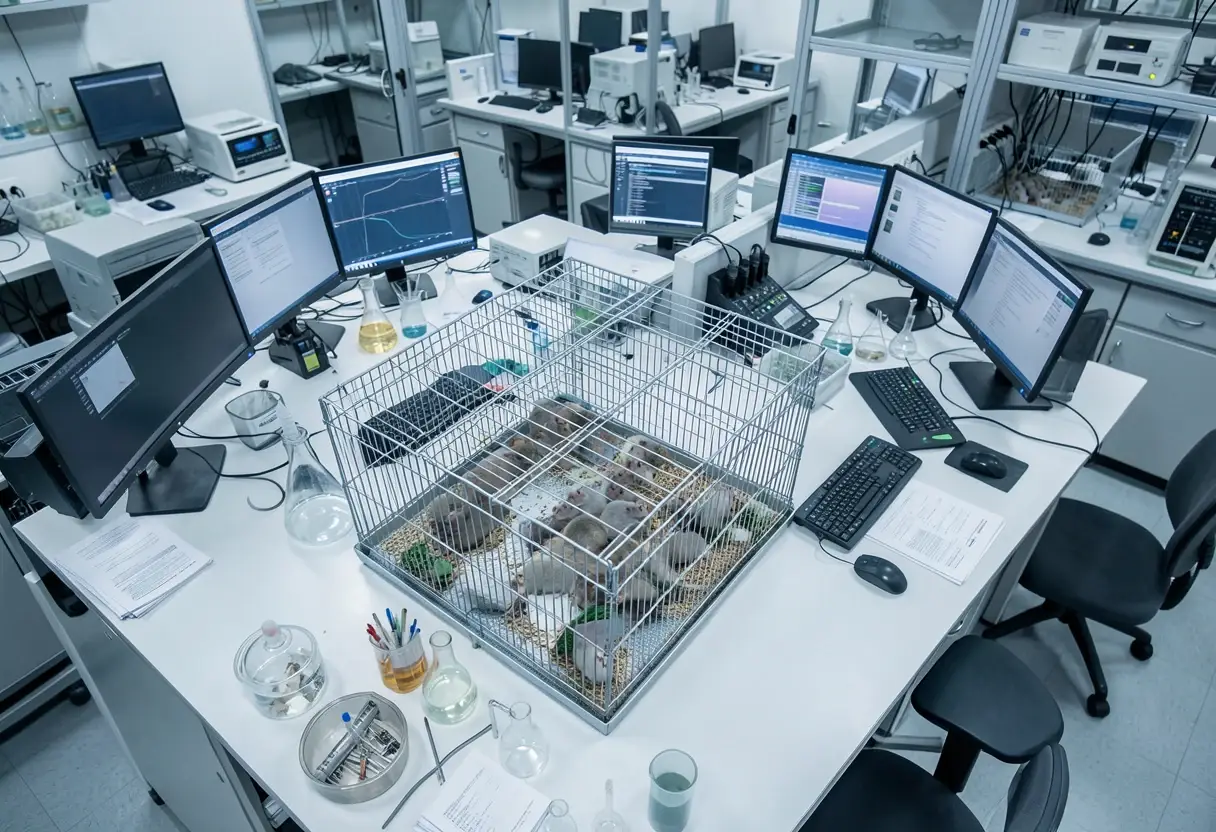
A protein designed with artificial intelligence lowered blood sugar by roughly 60% within two hours in mice carrying a defective insulin receptor — a mutation against which insulin itself does essentially nothing. The study, published Nov. 25 in Science Translational Medicine, is the first evidence that a fully synthetic molecule can switch on a broken receptor involved in severe genetic insulin resistance. Emphasis on "in mice." Let's take it apart.
What did the researchers actually build?
The molecule is called RF-409. The team, led by Columbia University cell biologist Eunhee Choi, designed it in 2025 using computational tools including AlphaFold2, the AI program that predicts how proteins fold and fit together. An earlier round of that work showed RF-409 could lower blood sugar in healthy mice and in mice with obesity. The new paper asks a harder question: does it work when the receptor itself is broken?
The thinking is straightforward. When blood sugar rises, the pancreas releases insulin, which binds to insulin receptors on the cell surface, changing their shape and triggering the signals that pull sugar out of the blood. Mutations in the gene that builds that receptor break the chain. More than 150 such mutations are known. In Donohue syndrome, one of the cruelest forms, children suffer dangerous blood-sugar swings and poor growth, and most die before their first birthday.
"Some [of these] patients produce extremely high levels of insulin, but their receptors cannot respond properly," Choi told Live Science. "Simply giving more insulin may not solve the problem."
How well did it work?
First, the researchers confirmed the basics in lab-grown mouse and rat cells and in healthy mice. RF-409 largely mimicked insulin's effects on cellular signaling and metabolism. One measured bonus: in the mice, its half-life in the bloodstream was nearly 60-fold longer than insulin's, meaning it circulates far longer before breaking down.
Then came the real test. The mice in question carried a mutation previously identified in Donohue syndrome patients; it alters a key part of the receptor so insulin can't bind. Compared with mice retaining a working copy of the gene, these animals averaged about 2.5 times higher blood sugar and 10 times higher fasting insulin. Injected insulin produced no substantial drop in their blood sugar. RF-409 did — roughly 60% within two hours.
Computer models suggest why: the designed protein bypasses the damaged region and holds the receptor in the shape it needs to transmit signals inside the cell.
After 14 days of continuous treatment, five mice on RF-409 had lower blood sugar, maintained body weight, and kept more abdominal fat than five saline-treated comparison mice. The treated animals also showed less pancreatic damage — relevant because the condition normally wastes both the gland and the animal.
"It is like designing a new key to open a defective lock," said Kalaiarasan Ponnusamy, a computational biologist at SRM Institute of Science and Technology in India, who was not involved in the study. "From a computational protein-design perspective, this is a major advance because it demonstrates that entirely new proteins can be engineered to restore receptor function without correcting the underlying genetic mutation."
What does this change for patients?
Right now, very little — and the paper's own experts say so. "Both these features make [the finding] more than just an elegant trick," said Dr. Rajiv Agarwal, a nephrologist at Indiana University School of Medicine, pointing out that RF-409 reproduces most of insulin's normal signaling, "which matters in children who need growth as well as glucose control." But he also flags hurdles: the immune system's reaction to the protein needs careful study, and trials in infants with rare disorders are notoriously hard to run.
The limits run deeper than logistics. The trick only works if the receptor can still transmit signals once it's forced into the right shape. Some mutations stop the receptor from reaching the cell surface at all, or kill its signaling entirely. Against those, RF-409 has nothing to grab. "Extending this approach to other disease-causing receptor mutations is a realistic possibility, provided the receptor retains its ability to transmit signals," Ponnusamy said.
Choi's next steps are exactly what you'd want: identifying which of the 150-plus known mutations can be treated this way, mapping how RF-409 affects different tissues, and testing whether it stays safe and effective over longer treatment periods. None of that work has been done yet.
Still, Agarwal sees something genuinely new here. "This is the first approach I have seen that addresses the actual defect rather than working around it," he said. For a disease with no treatment aimed at its underlying cause, that's a claim worth testing — and, as always, the mice got the good news first.
via livescience.com/feeds/news (Source)
More from James Calloway
Show full bio
Staff writer covering regulation, policy and their impact on general science news at SciBeat.
606 articles
Nearby plates
- Implant Converts Blood Sugar Into Harmless Byproduct in Diabetes Breakthrough
- Early Trial: Some Type 1 Diabetes Patients Off Insulin
- Electric Implant Cuts Blood Sugar Without Drugs — In Mice, So Far
- All 12 Trial Participants Off Insulin After Tegoprubart Treatment
- Mouse study: Wireless implant normalized blood sugar without insulin