Recorded November 20, 2026
Biology & EvolutionReported finding
AI Tracks Beluga Whales From Drone Photos With 1% of the Usual Labels
Florida Atlantic-led team trained SEMI-DETR on just 34 labeled drone images to detect beluga whales, gaining 20% over supervised models and 24.3% on hard-to-spot calves.
By Marcus Bennett4 min read751 words
In brief
- Researchers trained and compared five AI models on 7,655 aerial drone images of beluga whales, each labeled adult or calf.
- The semi-supervised model SEMI-DETR reached a mean average precision of 19.2 with only 34 labeled images — 1% of the data — a 20% relative improvement over the best supervised model.
- Calf detection improved 24.3% at the 1% labeling level, versus 16.8% for adults.
- Comparable detection performance required roughly five to 10 times less manual annotation.
- The study appears in Frontiers in Marine Science (2026), DOI: 10.3389/fmars.2026.1913328.
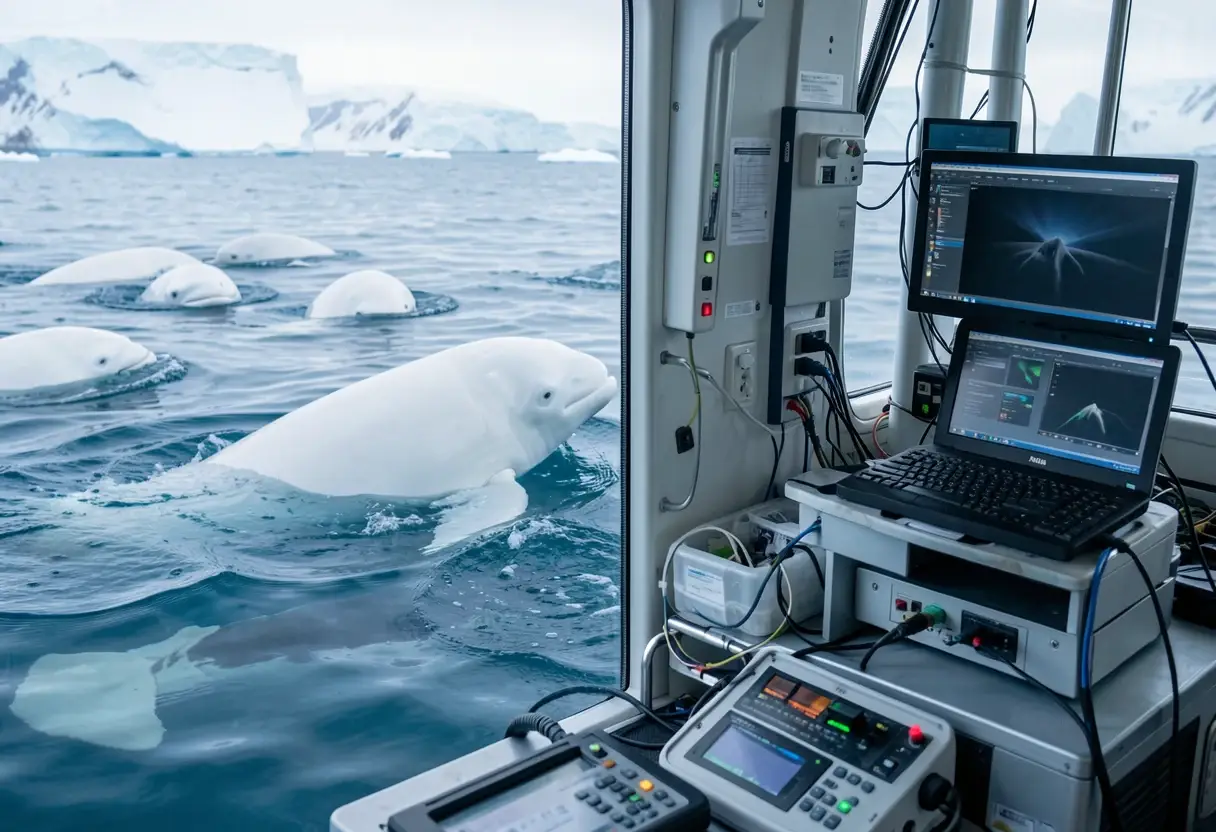
A deep-learning model detected beluga whales in aerial drone imagery after training on just 34 human-labeled photos — 1% of the labeled data conventional AI systems typically demand — while outperforming fully supervised rivals by 20%. The study, published in Frontiers in Marine Science (2026), points to a faster, cheaper path for monitoring Arctic marine mammals.
Researchers at Florida Atlantic University's College of Engineering and Computer Science and Harbor Branch Oceanographic Institute led the work, collaborating with Fisheries and Oceans Canada and the University of Manitoba. For Arctic survey teams, the practical stakes are simple: counting belugas from the air has long meant manually scanning thousands of images for animals that are hard to see and harder to tell apart — especially calves, whose smaller size, lower numbers and variable appearance make them easy to miss. Calf counts matter because they signal reproduction, population growth and long-term herd health.
How the models were tested
The team assembled 7,655 high-resolution aerial drone images, with each whale identified as either an adult or a calf. They trained five AI models and evaluated them at seven labeling levels, from 1% to 50% of the annotated data, to measure how well each model performs when expert-labeled imagery runs short.
The clear winner was a semi-supervised approach called SEMI-DETR. Semi-supervised learning, in plain terms, means the model learns from a small set of expert-annotated images and then exploits a much larger pool of unlabeled ones. At the 1% level — 34 images — SEMI-DETR achieved a mean average precision of 19.2, a 20% relative improvement over the best-performing supervised model. At the 5% labeling level, the advantage grew to 6.6 percentage points. Overall, the researchers found comparable detection performance with roughly five to 10 times less annotation, which could sharply cut the time and cost of preparing imagery for automated analysis.
"Artificial intelligence is opening a new path for conservationists to make sense of the enormous volumes of imagery that modern monitoring technologies can collect," said Hanqi Zhuang, senior author and associate dean and professor in FAU's Department of Electrical Engineering and Computer Science. Semi-supervised learning, he said, has "the potential to transform how we monitor wildlife — making sophisticated computer vision tools more accessible, scalable and practical for scientists working in some of the most challenging environments on Earth."
Why calves benefit most
The gains were largest exactly where human annotators struggle most. At the 1% labeling level, SEMI-DETR improved calf detection by 24.3% relative to the supervised baseline, compared with 16.8% for adults. That asymmetry matters for conservation programs, since calf counts are the hardest to compile by hand and the most informative about a population's trajectory.
The findings remain a benchmark from one dataset rather than a finished operational tool; the study evaluated detection on beluga imagery specifically, and the results give guidance for programs with limited annotation resources rather than a turnkey system. Still, the method reduces the labor-intensive human effort needed to train wildlife-detection AI.
What it means for Arctic monitoring
"This research demonstrates how artificial intelligence and engineering can be applied to address complex environmental challenges," said Stella Batalama, dean of FAU's College of Engineering and Computer Science. She said the work creates "practical solutions that can strengthen conservation efforts and help protect vulnerable species and ecosystems."
Co-author Greg O'Corry-Crowe, a research professor at FAU Harbor Branch, a National Geographic explorer and a specialist in wildlife evolution and behavior, framed the payoff in field terms: "It gives us the potential to look across far more images and observations than we could realistically process by hand, allowing us to better understand where belugas are, how they move, how successfully they reproduce and how those patterns are changing." As the Arctic environment shifts, he noted, better monitoring tools will grow only more important for protecting a species central to that ecosystem.
Additional co-authors are Mohammed G. Al-Jassani and Chiron Bang, Ph.D. students in FAU's Department of Electrical Engineering and Computer Science, plus Fisheries and Oceans Canada and University of Manitoba researchers Cortney A. Watt, a research scientist, and Mark Gillespie, a researcher and field technician.
The paper — "Using semi-supervised learning to detect beluga whales from aerial image sequences," DOI: 10.3389/fmars.2026.1913328 — offers conservation teams a concrete rule of thumb: with the right model, a few dozen expert labels can go a long way.
via phys.org/rss-feed/ (Source)
More from Marcus Bennett
Show full bio
News editor covering regulation, policy and their impact on general science news at SciBeat.
584 articles
Nearby plates
- Humpback Whale Calves Nearly Vanish From 2026 Migration
- Drone-Collected Whale Breath Yields First Whole Genome Without Biopsies
- Scientists Sequenced Whale Genomes From Nothing but Snot
- Baby Whales Are Washing Up Dead in Argentina, and Scientists Are Racing to Find Out Why
- North Atlantic Right Whales Fall to 382, Reversing Recent Gains