Recorded November 25, 2026
Chemistry & MaterialsReported finding
Antifreeze liquid may control water-layer formation on submerged ice
Atomic force microscopy measured a 4 nm water layer on ice in decane at −6 °C and a 2 nm layer in octane at −7 °C; octanol and saltwater showed direct contact.
By Marcus Bennett4 min read829 words
In brief
- Decane at −6 °C produced an approximately 4 nm water-layer jump.
- Octane at −7 °C produced an approximately 2 nm jump.
- Octanol and saltwater produced no jump, which the authors read as direct ice-liquid contact.
- Adding 1 wt.% octanol to decane eliminated the jump despite an expectation of no bulk-property change.
- The 2026 paper proposed that hydrogen bonding removes free surface OH groups in octanol and saltwater.
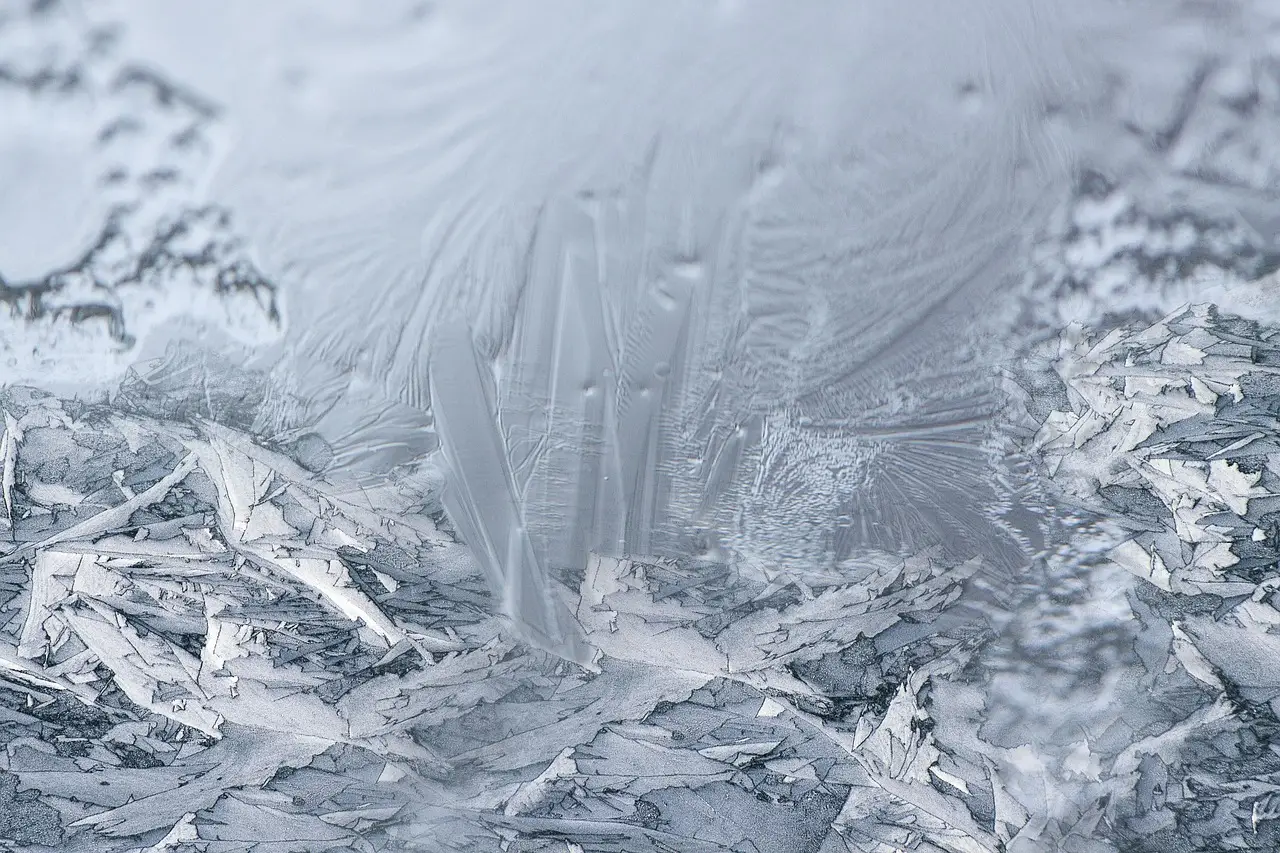
Atomic force measurements detected a roughly 4 nm water layer on ice in decane at −6 °C and a 2 nm layer in octane at −7 °C, but none in octanol or saltwater.
Published in 2026 in The Journal of Chemical Physics, the study suggests that the surrounding liquid can decide whether a thin layer of liquid water remains at the ice boundary. That matters because researchers cannot treat submerged ice, liquid water and antifreeze additives as separate actors when they meet only nanometers apart.
What did the measurements show?
Ryo Yanagisawa and colleagues used an atomic force microscope to test ice in several surrounding liquids. Their results were:
- Decane at −6 °C: The probe made a sudden “jump-in” of about 4 nanometers.
- Octane at −7 °C: The corresponding jump measured about 2 nanometers.
- Octanol: No jump occurred.
- Saltwater: No jump occurred.
- Decane with 1 wt.% octanol: One part octanol by weight per 100 parts of mixture eliminated the jump seen with pure decane.
The authors interpreted the absent jumps in octanol and saltwater as “direct contact between ice and liquid.” In other words, no intervening water layer produced a detectable mechanical transition for the probe in those tests.
They also reasoned that 1 wt.% octanol should not alter the bulk properties of decane, meaning the liquid’s overall physical characteristics. Since the mixture nevertheless removed the jump, they inferred that octanol accumulated at the ice-liquid interface and changed the local disordering process.
Across the reported tests, the surrounding liquid determined whether a nanometer-scale water layer appeared.
How did the microscope measure the film?
Ice exposed to a vacuum or vapor has been studied extensively, but submerged ice presents a harder measurement problem. Temperature changes make ice dissolve or grow, leaving a fluctuating interface while researchers try to examine it.
The team cooled an atomic force microscope to −10 °C. They moved the probe tip, attached to the free end of a flexible cantilever, through the antifreeze liquid toward an ice wafer. The instrument recorded the cantilever’s deflection as a function of its vertical coordinate.
The researchers converted that deflection into the force applied to the tip, producing force-versus-distance curves. In this method, a sudden “jump-in” meant the tip had reached a water layer rather than the solid ice. The depth of the jump then gave the layer’s thickness.
That mechanical reading explains the reported values: a jump of roughly 4 nm corresponded to a 4 nm film in decane, while a jump near 2 nm corresponded to a 2 nm film in octane.
The instrument did not produce a conventional picture of the film; it inferred thickness from how the probe responded as it approached and crossed the interface.
Why might octanol and saltwater erase the layer?
The authors began with a model used for ice in vacuum or vapor. In that model, free hydroxyl groups on the ice surface drive disorder. A hydroxyl group is an oxygen-hydrogen unit, abbreviated OH.
They hypothesize that the model also applies to alkanes, the carbon-and-hydrogen compounds represented here by decane and octane. Under that interpretation, surface disordering in those liquids would be consistent with the measured water layers.
For octanol and saltwater, the authors propose a different route. Hydrogen bonding across the octanol-ice or saltwater-ice interface removes the free OH groups from the ice. Hydrogen bonding is a directional attraction involving a hydrogen atom and a neighboring molecule.
Without those free surface OH groups, the antifreeze liquid can contact the ice directly rather than sitting behind a layer of water. The result matches the lack of a jump in the force curves.
The force measurements support the presence or absence of the film under the tested conditions. They do not directly image the OH groups or the proposed accumulation of octanol, so that molecular explanation remains a hypothesis rather than a separately observed structure.
What changes for laboratory researchers?
The immediate methodological lesson is that a probe’s jump can serve as a thickness measurement when a water film exists. A missing jump, under the same measurement logic, identifies direct ice-liquid contact instead.
The second lesson concerns additives. A concentration of only 1 wt.% octanol changed the measured interface even though the researchers did not expect it to change the bulk properties of decane. Surface chemistry can therefore matter at concentrations that leave the bulk liquid apparently unchanged.
Any comparison therefore has to specify the liquid, additive concentration and measurement temperature so that a different interface is not mistaken for the same one.
The paper, “Water layers on ice submerged in antifreeze liquid: Nano-forcemetry,” by Ryo Yanagisawa and colleagues, appeared in The Journal of Chemical Physics in 2026. Its DOI is 10.1063/5.0354662.
Takeaway: In laboratory studies of submerged ice, the surrounding liquid and even a trace additive can create or erase the nanometer-scale interface researchers are trying to measure.
via phys.org/rss-feed/ (Source)
More from Marcus Bennett
Show full bio
News editor covering regulation, policy and their impact on general science news at SciBeat.
610 articles