Plate Nº 12 · recorded November 8, 2026
Space & AstronomyReported finding
Auroras and Power Grid Failures Share One Cause, Study Finds
A substorm erupting up to 40,000 miles away can disturb Earth's surface magnetic field in about seven minutes, new satellite and ground data show — with real risks for power grids.
By Elena Vasquez4 min read783 words
In brief
- Ground magnetic disturbances began about seven minutes after a substorm's magnetic reconnection in space.
- Substorms release energy roughly 28,000–40,000 miles (45,000–65,000 km) from Earth, on the night side.
- A March 1989 storm knocked out power to more than 6 million people in Québec for about nine hours.
- The May 2024 storm — the strongest in over two decades — forced a Swedish transmission link to disconnect.
- Study published in Journal of Geophysical Research: Space Physics (2025), DOI 10.1029/2025ja034553.
By Elena Vasquez
Seven minutes. That's roughly how long it takes for an explosive release of magnetic energy tens of thousands of miles from Earth to begin disturbing the magnetic field at the planet's surface, according to new research published in the Journal of Geophysical Research: Space Physics.
The study, led by Sanjay Kumar and colleagues, shows that a single space weather event called a substorm can affect the ground within minutes of erupting in space. And the impact varies sharply from place to place, depending on latitude and the structure of the soil and rock below your feet.
The takeaway: the same process that paints auroras across the night sky also pushes electric currents through the ground, currents that can damage transformers and trip circuit breakers.
What is a substorm?
Earth sits in a constant stream of charged particles from the sun, called the solar wind. Occasionally the sun lets loose a much bigger eruption, a coronal mass ejection — a cloud of charged particles and magnetic fields.
That cloud doesn't simply slam into Earth and knock out power grids. Instead, it triggers a chain of events in space.
When the ejection arrives, its magnetic field can connect with Earth's field on the sun-facing side, in the magnetosphere — the region of space dominated by Earth's magnetic field. The solar wind then drags those connected field lines around the planet and stretches them far behind Earth, forming a long structure called the magnetotail.
Magnetic energy piles up in the magnetotail. When the stretched field lines come close enough to reconnect, that stored energy releases explosively. That's the substorm. It happens on Earth's night side, roughly 28,000 to 40,000 miles (45,000 to 65,000 kilometers) away.
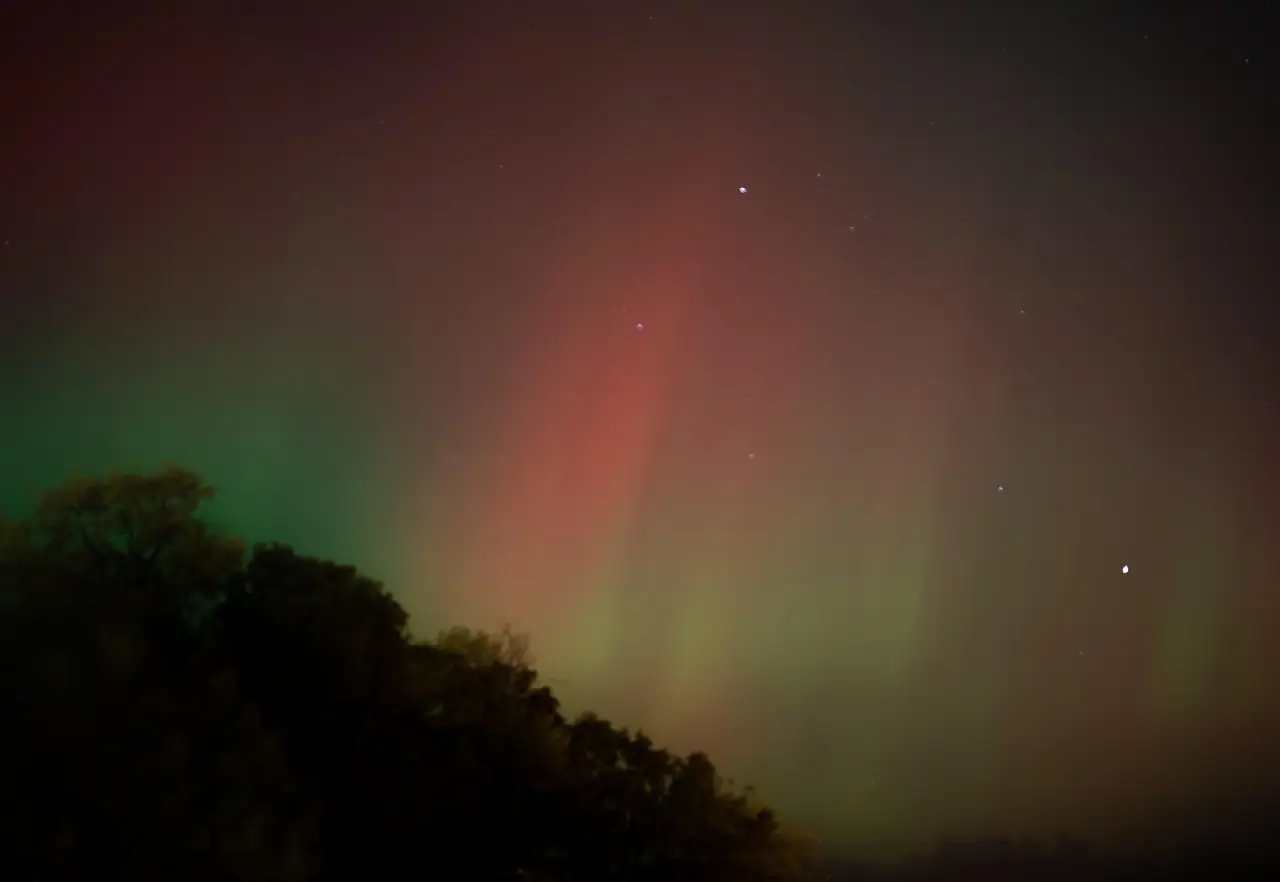
Energetic particles race along the field lines toward Earth. They slam into oxygen and nitrogen atoms 56 to 93 miles (90 to 150 kilometers) overhead, producing the glowing green and red curtains of the aurora. That's the light show.
How did the team measure it?
The researchers combined data from NASA's THEMIS spacecraft — short for Time History of Events and Macroscale Interactions During Substorms — with NOAA's GOES satellites and a dense network of ground magnetometers, instruments that measure magnetic field changes, spread across Arctic Canada.
They examined two auroral events in detail. The observations showed a clear sequence: when the stretched nightside field lines suddenly reconnected, spacecraft recorded an abrupt magnetic shift and a burst of charged particles heading toward Earth. About seven minutes later, ground instruments picked up rapid magnetic changes.
The disturbance didn't appear everywhere at once. In these observations, effects began at lower latitudes and spread toward the North Pole over the next 20 to 30 minutes.
The bottom line: energy released far out in the magnetotail reaches Earth's surface fast.
Why do nearby places feel it differently?
Here's the surprising part. Magnetic stations tens to hundreds of miles apart often recorded very different responses — strong swings at one site, weak ones at the next.
The differences depended on:
- The strength of electrical currents in the upper atmosphere
- How electrically conductive the upper atmosphere is overhead, which varies with sunlight and auroral activity
- How conductive the ground is beneath each station, which depends on local geology and moisture
So a spectacular aurora overhead doesn't guarantee the strongest magnetic disturbance or ground currents below it.
In short, you can't judge ground risk by looking at the sky.
When has this actually caused blackouts?
History offers sobering precedents.
During the March 1989 geomagnetic storm, observers saw auroras as far south as Texas, while rapid magnetic field changes contributed to the collapse of the Hydro-Québec power system. More than 6 million people lost electricity for about nine hours on a cold winter night.
The Halloween storms of October 2003 brought auroras across Europe, and geomagnetically induced currents contributed to a blackout affecting about 50,000 people in Malmö, Sweden.
In May 2024, during the strongest geomagnetic storm in over two decades, induced currents stressed the grid in southern Sweden, forcing a transmission link to disconnect and briefly interrupting electricity flow.
What does this mean for forecasting?
Space weather forecasts can warn grid operators hours before solar activity arrives, giving them time to monitor conditions. But substorm effects develop only after the solar wind interacts with Earth's magnetic environment, and the new research shows they unfold on timescales of minutes.
That leaves little warning room. The study's plain message: the aurora's beauty and the risk of invisible currents above and below are two faces of the same space weather event — and the ground feels it within minutes.
via phys.org/rss-feed/ (Source)
More from Elena Vasquez
Show full bio
Correspondent covering money, funding and market shifts around general science news at SciBeat.
384 articles
Nearby plates
- Smile Mission Delivers First Ultraviolet Footage of Earth's Full Aurora Ring
- Gravity can snap and reconnect like the sun's magnetic field, study finds
- Mars's Oddest Cloud May Be Even Odder Than We Thought
- Jupiter's Invisible Shield Is Stranger Than Earth's, Juno Finds
- Meteors Don't Just Burn: Seven Violent Stages Decide Their Fate