Plate Nº 76 · recorded November 11, 2026
Space & AstronomyReported finding
Gravity can snap and reconnect like the sun's magnetic field, study finds
A new study of Einstein's equations finds gravitational field sheets can break and reconnect like the sun's magnetic field lines, potentially reshaping how gravity and matter exchange energy.
By Elena Vasquez4 min read853 words
In brief
- The study, published Oct. 28 in Physical Review D, was authored by Luca Comisso of Columbia University and Felipe Asenjo of Adolfo Ibáñez University in Chile.
- Gravitational field sheets can break and reconnect much like magnetic field lines in plasmas, the study found.
- The findings require no new physics and follow entirely from Einstein's general relativity.
- Possible natural triggers include black hole singularities, tiny gravitational ripples, and Hawking radiation.
- LIGO has recorded gravitational waves from cosmic collisions since 2015, a possible testing ground for the theory.
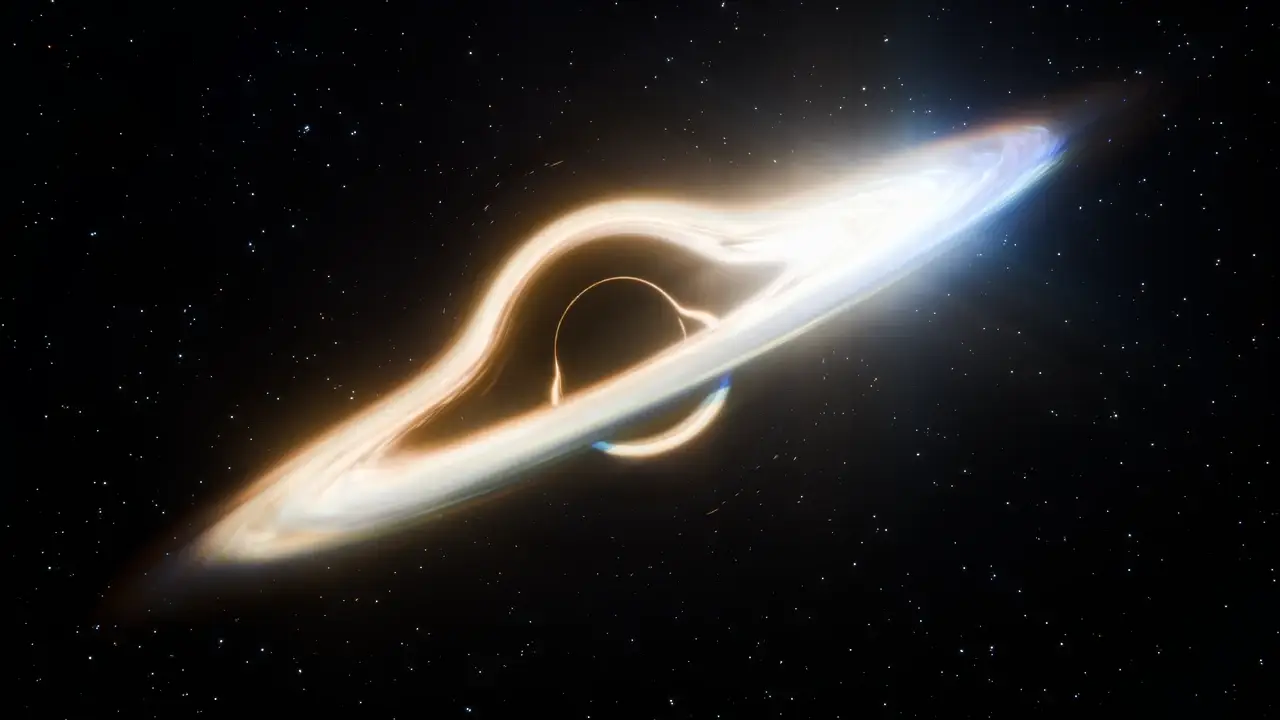
Gravity can tear and reconnect the way the sun's magnetic field lines do, according to a theoretical study published Oct. 28 in the journal Physical Review D. The result hints at a previously unexplored way that gravity and matter trade energy — and it follows entirely from Einstein's own equations, with no new physics required.
The paper builds on the concept of magnetic reconnection, the process behind the sun's most violent outbursts. On the sun, magnetic field lines are normally "frozen" into plasma — the hot, electrically charged gas that makes up stars — and carried along wherever it flows. The lines can stretch and twist, but not cut. Where that rule breaks down, they snap and rejoin, releasing pent-up energy in explosive bursts such as solar flares.
Luca Comisso, an astrophysicist at Columbia University and first author of the study, asked the natural follow-up question. "In plasma physics, reconnection has become an essential part of our understanding of how magnetic fields reorganize and exchange energy with matter," Comisso told Live Science via email. "Could something similar be true for gravity?"
How do you get magnetic behavior out of gravity?
The answer starts with a mathematical trick. Einstein's theory of general relativity describes gravity through the geometry of space-time. But Comisso and co-author Felipe Asenjo, a physicist at Adolfo Ibáñez University in Chile, used a framework called the tetrad formulation, in which certain aspects of gravity can be expressed through quantities resembling electric and magnetic fields.
"Gravity and magnetism describe very different aspects of nature, so there's no obvious reason to expect them to behave alike," Comisso said. "But when we express Einstein's equations in a particular mathematical form, some of the same principles that govern magnetic fields also emerge in gravity."
In a prior study, published in Physical Review Letters earlier this year, the pair applied this framework and found that gravitational fields can form two-dimensional structures called gravitational field sheets. One dimension of a sheet stretches through space; the other stretches through time, so each sheet is the trail a line leaves as time passes. A snapshot at any instant catches each sheet as a line, much like the field lines drawn around a magnet. And under certain conditions, these sheets evolve without breaking or changing their connections.
The takeaway: gravity, written in the right mathematical language, produces rope-like structures that behave like magnetic field lines frozen in plasma.
What did the new study find?
The new paper shows the frozen-in rule doesn't always hold. "Gravitational field sheets can break and reconnect in a different arrangement, much like magnetic field lines do in plasmas," Comisso said.
The researchers also drew a careful boundary around the effect. Breaking the frozen-in rule doesn't, by itself, guarantee reconnection. Sometimes the sheets merely slip relative to the flow carrying them, staying intact because they remain frozen into a different flow. Genuine reconnection happens only when no such alternative flow exists.
The team derived equations describing how quickly the reconnection can occur and how it affects the transfer of energy and momentum. In general relativity, gravity and matter can trade energy and momentum, with only their combined total conserved — and the study shows reconnection changes the local rate of that exchange. Reconnection also alters gravitational helicity, the gravitational counterpart of a quantity measuring how twisted and interlinked magnetic field lines are. Frozen-in sheets keep their helicity fixed; reconnection can create or destroy it.
"Everything follows from Einstein's general relativity," Comisso said. "Einstein developed his theory more than a century ago, and it has passed an extraordinary number of experimental tests. Yet even after more than a century, there are still new insights to be gained from those same equations."
The takeaway: pure math, drawn from a 1915 theory, predicts a new kind of gravitational behavior.
Could black hole collisions show it?
What could trigger gravitational reconnection in nature remains an open question. The candidates the researchers suggest include the singularities thought to lurk at the hearts of black holes, the combined effect of gravitational ripples too small to track individually, and quantum effects linked to Hawking radiation — the faint glow black holes are predicted to emit.
"We're still at the beginning, but one of the most interesting possibilities is that gravitational reconnection could play a role in extreme events, such as the merger of two black holes or the collision of neutron stars," Comisso said. "These are environments where gravity is extremely strong and the geometry of spacetime changes dramatically."
Such collisions send out ripples in space-time called gravitational waves, which detectors such as LIGO, the Laser Interferometer Gravitational-Wave Observatory, have been recording since 2015. "We'd like to understand whether gravitational reconnection could contribute to transferring energy, and whether it might leave a recognizable signature in gravitational waves," Comisso added. "We don't know the answers yet, but these are questions that we can now begin to investigate."
The takeaway: this is early-stage theory, but it hands gravitational-wave astronomers a concrete new question to chase.
via livescience.com/feeds/news (Source)
More from Elena Vasquez
Show full bio
Correspondent covering money, funding and market shifts around general science news at SciBeat.
384 articles
Nearby plates
- Gravity Can Break and Reconnect Like Magnetic Fields, Physicists Calculate
- Solar Orbiter traces solar wind switchback back to the Sun
- Solar Orbiter Flies Straight Through a Magnetic Switchback
- Record-Breaking X-Ray Flash May Mark Birth of a Magnetar
- Hubble finds stellar winds can suppress escaping ultraviolet light