Plate Nº 27 · recorded October 10, 2026
Space & AstronomyReported finding
Solar Orbiter traces solar wind switchback back to the Sun
ESA's Solar Orbiter has traced an S-shaped magnetic kink in the solar wind back to a specific region on the Sun's surface for the first time, identifying 'interchange reconnection' as the formation mechanism.
By James Calloway3 min read619 words
In brief
- Solar Orbiter made the switchback observation in 2022 while sitting roughly halfway between Earth and the Sun.
- The study was published in Nature Astronomy in 2026 with DOI 10.1038/s41550-026-02928-0.
- Lead author Jesse Coburn works at CNRS/LPP in France; co-author Stephanie Yardley works at Northumbria University in the UK.
- The team detected charged oxygen and carbon ions unique to closed magnetic loops on the Sun's surface.
- The analysis combined Solar Orbiter's SWA instrument data with images from NASA's Solar Dynamics Observatory.
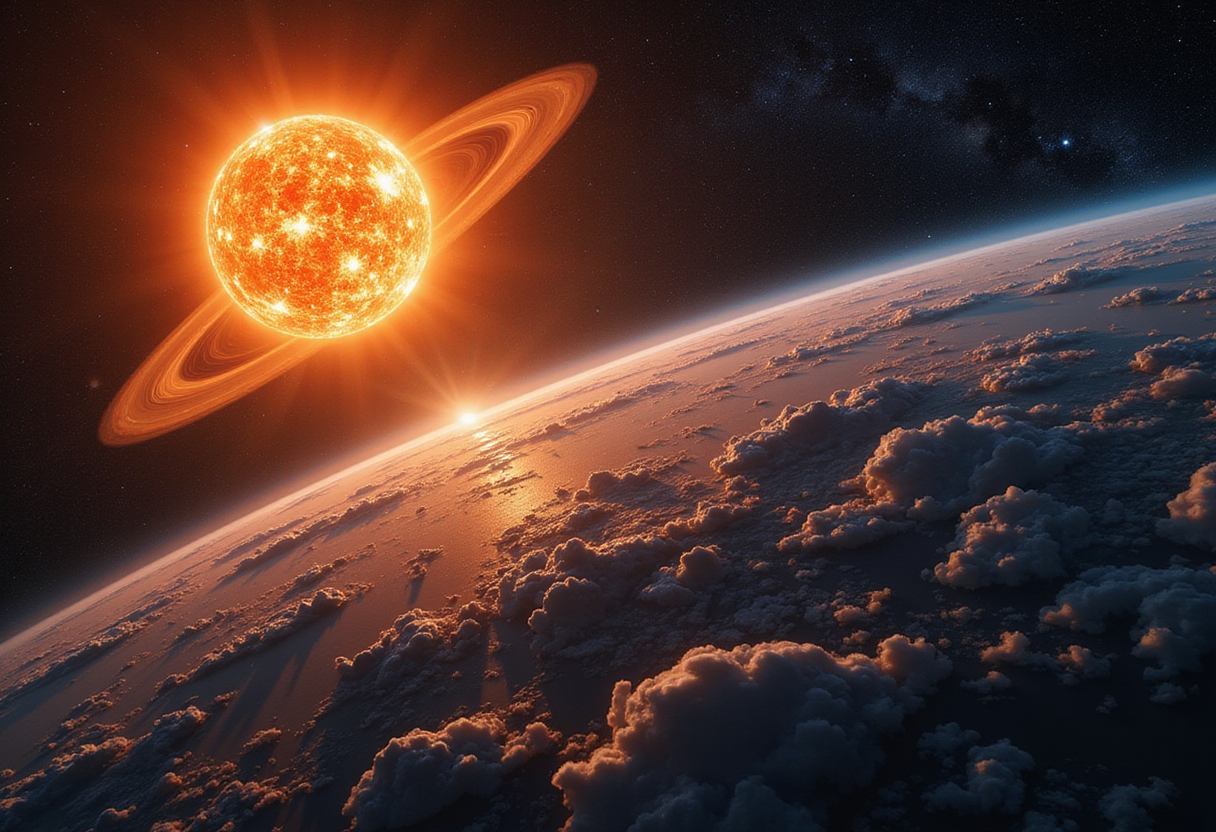
The European Space Agency's Solar Orbiter has, for the first time, traced an S-shaped magnetic kink in the solar wind—called a switchback—to a specific region on the Sun's surface, identifying the mechanism behind its formation.
The discovery appears in Nature Astronomy. It draws on data gathered in 2022, when the spacecraft flew through a switchback while sitting roughly halfway between Earth and the Sun.
What is a switchback?
A switchback is a sudden fold in the Sun's magnetic field, carried outward by the solar wind—a continuous stream of charged particles, or plasma, flowing into space. These kinks appear as sharp bends in otherwise orderly field lines, giving the magnetic structure an S-shape.
Scientists have spotted switchbacks near the Sun for years but have struggled to explain how they form. ESA reported in 2022 that Solar Orbiter had detected one and confirmed the S-shape that earlier models predicted.
How did the team identify the source?
The researchers analyzed plasma sampled by Solar Orbiter's Solar Wind Analyser (SWA) instrument. Within the switchback, they detected a distinctive mixture of charged oxygen and carbon ions—particles that could only have formed inside hot, closed magnetic loops anchored at the Sun's surface.
"Solar Orbiter flew through a very large switchback," says lead author Jesse Coburn of CNRS/LPP in France. "Because of this, we were able to sample rarely observed particles there—their fingerprints reveal that this structure formed through a process known as 'interchange reconnection.'"
To match those fingerprints to a location on the Sun, the team built a new model combining SWA measurements with images from NASA's Solar Dynamics Observatory. The model pinpointed the region on the solar disk where the plasma originated.
Which formation theory do the findings support?
Two main theories compete to explain switchbacks. The first involves interchange reconnection, in which magnetic field lines of opposite polarity meet, snap, and reconnect—releasing trapped plasma into space. The second invokes waves and turbulence generated near the Sun.
The new data point to interchange reconnection as the switchback's birth mechanism. Yet the team also found signs of waves and turbulence—though only after the structure had already left the Sun.
"Once the switchback has left the Sun, waves and turbulence take over and govern how it moves," says co-author Stephanie Yardley of Northumbria University in the UK. "Our finding reconciles the two theories, showing that they simply operate at different stages in a switchback's lifetime."
Why does this matter for space weather?
The solar wind and its embedded magnetic field drive space weather, including solar storms that can disrupt satellites, radio communications, and power grids on Earth. Tracing switchbacks to their solar origins helps researchers understand how the star heats its atmosphere and accelerates plasma outward.
Beyond switchbacks, the study shows that the Sun imprints chemical signatures onto escaping particles. That imprint offers a way to reconstruct the history of solar plasma from samples measured far away.
Daniel Müller, ESA's project scientist for Solar Orbiter, called the result a vivid demonstration of the mission's reach. He added that better understanding of solar wind dynamics has direct implications for protecting satellites and technology from extreme space weather.
Limitations and next steps
The authors caution that the conclusion rests on a single switchback event. More observations, paired with measurements from NASA's Parker Solar Probe, will test whether interchange reconnection drives all switchbacks—or only a subset. Initial findings remain preliminary until additional cases confirm them.
Publication details
The study, "On the Coronal Origin of Magnetic Switchbacks in the Solar Wind," appears in Nature Astronomy in 2026. Its DOI is 10.1038/s41550-026-02928-0.
via Phys.org Space & Astronomy (Source)
More from James Calloway
Show full bio
Staff writer covering marketplaces and e-commerce at SciBeat.
205 articles
Nearby plates
- Balloon Observatory Reveals Hidden Magnetic Threads on the Sun
- Hubble Spots a Sudden 10-Sided Wave at Saturn's South Pole
- Smile Mission Delivers First Ultraviolet Footage of Earth's Full Aurora Ring
- 97-Million-Year-Old Magnetic Fossils May Be Oldest Animal 'GPS'
- Webb Telescope Spots Mars-Sized Worlds Smashing Together