Plate Nº 35 · recorded November 17, 2026
Space & AstronomyReported finding
Hubble Finds a Ten-Sided Wave Swirling Near Saturn's South Pole
Hubble images from 2025 reveal a ten-sided wave near Saturn's south pole, drifting east at 2.5 m/s within winds of 420 km/h, echoing the north's famous hexagon.
By Elena Vasquez3 min read615 words
In brief
- Hubble spotted a ten-sided wave between 58 and 63 degrees south latitude on Saturn, reported in Science Advances.
- The wave drifts east at about 2.5 m/s inside a jet blowing at 116 m/s, roughly 420 km/h.
- Observations span 2023–2025, with the pattern clearest in 2025; amateurs contributed images in 2024.
- Saturn's northern hexagon has persisted over 40 years; Cassini saw only short-lived southern shapes in 2004.
- Hubble's Outer Planet Atmospheres Legacy program has tracked Saturn since 2018.
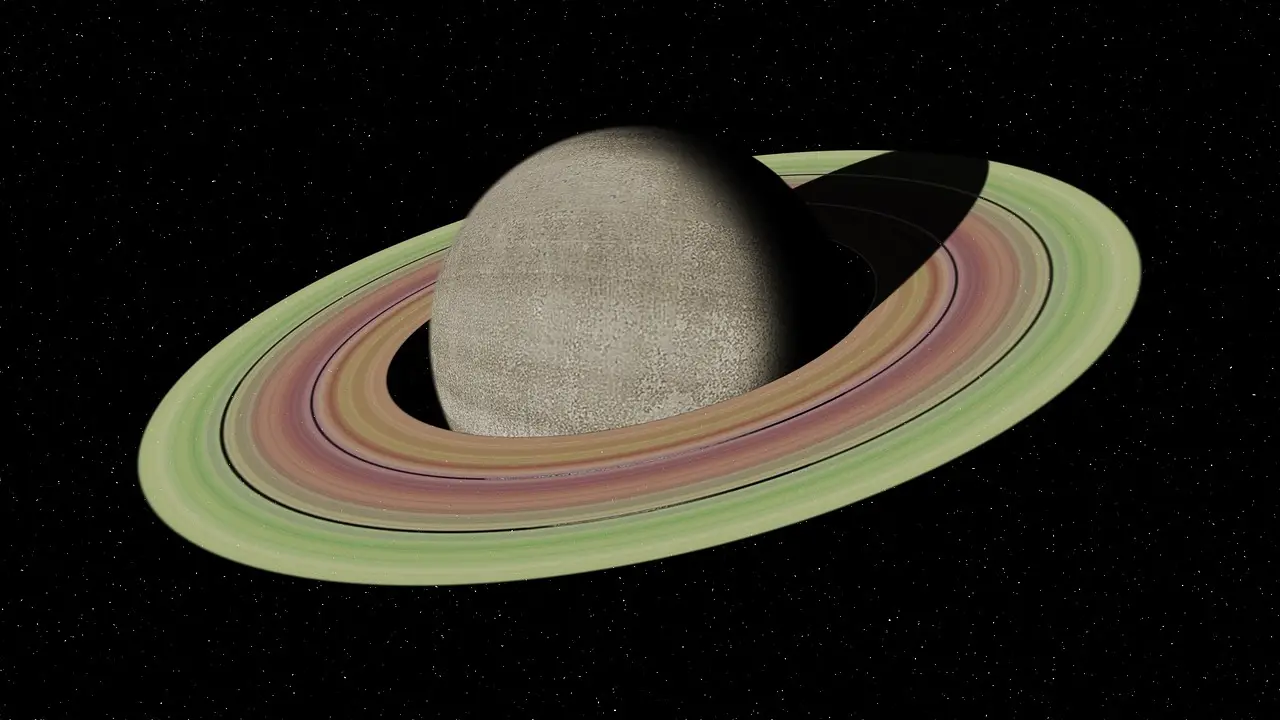
NASA's Hubble Space Telescope has revealed a giant ten-sided wave in Saturn's atmosphere near the south pole — the first long-lasting southern pattern of its kind ever recorded. Researchers published the observations in Science Advances, drawing on images taken from 2023 through 2025.
The find matters because Saturn's north pole has carried its famous six-sided pattern, the hexagon, for more than four decades. Now, for the first time, scientists can compare how two different shapes form on the same planet, in two different jet streams.
What exactly did Hubble see?
The new pattern is traced by clouds riding a fast-moving belt of wind. It sits between roughly 58 and 63 degrees south latitude — a wide band of atmosphere, far from the pole itself.
The numbers tell the story of how it behaves:
- The wave creeps east at about 2.5 meters per second.
- The winds in the jet stream itself blow at roughly 116 meters per second — around 420 kilometers per hour.
- That means the clouds race around the planet while the bends in their path drift along almost 50 times slower.
Think of a river. Water rushes past, but a ripple pattern in the current can hold its shape and stay in view for a long time. Saturn's wave works the same way: the clouds move fast, the ten-sided pattern they trace moves slowly.
How was it found?
Researchers examined Hubble observations spanning 2023 to 2025. The earliest images held only faint hints of the shape. Amateur astronomers chipped in with their own images during 2024. The breakthrough came with Hubble's 2025 observations, when the pattern became much clearer.
The team used images taken through different filters. That technique lets scientists see how the pattern looks at different heights in the atmosphere, because clouds and haze can make the same patch of Saturn appear quite different depending on the wavelength.
Is this really new?
Yes. NASA's Cassini spacecraft spotted short-lived shapes in Saturn's southern jet back in 2004, but nothing as durable as what Hubble has now picked up. The northern hexagon, by contrast, has been observed continuously for over 40 years.
The data come from Hubble's Outer Planet Atmospheres Legacy program, a long-running monitoring effort that has tracked Saturn since 2018. A slow-moving wave like this one is hard to recognize in a single snapshot. A series of pictures over years is what makes the detection solid.
What caused the wave?
Nobody knows yet, but the researchers have a leading suspect: a dark storm near 55 degrees south. That storm rotates against the direction of the surrounding flow and may have disturbed the jet enough to set the wave in motion.
The caveat is real, though. The team also considers whether the fast wind alone can produce this kind of wave without any outside trigger. Both explanations are still on the table.
Why the wait for answers?
Blame Saturn's calendar. The planet takes about 29 Earth years to orbit the Sun, so its seasons — and the lighting on each pole — change extremely slowly. As the south pole becomes easier to see in coming years, scientists will watch whether the wave keeps its shape or fades.
Repeated Hubble images should answer three questions: how the bends shift over time, whether the dark storm stays nearby, and whether the ten sides persist. If they do, comparing the southern wave with the northern hexagon could finally explain why the two jets carve out different shapes.
For now, the takeaway is simple: Saturn has two polygonal patterns, not one, and the second one may help crack the mystery of the first.
via knowridge.com (Source)
More from Elena Vasquez
Show full bio
Correspondent covering money, funding and market shifts around general science news at SciBeat.
503 articles