Plate Nº 38 · recorded October 30, 2026
Space & AstronomyReported finding
Hubble and Webb Examine the Cat’s Head Nebula in Carina
Hubble and Webb images of the Cat’s Head Nebula, 7,500 light-years away, expose dust, embedded stars and the ultraviolet radiation eroding a small pillar in Carina.
By Priya Raman4 min read789 words
In brief
- The Cat’s Head Nebula lies approximately 7,500 light-years from Earth within the Carina Nebula.
- Hubble’s filters capture light emitted by oxygen, hydrogen and sulfur.
- ESA provided 50% of Webb’s mid-infrared MIRI instrument.
- ESA provided Webb’s launch service using the Ariane 5 launch vehicle.
By Priya Raman
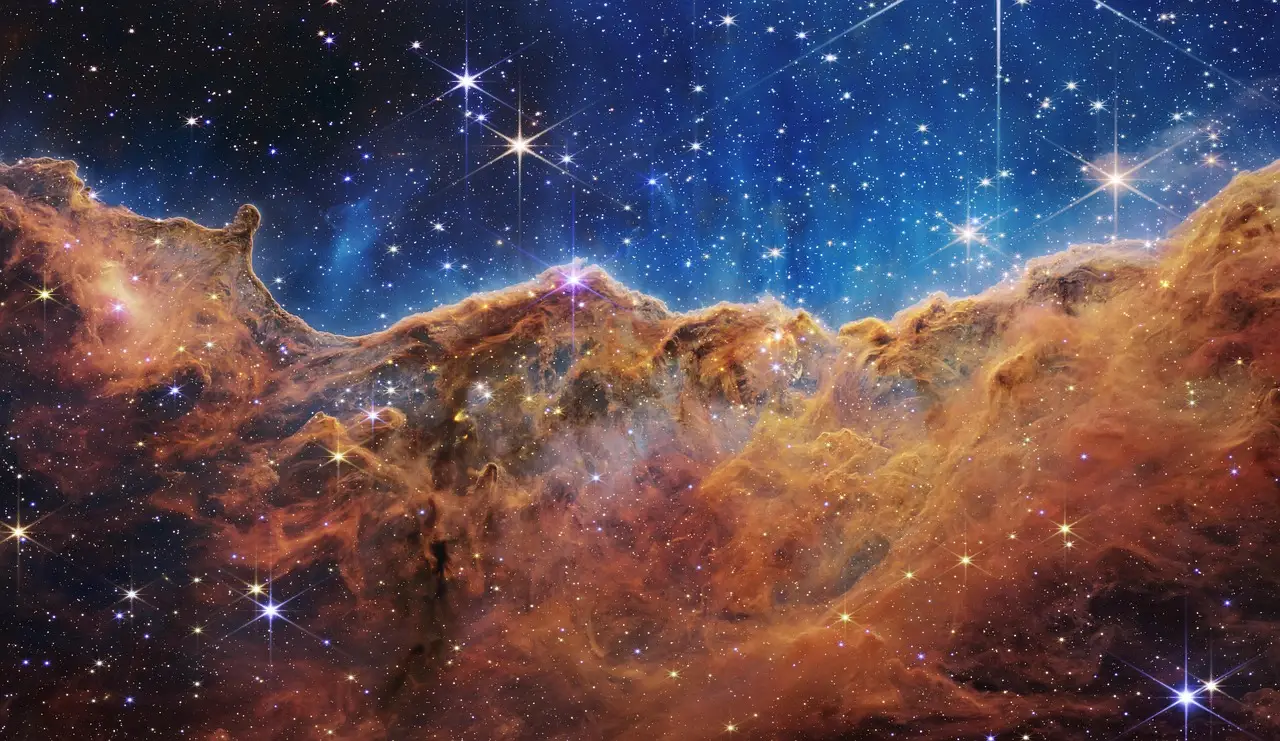
Approximately 7,500 light-years from Earth, the Cat’s Head Nebula has been observed in visible and infrared light by the NASA/ESA Hubble and NASA/ESA/CSA James Webb space telescopes.
The target is a small selected patch of gas and dust inside the Carina Nebula, a diffuse star-forming region. Astronomers have nicknamed the patch the Cat’s Head because it resembles a cat sitting with its back toward the viewer. Its head turns to the right, and a glowing feature marks the eye.
Astronomers think the outline has probably been sculpted over time by intense ultraviolet radiation and stellar winds from massive stars. Ultraviolet light lies beyond the visible spectrum, while stellar winds consist of material streaming outward from stars.
Both processes erode surrounding gas and dust, while denser material within the pillar resists, at least for now.
What does Hubble show in visible light?
- Hubble’s visible-light image presents the nebula as an opaque, dark brown pillar of dust. The cat’s glowing red eye may mark a young star still partly embedded in the dust.
- A hazy yellow ridge follows the filament’s right side. Its brightness is consistent with gas illuminated and ionized by ultraviolet radiation from nearby massive stars.
- The surrounding diffuse material glows blue and cyan above, then shifts through yellow and orange to red toward the bottom. Hubble’s filters capture light emitted by oxygen, hydrogen and sulfur, as well as starlight scattered by dust. These colors reveal a mixture of energized gas, dust and illumination from stars.
The wispy rim may mark photoevaporation, a process in which energetic ultraviolet light heats gas and drives it away.
What does Webb reveal in infrared?
Near-infrared light lies just beyond the visible spectrum. It makes the filament more transparent while leaving its overall shape recognizable. Webb’s image also resolves its complex surface and ghostly wisps of dust and gas on the cat’s left, structures exposed to radiation from nearby massive stars.
Webb’s mid-infrared image records longer wavelengths that trace warm dust and carbon-based molecules, outlining intricate structures within the nebula.
Optical nebulosity prominent in Hubble’s view becomes less prominent in Webb’s near-infrared image. A dense scattering of blue and yellow stars appears instead in the color composite, although some remain veiled by dust to varying degrees.
Bluish and greenish areas in the mid-infrared view include emission from polycyclic aromatic hydrocarbons (large carbon-based molecules), or PAHs. The colors and brightness may reflect changes in PAH emission, dust continuum (smooth light from dust) and local irradiation (radiation reaching a particular area), rather than temperature alone.
In that mid-infrared view, delicate globules (small, compact knots) and strands stand out on the pillar’s left.
What do the eye and jet-like feature show?
The cat’s eye remains conspicuous and provides a clearer example of an embedded star. Near the cat’s belly, a faint jet-like feature could indicate an outflow associated with a young star, meaning gas ejected by that star.
The feature suggests a young star may lie nearby, either within the cat’s outline or just outside its right edge.
What remains uncertain?
Webb’s mid-infrared image also shows a bright source to the right of the pillar, appearing yellow against reddish emission from surrounding material. A narrow filament appears to cross it, but the image alone cannot establish whether the source and filament are physically related.
The Cat’s Head is a temporary scene that will eventually disperse. Even so, the region offers abundant information for studying star formation, the complex process by which new stars emerge within clouds of gas and dust. Neither instrument supplies the entire picture, because each wavelength emphasizes different matter and physical conditions.
How do the telescopes fit together?
Hubble is a project of international cooperation between the European Space Agency (ESA) and NASA. Webb is an international partnership among NASA, ESA and the Canadian Space Agency (CSA).
ESA describes Webb as "the largest, most powerful telescope ever launched into space." The agency provided Webb’s launch service using the Ariane 5 launch vehicle, while Arianespace procured that service. ESA and its partners developed and qualified the Ariane 5 adaptations required for the Webb mission.
ESA also provided the workhorse NIRSpec spectrograph (an instrument that separates light into wavelengths) and 50% of the mid-infrared MIRI instrument. The MIRI European Consortium, a group of nationally funded European institutes, designed and built MIRI in partnership with JPL and the University of Arizona.
Placed side by side, the two sets of images show how radiation, dust and embedded stars interact within one small part of the larger Carina Nebula.
via ESA Space Science News (Source)
More from Priya Raman
Show full bio
Senior reporter covering people, launches and day-to-day practice in general science news at SciBeat.
280 articles