Plate Nº 23 · recorded October 30, 2026
Space & AstronomyReported finding
Webb Reveals the Cat’s Head Nebula in Mid-Infrared Light
NASA’s Oct. 29, 2026 Webb image shows the Cat’s Head Nebula’s cat-shaped dust pillar, likely sculpted over time by ultraviolet radiation and winds from massive stars in the Carina Nebula.
By Priya Raman3 min read680 words
In brief
- NASA released the mid-infrared image on Oct. 29, 2026.
- The central bluish-gray filament stretches from the bottom to almost the top of the frame.
- The filament’s tail ends in the lower third at a triangular peak of dust.
- Some stars in the view display eight-point diffraction spikes.
- Massive stars in the Carina Nebula likely sculpted the pillar through ultraviolet radiation and stellar winds.
By Priya Raman
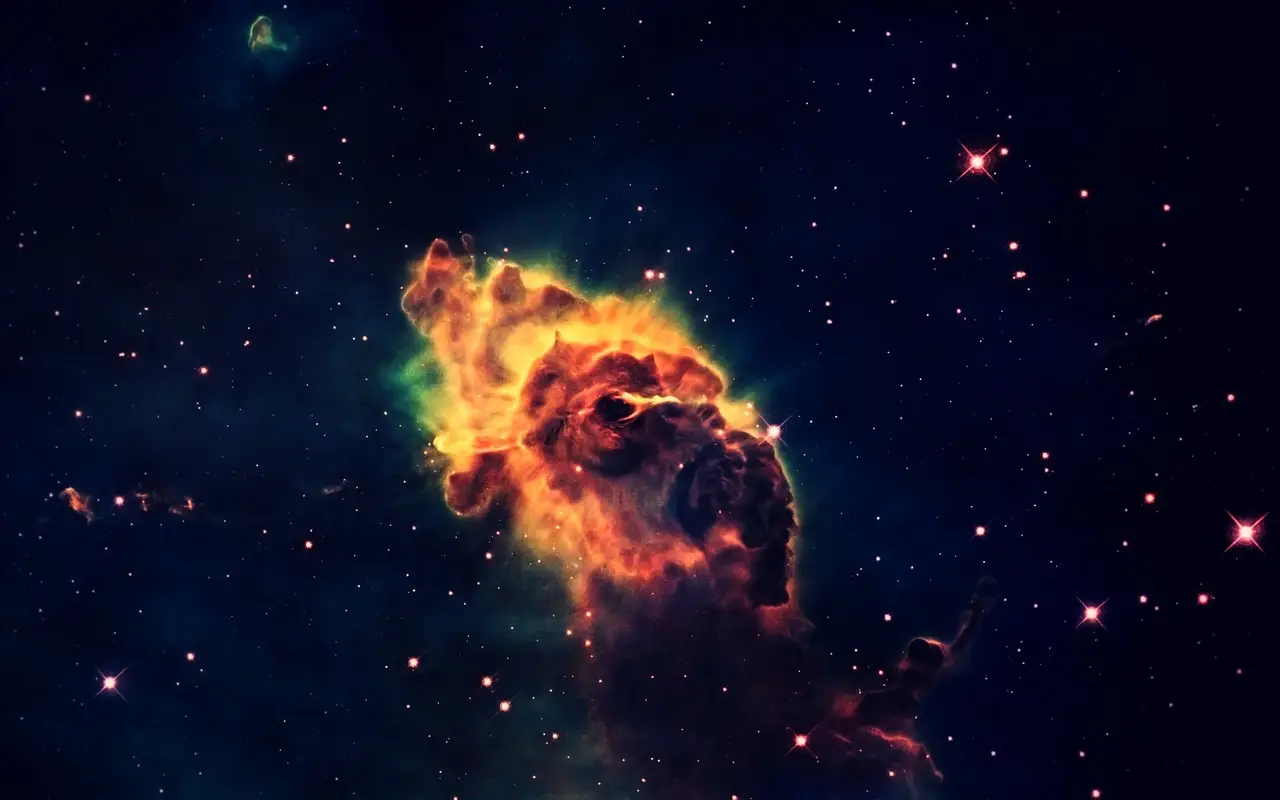
NASA’s James Webb Space Telescope released a mid-infrared view of the Cat’s Head Nebula on Oct. 29, 2026, revealing a narrow dust pillar whose outline resembles a seated cat with a bright white eye.
The image centers on a bluish-gray filament that stretches from the bottom to almost the very top of the frame. Its shape is narrow and irregular. The cat-like form sits with its back toward the viewer and its tail extending downward.
At the lower third of the filament, the tail ends in a widened triangular peak of dust. The cat’s head turns to the right, revealing a white glowing eye in profile. Together, those features create the recognizable silhouette that gives the Cat’s Head Nebula its name.
A mostly red field surrounds the central filament. Black space appears in the upper-left and upper-right corners. On the cat’s left, a dome-shaped grouping of faint dust filaments forms a secondary structure, less distinct than the central pillar.
Yellow and blue stars are scattered across the view. Some carry the telescope’s signature eight-point diffraction spikes, the patterns that appear around bright stellar images. The blue-gray pillar and bright points of starlight stand against the red background.
What does the mid-infrared image show?
Webb’s mid-infrared image—a view made in a band of infrared light beyond visible red—illuminates intricate structures within the Cat’s Head Nebula. The central subject is not a solid animal-like object but a concentration of dust shaped by its environment. That distinction separates the visible evidence from NASA’s interpretation of how the form arose.
NASA’s caption describes the distinctive shape as “likely sculpted over time” by intense ultraviolet radiation and winds from massive stars in the Carina Nebula. The wording identifies a plausible physical history without presenting the erosion process as a certainty.
A nebula is a cloud of gas and dust, and this one contains a pillar dense enough to resist the erosion described in the release. Finer filaments remain visible around the main shape, while the image’s color and tonal contrasts distinguish the pillar, neighboring material, stars and the red background.
How did the cat’s-head shape form?
NASA’s explanation centers on stellar feedback, the process by which energetic output from stars changes nearby gas and dust. Here, two forces do the work: intense ultraviolet radiation, meaning high-energy light, and stellar winds, streams of material moving outward from massive stars in the Carina Nebula.
Over time, NASA says, that interaction likely sculpted the distinctive cat’s-head form. As the radiation and winds erode surrounding gas and dust, the denser material inside the feline-shaped pillar resists the same erosion. The contrast leaves the denser outline visible while the less dense material around it recedes.
In this explanation, the dense material forms the surviving part of the structure, while erosion removes the less dense surroundings. The visible outline therefore results from uneven removal, with the pillar retaining its form longer than the material around it.
How certain is NASA’s explanation?
The account remains provisional in two specific ways. First, NASA uses “likely” rather than presenting the sculpting process as a certainty. Second, it qualifies the surviving pillar with “at least for now,” leaving open the possibility that continued erosion will change the shape.
A single infrared frame can show the structure’s present appearance but cannot by itself reconstruct a continuous history of erosion. The release provides no numerical timeline and no measurement of how quickly radiation and winds remove the surrounding gas and dust. The cautious interpretation therefore rests on the visible contrast between the dense pillar and its eroding surroundings.
Who prepared the published frame?
NASA, the European Space Agency, the Canadian Space Agency and the Space Telescope Science Institute contributed to the published frame. Joseph DePasquale of the institute processed the image.
At least for now, the denser dust keeps its cat-shaped outline as radiation and winds erode the surrounding material.
via science.nasa.gov (Original)
More from Priya Raman
Show full bio
Senior reporter covering people, launches and day-to-day practice in general science news at SciBeat.
280 articles
Nearby plates
- Hubble and Webb Examine the Cat’s Head Nebula in Carina
- Webb Captures a Turbulent Star Nursery 161,000 Light-Years Away
- Webb Telescope Reveals Hidden Stars in NGC 7129
- Webb Telescope Reveals Hidden Stars in NGC 7129, 3,300 Light-Years Away
- NASA’s 16-image gallery maps black holes, star births and collisions