Plate Nº 84 · recorded November 17, 2026
Space & AstronomyReported finding
DESI Weighs the Milky Way: 1.19 Trillion Suns, Give or Take 11%
The DESI Collaboration puts the Milky Way at 1.19 trillion solar masses with about 11% uncertainty — the most precise figure yet, though still a preprint with caveats.
By James Calloway4 min read723 words
In brief
- DESI measured the Milky Way's mass at 1.19 trillion solar masses with about 11% uncertainty, posted to arXiv on November 17, 2026.
- The analysis used more than 10,000 stars lying between roughly 30,000 and 310,000 light-years from the galactic center.
- The team validated four modeling approaches on mock surveys of six simulated galaxies viewed from four vantage points each.
- Uncertainty drops to about 8% for material within 260,000 light-years of the galactic center.
- Results are preprints (DOI: 10.48550/arxiv.2611.05518) and don't settle the debate over an extended dark matter halo.
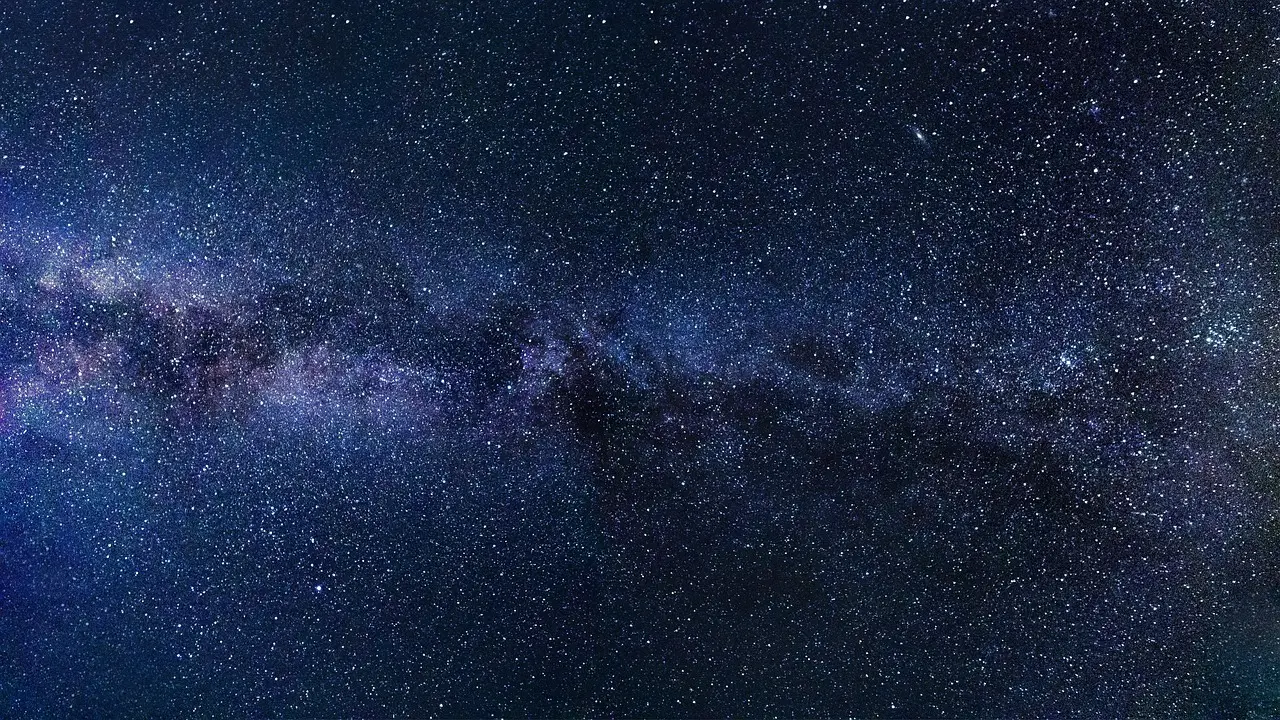
The Milky Way weighs 1.19 trillion times as much as the sun, according to the most precise measurement ever made of our galaxy's mass. The DESI Collaboration, which runs the Dark Energy Spectroscopic Instrument, reports an uncertainty of just about 11% — a figure that sounds loose until you compare it with previous estimates, which have disagreed wildly for years.
The results appear in a paper posted November 17, 2026, on the arXiv preprint server (DESI DR2 Results III: The Mass of the Milky Way). Note the venue. This is a preprint, not yet peer-reviewed, so treat every number as provisional until journals get their hands on it.
How do you weigh a galaxy you're sitting inside?
You can't put it on a scale. Astronomers instead track how fast stars and small satellite galaxies move at various distances from the galactic center. The faster something orbits at a given distance, the more mass must be pulling on it. Simple physics, messy practice.
For years, this method has shown something strange: most of the Milky Way's mass can't be accounted for by the stars and gas we can actually see. The rest is dark matter — invisible stuff that only reveals itself through gravity, filling a vast, sparse outer region called the halo.
Why did earlier estimates disagree so much?
That's the practical question, and the DESI team has a blunt answer. Earlier studies rarely tested several methods against each other at once, and they rarely accounted for the realistic ways gravity disturbs a galaxy's shape. They also tended to ignore the limitations of the surveys themselves — the gaps in sky coverage and the measurement errors that bias any large dataset.
The result was a mess. Studies of stars in the outer halo, of long streams of stars torn from smaller galaxies, and of tightly packed star clusters and satellite galaxies all gave answers that drifted apart. Worse, recent models of how the galaxy's disk rotates pointed to far lower masses than studies of more distant objects. Something wasn't adding up.
What did DESI actually do?
The team analyzed more than 10,000 distant stars recorded during DESI's first three years of observations, all lying between roughly 30,000 and 310,000 light-years from the galactic center. They combined that data with measurements of the stars' motions across the sky from the Gaia space telescope. The stars belong to two distinct types of aging stars whose predictable brightness makes them reliable distance markers.
Then came the stress test — the part earlier studies skipped. The researchers applied four different modeling approaches to both stellar populations. Before trusting any of them, they tested each approach on mock surveys of six simulated galaxies, each viewed from four different vantage points. Those mock surveys included realistic measurement errors and gaps in sky coverage, which let the team correct for biases in each method — including biases the methods share.
What does the new number change?
For total mass, dark and ordinary matter combined: 1.19 trillion solar masses, plus or minus about 11%. For material within 260,000 light-years of the galactic center, the uncertainty shrinks to roughly 8%.
That's the precision record. But here's what it doesn't do. The relatively high result could hint at a massive, extended dark matter halo, yet it doesn't fully resolve the debate with theories that argue against one. All four methods also assumed a perfectly round galaxy in a steady state — and the mock tests themselves suggest that assumption is wrong. Future models, the team concludes, should allow for a less spherical, more gravitationally disturbed Milky Way.
So even the best measurement to date comes with a built-in asterisk. The galaxy's shape may be skewing the number.
What comes next?
Two things. More distant stars and further Gaia measurements should firm up estimates of the outer halo's mass, the least certain part of the total. And DESI's observations will soon be made public, opening the door to independent analyses — which, given this field's history of dueling estimates, is exactly what the topic needs.
A number this precise invites trust. Don't give it all. The uncertainty is honest, the preprint status is real, and the galaxy, inconveniently, refuses to be spherical.
via phys.org/rss-feed/ (Source)
More from James Calloway
Show full bio
Staff writer covering regulation, policy and their impact on general science news at SciBeat.
474 articles
Nearby plates
- Three active black holes found in a galaxy 12.5 billion years away
- Newton's gravity law passes largest test yet, dark matter gains ground
- JWST Detects 104 Magnified Stars in Dragon Galaxy, More Than Doubling Record
- Milky Way's Central Black Hole May Feed Energy to Cosmic Rays
- Dark-Matter-Free Model Reproduces Rotation of All 175 SPARC Galaxies