Plate Nº 64 · recorded November 13, 2026
Space & AstronomyReported finding
Dark-Matter-Free Model Reproduces Rotation of All 175 SPARC Galaxies
A 26.7-billion-year-old universe with no dark matter fits all 175 SPARC galaxy rotation curves, early-galaxy sizes and Big Bang element abundances, Gupta and Samaras report.
By Marcus Bennett4 min read876 words
In brief
- CCC+TL reproduced rotation curves of all 175 galaxies in the SPARC database without dark matter.
- The model puts the universe's age at 26.7 billion years, versus roughly 13.8 billion under ΛCDM.
- At cosmic dawn, CCC+TL gives 4.6 billion years where the standard model gives about 300 million.
- Early galaxies come out about 12 times larger in size and mass than ΛCDM predicts (Galaxies 13, 115).
- Reference paper published 25 June 2026 in Universe, DOI 10.3390/universe12070193.
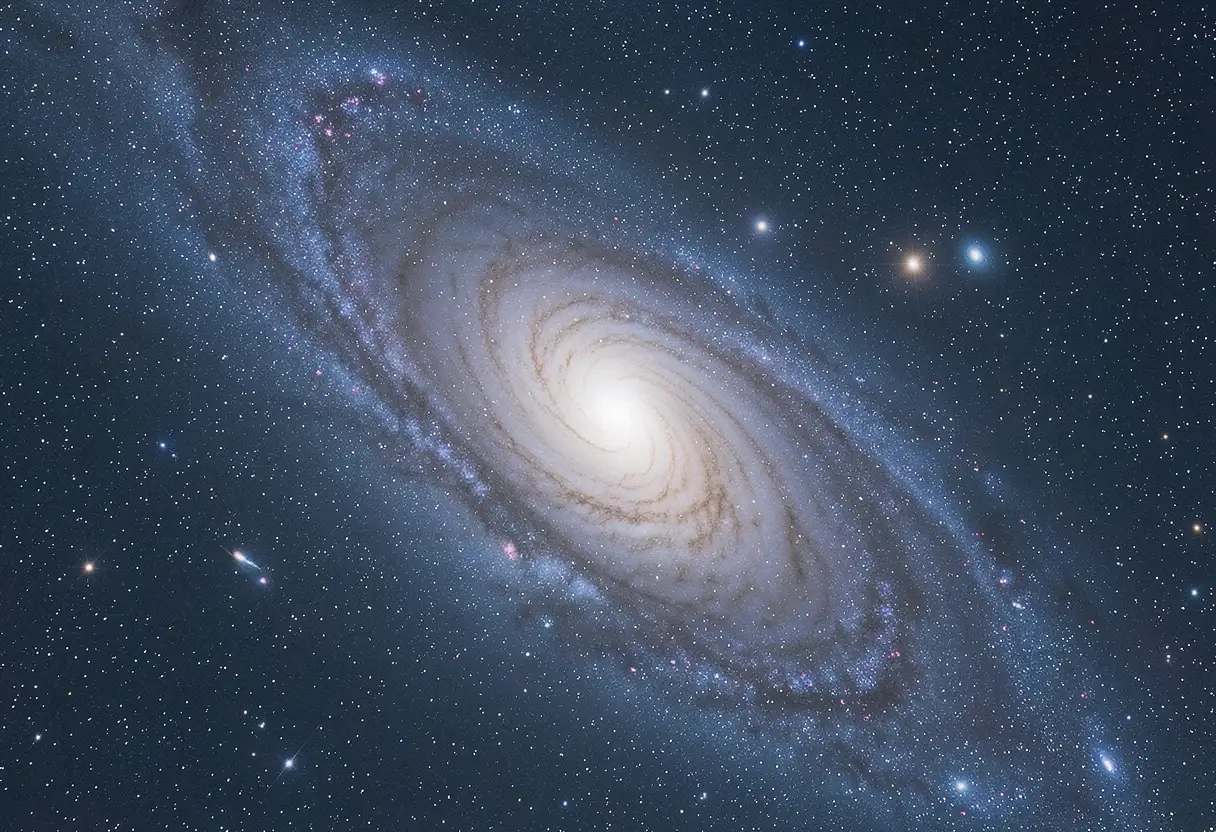
A cosmological model that requires no dark matter has reproduced the rotation curves of all 175 galaxies in the SPARC database, according to a new paper in Monthly Notices of the Royal Astronomical Society. Rotation curves — graphs showing how fast stars and gas orbit at each distance from a galaxy's center — are the primary evidence that convinced physicists galaxies contain invisible mass. Matching all 175 without it is the model's strongest result to date.
The work comes from Rajendra Gupta, an adjunct professor in the University of Ottawa's Department of Physics, and postdoctoral researcher Dr. Nikolaos Samaras. Through 2025 and 2026 they ran a series of tests comparing astronomical observations against CCC+TL, a framework that places the universe's age at 26.7 billion years — roughly twice the standard 13.8 billion — and discards both dark matter and dark energy.
What is CCC+TL, and what does it replace?
The name stands for "covarying coupling constants plus tired light." The first half says the fundamental quantities that govern forces and particle interactions evolve together over time. The second half says light loses energy as it travels across cosmic distances. Combined, changing constants could produce the gravitational and expansion effects usually credited to dark matter and dark energy.
Testing this required more than tweaking parameters in existing software. CCC+TL modifies the Einstein and Friedmann equations, the mathematical core describing gravity and the universe's expansion. For each test, Gupta and Samaras wrote their own equations and computer code consistent with the model.
The target they beat is ΛCDM — lambda cold dark matter, the standard cosmology. Λ (the Greek letter lambda) denotes the cosmological constant tied to dark energy, the assumed driver of accelerating expansion; "cold" means the dark matter moves slowly compared with light. Scientists have hunted for both components for decades and have directly detected neither.
Takeaway: the new model claims to explain galaxy rotation through evolving physical constants instead of invisible mass.
Does it survive the Bullet Cluster?
The Bullet Cluster, where two galaxy clusters collided, has long favored dark matter because the extra gravity tracks the galaxies rather than the hot, X-ray-emitting gas. Under CCC+TL, the team reports, the predicted gravitational effect also follows the galaxies. They describe the result as an early proof of concept that needs further study — an appropriately cautious label for one of cosmology's most scrutinized objects.
"Observations attributed to dark matter and dark energy likely originate from covarying coupling constants," says Gupta, whose companion paper on the origin of dark matter and dark energy develops the argument.
Takeaway: one historically hostile data point now fits the model, but the analysis remains preliminary.
Why an older universe solves the 'impossible galaxy' problem
Astronomers keep finding large, mature galaxies early in cosmic history, which strains ΛCDM because galaxies need time to grow. How much time depends on how a model interprets redshift — the shift of a galaxy's light toward longer, redder wavelengths.
The numbers diverge sharply. For observations from cosmic dawn that ΛCDM dates to a universe about 300 million years old, CCC+TL assigns an age of about 4.6 billion years at the same measured redshift. In calculations reported in Galaxies 13, 115, early galaxies come out roughly 12 times larger in size and mass than the standard model predicts.
"Impossible early galaxies become predictable galaxies," Gupta explains. "We predict that galaxies exist well beyond the distances the James Webb Space Telescope has reached."
The James Webb Space Telescope's GLIMPSE program plans to search for galaxies at redshifts above 50 — a regime where the standard model may allow too little time for massive galaxies to form, but CCC+TL imposes no such constraint. The observation could become a direct test of the prediction.
Takeaway: the model buys early galaxies billions of extra years, turning a ΛCDM embarrassment into a forecast.
How far do the checks extend?
- The framework's predictions for hydrogen, helium and other light elements formed shortly after the Big Bang match the standard model's.
- It agrees with cosmic-chronometer measurements, which use galaxy ages to estimate how fast the universe has expanded over time.
- A separate study of time dilation — the stretching of a supernova's observed timescale — also supports CCC+TL, though that paper remains under review.
- The team's analysis extends to the cosmic microwave background, the relic radiation from the early universe.
"Most emerging models explain only a limited set of observations," Gupta says. "A new model must not conflict with the pillars of cosmology and astrophysics, and our findings meet that challenge, including the yet-to-be-published Cosmic Microwave Background challenge."
The reference paper, "A Big Bang Nucleosynthesis Consistency Test of the CCC+TL Cosmology" by Rajendra P. Gupta and Nikolaos Samaras, appeared 25 June 2026 in Universe (DOI: 10.3390/universe12070193).
Peer scrutiny of an unconventional framework will be severe, and several results await publication or replication. Still, as Gupta puts it: "The success should encourage astronomers to take the new model seriously. It is challenging to understand and apply, but we believe it extends the physics of the Universe beyond ΛCDM limits."
For now, the burden of proof sits with the model — and the next Webb observations.
via google.com (Original)
More from Marcus Bennett
Show full bio
News editor covering regulation, policy and their impact on general science news at SciBeat.
404 articles
Nearby plates
- H.E.S.S. telescopes set strongest limits yet on Milky Way dark matter
- Newton's gravity law passes largest test yet, dark matter gains ground
- JWST Detects 104 Magnified Stars in Dragon Galaxy, More Than Doubling Record
- Smithsonian's Lumina Simulation Recreates the Universe's First 2 Billion Years
- New Method Tests Whether the Universe's Oldest Light Is Twisted