Plate Nº 63 · recorded November 13, 2026
Space & AstronomyReported finding
Euclid's First Data Release Images 900 Million Galaxies
Euclid's first release images 900 million galaxies across 2.5 trillion pixels, giving cosmologists the data to test dark matter, dark energy and gravity itself.
By Marcus Bennett3 min read602 words
In brief
- Euclid's first release contains images of roughly 900 million galaxies and 60 million candidate quasars.
- The data span about 2.5 trillion pixels over an area nearly 10,000 times the apparent size of the full moon.
- ESA launched Euclid in July 2023; its field of view covers over 100 times the sky of Hubble or Webb per image.
- Dark matter makes up about 27% of the universe and dark energy about 68%; ordinary matter only 5%.
- Further results are planned for 2027; the release is preliminary, not a verdict on the standard cosmological model.
By Marcus Bennett
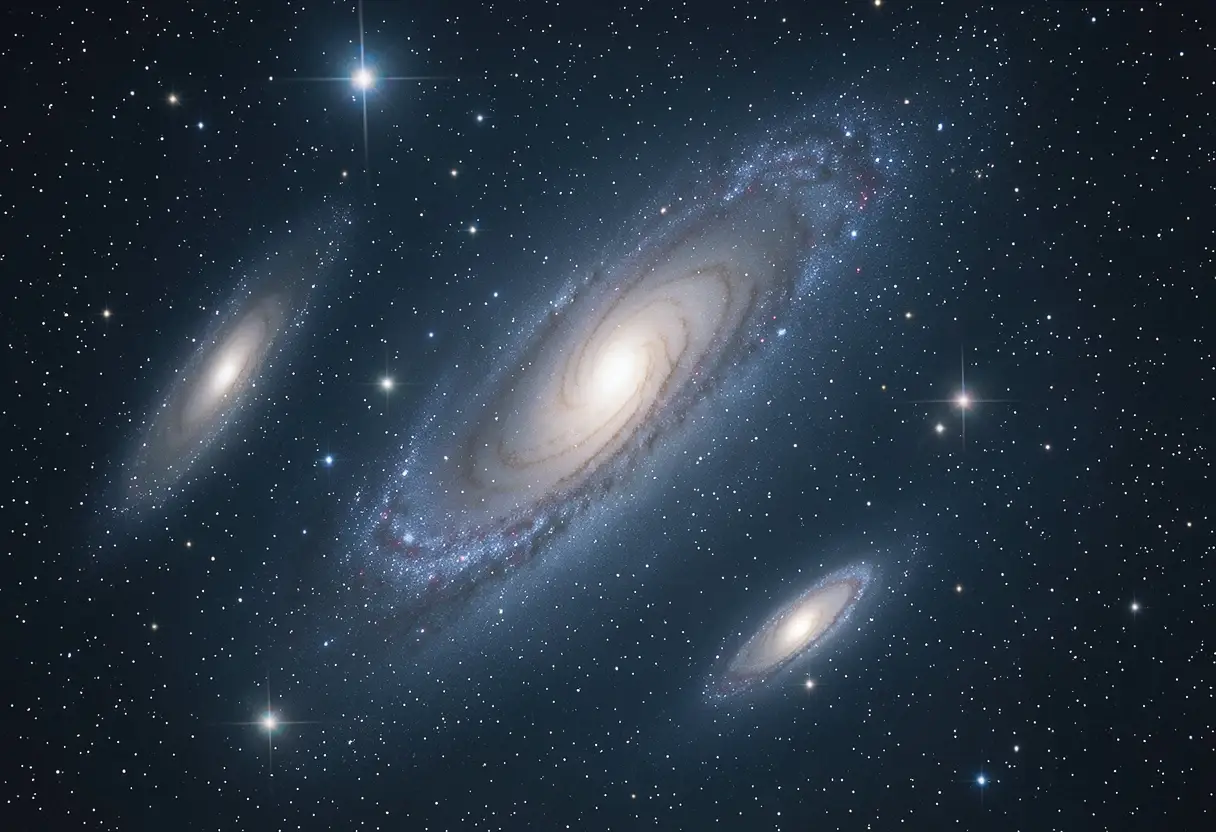
The European Space Agency's Euclid telescope has released its first major data set: images of roughly 900 million galaxies and 60 million candidate quasars — the brightest cores of distant galaxies — spanning about 2.5 trillion pixels of sky. For cosmologists, this is the largest consistent measurement of galaxy shapes ever assembled, and the raw material for testing what the universe is actually made of.
What did Euclid deliver?
ESA launched Euclid in July 2023 with a design brief that breaks from flagship-telescope habit: survey wide, not deep. A single Euclid image covers more than 100 times the patch of sky captured by Hubble or James Webb in one frame.
The first release covers an area almost 10,000 times the apparent size of the full moon. Some galaxies in the catalog existed when the universe was only about 700 million years old; their light has traveled billions of years to reach the detector, letting researchers read earlier chapters of cosmic history.
Takeaway: one instrument, one method, 900 million galaxies — a data set no single previous survey could match.
Why does this matter for dark matter and dark energy?
The mission targets the two biggest gaps in cosmology. Ordinary matter — stars, planets, people — accounts for only about 5% of the universe's contents. Dark matter, invisible stuff detected only through its gravity, makes up around 27%. Dark energy, the driver of the universe's accelerating expansion, accounts for roughly 68%. Nobody knows what either one is.
Scientists infer dark matter from its gravitational fingerprints: how galaxies move, and how light bends around massive objects — a distortion called gravitational lensing. Dark energy remains a label for the observed acceleration of space itself, with no established underlying nature.
Euclid will attack both problems the same way: map the distribution of galaxies across the sky and measure subtle distortions in their shapes. Those distortions, caused by matter bending light on its way to us, let researchers trace how matter has clustered over cosmic time and check whether existing theories of gravity hold on the universe's largest scales.
Takeaway: the same galaxy map tests both the invisible-matter budget and whether gravity behaves as Einstein's equations predict at cosmic scale.
What makes Euclid different from other surveys?
Consistency. Euclid observes many galaxies with the same instruments and the same measurement methods. That uniformity matters practically: when researchers compare galaxy shapes across the sky, they can trust that differences reflect genuine cosmic patterns rather than quirks of separate telescopes or mismatched survey pipelines.
The measurement itself remains hard. Distant galaxies appear faint and tiny; instruments blur their images, and neighboring objects can overlap on the detector. Scientists must model and remove these effects before interpreting minute shape distortions as evidence about invisible matter or the expansion of the universe. Get that calibration wrong, and the cosmology follows.
Takeaway: uniform data is Euclid's real edge — the hard part is cleaning it well enough to trust.
How firm are the conclusions?
Very preliminary. The current release is a starting point, not a final verdict on the standard model of cosmology — the framework that describes the universe's composition and evolution. The decisive tests will come as researchers process and compare the observations, with further results planned for 2027.
Even before those answers arrive, Euclid gives scientists a far broader view of the universe than any instrument before it. The data are on the table; the verdicts on dark matter and dark energy must wait for the analysis.
Takeaway: a survey of record size has opened, but the physics verdicts land in 2027.
via knowridge.com (Source)
More from Marcus Bennett
Show full bio
News editor covering regulation, policy and their impact on general science news at SciBeat.
404 articles
Nearby plates
- Euclid releases data on 900 million galaxies for a 3D cosmos map
- Euclid's First Data Haul: 900 Million Galaxies in 2.5 Trillion Pixels
- Euclid's first major data release captures over 1 billion cosmic objects
- Euclid's New 3D Map Covers Sky Equal to 9,500 Full Moons
- Euclid's New Data Release Maps a Billion Cosmic Objects in 3D