Plate Nº 97 · recorded November 13, 2026
Space & AstronomyReported finding
SpaceX aims for first-ever catch of Starship on flight 15
SpaceX's 15th Starship test on Friday targets a first in space history: catching the spacecraft in mechanical arms after 14 orbits and 22 hours, with FAA approval still pending.
By Marcus Bennett4 min read769 words
In brief
- Starship's 15th test flight is scheduled for 4:45 p.m. Friday (2245 GMT) from Starbase in southern Texas
- The 124-meter (407-foot) vehicle will deploy 26 Starlink satellites and circle Earth 14 times before returning about 22 hours after liftoff
- Super Heavy is planned to be caught by the chopstick arms six and a half minutes after liftoff, its fourth attempt after three previous catches
- As of late Thursday the FAA had not yet granted final approval for the test flight
- Starship's first orbital flight, in September, was cut short by an engine issue
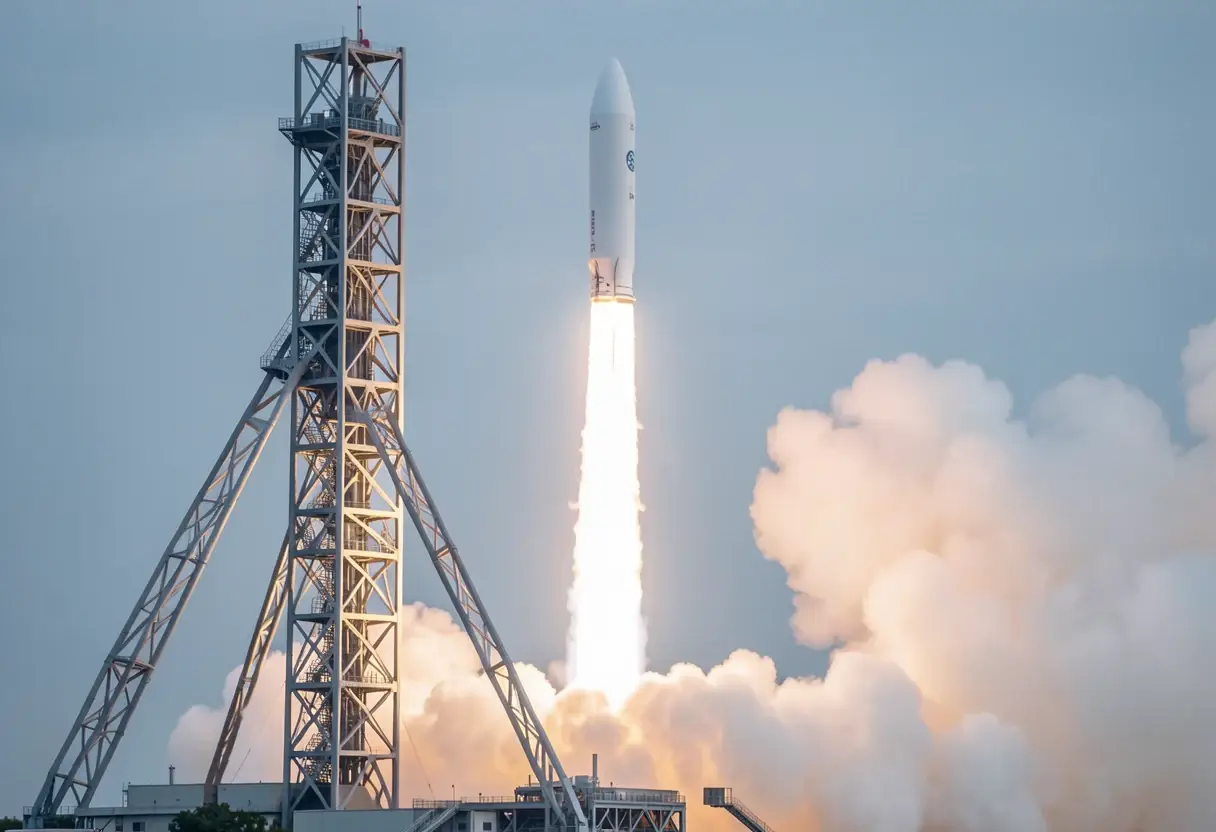
At 4:45 p.m. Friday (2245 GMT), SpaceX will launch the 15th test flight of its 124-meter (407-foot) Starship rocket from Starbase in southern Texas, and attempt something no operator has done before: catching the spaceship itself with mechanical arms after it has circled Earth 14 times.
That single maneuver is the point of the flight. Everything else — the booster landing, the Starlink payload — is preparation for it.
What does Friday's flight actually involve?
The schedule runs on two clocks. Six and a half minutes after liftoff, the first stage, Super Heavy, will descend vertically back to the launch site on the Gulf of Mexico coastline and nestle into a pair of mechanical "chopstick" arms. SpaceX has caught the booster that way three times already.
The upper stage keeps climbing. In orbit it will deploy 26 satellites into Musk's Starlink constellation, which has become a major revenue stream for the company. Then it circles the planet 14 times, and roughly 22 hours after liftoff it comes back down — this time aimed at the arms.
- 4:45 p.m. Friday (2245 GMT): liftoff from Starbase, southern Texas
- T+6.5 minutes: Super Heavy descends and settles into the chopstick arms — a fourth attempt, after three previous catches
- Orbit: 26 Starlink satellites deployed; 14 trips around Earth
- T+22 hours: Starship descends and, if conditions hold, is caught
The take-away: Friday tests two recoveries, and the harder one happens last.
Why is catching the ship harder than catching the booster?
Super Heavy falls a relatively short distance at a speed the arms were built for. The spaceship does not. It arrives from orbit, descending much faster and from a much greater altitude, with the heat of reentering Earth's atmosphere to survive. And a spacecraft only counts as reusable if it returns to service without extensive refurbishment.
The take-away: a catch becomes reuse only if the ship can fly again soon afterward, with little more than a refuel.
Why does the catch matter so much?
"If successful, this will mark the first full recovery of an orbital launch system and a breakthrough moment in making Starship a reliable, rapidly reusable rocket," SpaceX said.
Clayton Swope, an aerospace expert at the Center for Strategic and International Studies, called full reusability the "holy grail" of the space industry. "No one's really been able to do that so far," he said. "People have been trying to do that since the (NASA) space shuttle. But the space shuttle ended up being kind of a compromise because a lot of the vehicle wasn't reusable."
The take-away: reusability is the cost lever for spaceflight, and nobody has fully pulled it yet.
What could derail Friday?
Federal sign-off was not in hand. As of late Thursday, the U.S. Federal Aviation Administration had not yet given final approval for the test flight. SpaceX has said it would proceed with these maneuvers only if conditions are optimal, and the company has a record of last-minute changes to test flights under Musk's "fail fast" strategy of learning through crashes, explosions and other mishaps.
The previous attempt at orbit did not go to plan. Following SpaceX's high-profile stock market debut in June, the company carried out the first orbital flight of Starship in September, but the mission was cut short because of an engine issue.
The take-away: Friday's outcome could range from a clean double catch to a delayed scrub, and SpaceX has shown it accepts that spread.
What remains unsolved?
Orbital refueling. Moving fuel into Starship in orbit is a requirement for any journey to the moon or Mars, and it sits alongside the years-long delays that have dogged the project as SpaceX grapples with novel engineering challenges. NASA, meanwhile, is counting on the spaceship to serve as the lunar lander for its Artemis program. Some Starship versions are designed to launch internet satellites and data centers into orbit; others will ferry people to the moon and Mars.
The take-away: even a perfect catch on Friday leaves refueling and the Artemis schedule ahead.
Where does this fit?
Musk has already reshaped the launch market with the partially reusable Falcon rockets, which regularly carry satellites and astronauts to the International Space Station. Starship is the larger bet on the same logic, and SpaceX is investing heavily in additional launch sites in Louisiana and Florida to handle its megarocket.
The take-away: Friday is one milestone in a program whose promised payoff is routine, cheap, frequent launch rather than a one-off spectacle.
via phys.org/rss-feed/ (Source)
More from Marcus Bennett
Show full bio
News editor covering regulation, policy and their impact on general science news at SciBeat.
404 articles
Nearby plates
- Starship Flight 15 Launches Nov. 13 — Here's How to Spot It
- SpaceX Aims for First-Ever Double Starship Landing on Friday
- SpaceX Aims for First-Ever Double Catch of Starship's Two Stages
- SpaceX Readies Double Catch of Starship Booster and Ship on Flight 15
- Starship Reaches Orbit for the First Time and Deploys 26 Starlink Satellites